Table of Content
- How ROI on Custom Enterprise Software Is Actually Calculated
- Why the "Low-Cost Platform" Comparison Is Usually Misleading
- Cost Ranges That Actually Drive the ROI Denominator
- Payback Timelines by Value Driver
- What This Looks Like in Practice
- Building an ROI Model Before You Commit Budget
- FAQs
- How long does it take for custom enterprise software to pay for itself?
- Is custom software actually cheaper than SaaS in the long run?
- What's the biggest hidden cost that ruins ROI projections?
- Does AI-assisted development lower the cost enough to change the ROI math?
- How do you measure ROI on compliance or risk reduction?
- Should ROI calculations differ for a startup versus an established enterprise?
- How Digisoft Solution Helps in Custom Enterprise Software Development
Digital Transform with Us
Please feel free to share your thoughts and we can discuss it over a cup of coffee.
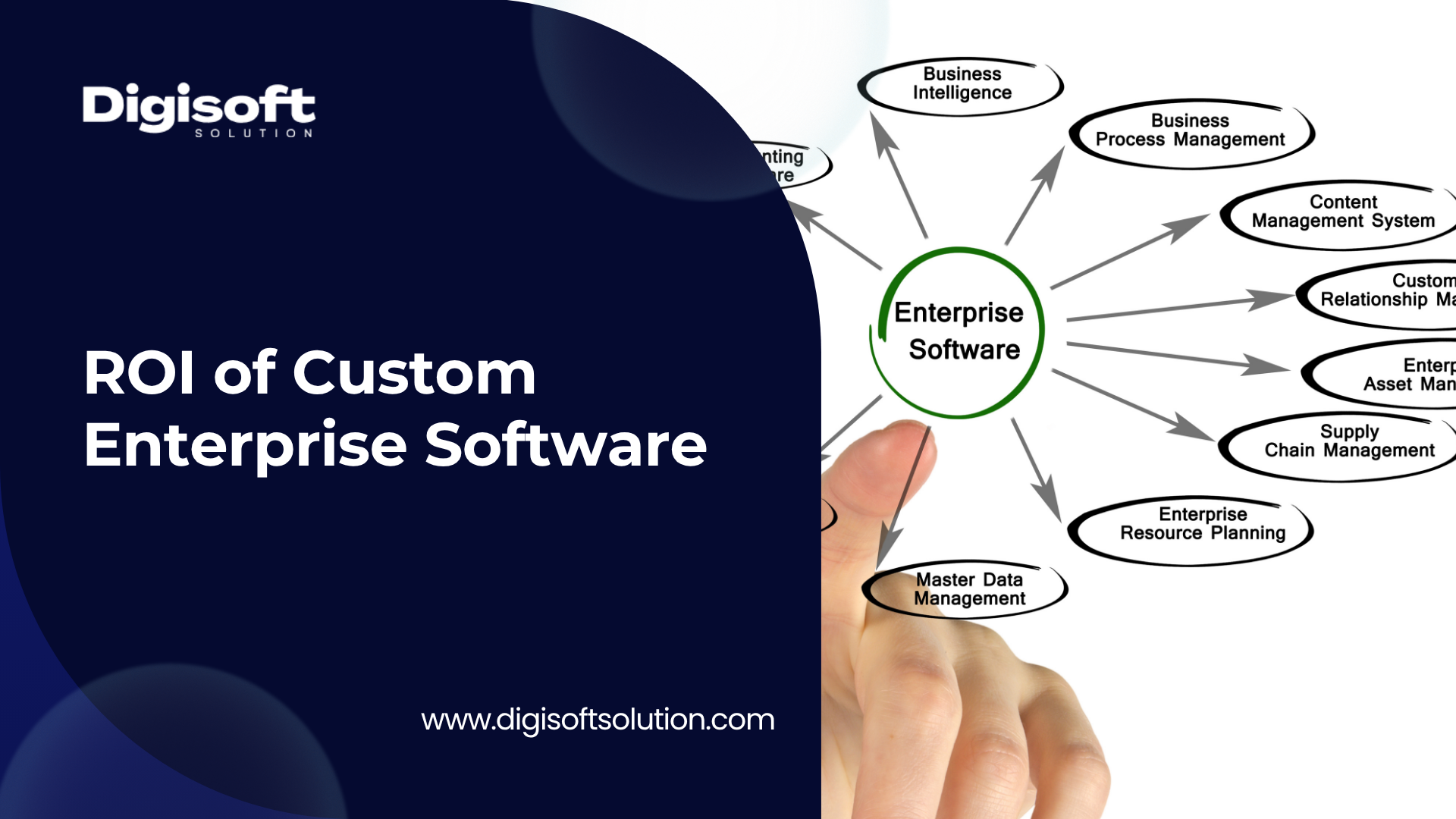
Custom enterprise software typically pays back its investment in 12 to 24 months when it replaces manual processes or per-seat licensing at scale, and delivers 3 to 5-year ROI of 150 to 400 percent when labor savings, error reduction, and eliminated subscription fees are factored in. The exact number depends on your current inefficiency cost, not the vendor's hourly rate.
That single sentence is also where most ROI conversations go wrong. Most calculators compare a development quote to a software subscription price, as if those were the only two numbers that matter. Real ROI depends on what a process costs you today, how much of that cost disappears after launch, and how honestly you account for the maintenance years that follow year one.
How ROI on Custom Enterprise Software Is Actually Calculated
The formula is simple on paper: ROI = (Value Generated − Total Cost of Ownership) / Total Cost of Ownership × 100. The part everyone gets wrong is what belongs on each side of it.
Value generated should include:
- Labor hours reclaimed from manual work, valued at fully loaded employee cost, not just salary
- Error and rework reduction (a compliance fine avoided, a chargeback eliminated, a duplicate payment stopped)
- Revenue effects, such as higher conversion or average order value from a smoother user workflow
- Licensing fees you stop paying once a custom system replaces a per-seat SaaS product
- Risk reduction that has a quantifiable cost if it materializes, like a HIPAA violation or a missed SLA penalty
Total cost of ownership should include:
- Discovery, design, development, and QA (the number in the vendor's proposal)
- Cloud hosting and infrastructure, typically $500 to $5,000+ per month depending on scale
- Annual maintenance and security patching, usually 15 to 25 percent of the original build cost per year
- Integration costs for every legacy system the new platform has to talk to
- Change management and staff training, which almost never appears in the initial estimate
Most in-house ROI models only capture the first bullet on each side. That's how a project that looks like it pays back in six months ends up taking eighteen once real maintenance costs show up.
Why the "Low-Cost Platform" Comparison Is Usually Misleading
A lot of the content ranking for this topic quotes a low monthly SaaS fee and calls it the cheaper option by default. That comparison is technically incomplete.
Per-seat and per-workflow SaaS pricing scales with your growth. A platform that costs $500 a month at 20 users can cost $4,000 to $8,000 a month at 200 users, before AI feature add-ons, which most vendors now price separately. Over a five-year horizon, that recurring cost frequently exceeds what a custom build would have cost outright, and you still don't own the system. If you outgrow the platform's data model, migrating off it typically runs 25 to 50 percent of a full custom build, on top of everything already paid in subscription fees.
Custom software flips that cost curve. The upfront number is higher, but there's no per-seat multiplier, no vendor-controlled price increase, and no forced migration when the platform's roadmap stops matching your business. The breakeven point against a growing SaaS bill is the real question, not the sticker price on either option. We've mapped this trade-off in more detail in our build versus buy decision framework.
Cost Ranges That Actually Drive the ROI Denominator
Here's a realistic breakdown of what custom enterprise software costs in 2026, based on current market benchmarks. These are development costs only; add 15 to 25 percent annually for maintenance once live.
|
Project Tier |
Typical Build Cost |
Timeline |
What Drives It Up |
|
Departmental tool (single workflow, one team) |
$80,000 – $200,000 |
3 – 6 months |
Compliance needs, legacy integration |
|
Multi-module enterprise platform |
$200,000 – $500,000 |
6 – 12 months |
Number of user roles, real-time sync requirements |
|
Full ERP-scale or multi-region system |
$500,000 – $1,500,000+ |
12 – 18+ months |
Multi-site deployment, complex data migration, regulatory scope |
Team location changes these numbers significantly. Senior engineering talent runs $120 to $250 per hour in North America versus $50 to $95 in Western/Central Europe and $20 to $60 in South Asia, but the cheapest hourly rate rarely produces the cheapest total project once coordination overhead and rework are priced in. A hybrid model, senior architecture and technical leadership paired with a distributed delivery team, is usually the more defensible ROI play, since it protects the parts of the build (architecture, security, integration logic) where mistakes are most expensive to unwind later. We go deeper on staffing structures in our guide to fully-managed enterprise engagement models.
Payback Timelines by Value Driver
Not every ROI driver pays back on the same schedule. This is where a lot of ROI projections quietly overstate speed.
|
Value Driver |
Typical Payback Window |
Why |
|
Labor time reclaimed (admin, manual data entry) |
6 – 14 months |
Savings start accruing the day the system goes live |
|
Eliminated per-seat SaaS fees |
12 – 30 months |
Depends on current headcount and subscription escalation |
|
Conversion or AOV lift (e-commerce, subscriptions) |
3 – 12 months |
Fast when tied directly to a live revenue channel |
|
Compliance risk reduction |
Hard to time, high magnitude |
Payback is a single avoided fine or audit failure, not a monthly accrual |
|
Legacy system replacement (technical debt) |
18 – 36 months |
Savings show up as reduced incident response and slower breakage, not a line item |
What This Looks Like in Practice
Numbers on a spreadsheet are one thing. Real delivery data is more convincing, so here's what we've measured across projects where operational efficiency was the primary ROI lever.
For S Cubed, an ABA therapy platform built to be HIPAA-compliant from the architecture stage, automating documentation and scheduling workflows cut administrative time by 60 percent, and the platform passed its first HIPAA audit with full compliance on the first review. That 60 percent is a direct labor-cost input into an ROI model, not an estimate: it's hours a clinical staff member no longer spends on paperwork, multiplied by their loaded cost, every week the system runs.
For RISE311, a Shopify subscription platform, the build shipped in 10 weeks and drove a 34 percent increase in average order value. A 10-week window on a revenue-generating channel means the payback clock starts running almost immediately after go-live.
For Vision Care Direct, a SaaS enrollment and billing platform, provider onboarding dropped from 3 days to 30 minutes and payment error rates fell to under 1 percent. Onboarding time and payment error rate are both direct cost centers before a rebuild, so both improvements translate cleanly into dollar savings.
Building an ROI Model Before You Commit Budget
A defensible ROI projection, one that survives a CFO's scrutiny, needs four inputs before a single line of code is written:
- Current-state cost baseline. Quantify what the manual process, legacy system, or SaaS subscription actually costs today, including labor time nobody's tracking.
- A realistic TCO, not just a build quote. Add hosting, maintenance, integration, and training to whatever number a vendor proposes.
- A conservative adoption curve. Value doesn't materialize on launch day. Staff need training and edge cases surface in the first 60 to 90 days.
- A multi-year horizon. Year one ROI is frequently flat once the full build cost is included. The real return shows up in years two through five, as savings compound against a cost base that no longer scales with headcount.
This is also where a paid discovery phase earns its cost. A 2 to 6-week discovery engagement, typically $10,000 to $30,000 for projects above $150,000, locks in the cost baseline and scope before budget is committed, the single biggest lever for protecting the ROI number you eventually report.
FAQs
How long does it take for custom enterprise software to pay for itself?
Most well-scoped projects break even in 12 to 24 months. Revenue-facing systems, like e-commerce or subscription platforms, can break even in under a year, while systems replacing manual labor take longer since savings accrue gradually as adoption stabilizes.
Is custom software actually cheaper than SaaS in the long run?
Not immediately. SaaS is almost always cheaper in year one. Custom software tends to win on a 3 to 5-year total cost of ownership basis once per-seat licensing, feature add-on fees, and vendor price escalation are factored in, especially past 100+ users.
What's the biggest hidden cost that ruins ROI projections?
Annual maintenance. A build quoted at $200,000 typically requires $30,000 to $50,000 a year in ongoing patching, hosting, and small feature work. Projections that only account for the initial build cost consistently overstate ROI.
Does AI-assisted development lower the cost enough to change the ROI math?
Partially. AI coding tools can cut development time by roughly 20 to 30 percent on repetitive coding and straightforward integrations, but complex business logic, security architecture, and enterprise integrations still need senior engineering judgment.
How do you measure ROI on compliance or risk reduction?
Price the cost of the event you're avoiding, a HIPAA violation, a failed audit, a breach notification requirement, and treat the software as insurance with an infrequent, high-magnitude payback rather than a monthly accrual.
Should ROI calculations differ for a startup versus an established enterprise?
Yes. A startup's case usually centers on revenue enablement, features that help you sell or close faster. An enterprise's case usually centers on cost displacement, replacing manual labor or legacy licensing with something that scales without adding headcount.
How Digisoft Solution Helps in Custom Enterprise Software Development
We don't build an ROI case around a generic industry average and hope it holds up. Before we scope a project, we help you build the current-state cost baseline, the actual labor hours, subscription fees, and error costs your organization is absorbing right now, so the projection is grounded in your numbers, not a benchmark from someone else's report.
From there, our enterprise software development services cover the full delivery lifecycle: architecture, secure cloud-native build, integration with your existing ERP or CRM stack, and a hypercare period after launch, specifically because that's when adoption, and the real ROI clock, actually starts. For organizations modeling total cost of ownership before committing budget, our enterprise software cost breakdown walks through the same cost drivers in more granular detail.
We've done this work in HIPAA-regulated environments where compliance risk is part of the ROI equation, in our healthcare software development practice, and in revenue-facing platforms where payback is measured in weeks. If you want a second opinion on a vendor's ROI projection, or want to build your own case first, our team will walk through the numbers with you, no generic sales deck, just the math applied to your business. You can review more delivery outcomes in our case studies.
Digital Transform with Us
Please feel free to share your thoughts and we can discuss it over a cup of coffee.