Table of Content
- What Are Search Engines and How Do They Actually Work?
- The Three Core Pillars: Crawling, Indexing, and Ranking
- Web Search vs App Store Search
- SEO Basics for New Websites
- Technical SEO Comes First
- On-Page SEO for New Sites
- Internal Linking Strategy
- Search Visibility for Software and SaaS Products
- Landing Pages That Actually Convert and Rank
- Feature Pages and How to Structure Them
- Documentation Indexing
- Programmatic SEO for SaaS
- Google Play Store Optimization (ASO for Android)
- App Title Optimization
- Short Description and Long Description
- Ratings, Reviews, and How They Impact Ranking
- Screenshots and Preview Videos
- Retention Signals and Download Velocity
- Apple App Store Optimization (ASO for iOS)
- App Name and Subtitle
- The Keyword Field
- App Previews and Localization
- iOS-Specific Ranking Factors
- SEO vs ASO: What Is the Actual Difference?
- Technical Basics Every Developer Should Know
- Indexability and Rendering
- Deep Linking and App Indexing
- Core Web Vitals in Practice
- Structured Data and Schema Markup
- Common Mistakes New Startups Make with Search Visibility
- Launching Without Any SEO Infrastructure
- Ignoring Metadata Entirely
- Thin or Vague App Descriptions
- No Backlink Strategy
- Thin Landing Pages for SaaS Products
- The Future of Search: What Is Coming and How to Prepare
- AI-Powered Search and Generative Engine Optimization (GEO)
- Voice Search Optimization
- App Indexing and Search Inside AI Assistants
- How Digisoft Solution Helps New Websites, SaaS Products, and Mobile Apps Get Found in Search
- SEO-Optimized Development from Day One
- Mobile Apps Built for ASO Success
- SaaS Product Development with Search Visibility Architecture
- UI/UX That Supports Search Rankings
- Digital Marketing and SEO Strategy
- Testing and Quality Assurance That Protects Your Rankings
- Frequently Asked Questions (FAQ)
- What is the difference between SEO and ASO?
- How long does it take for a new website to rank on Google?
- Do mobile apps rank on Google Search?
- What is Core Web Vitals and why does it matter for SEO?
- What is GEO (Generative Engine Optimization)?
- Should I hire a digital marketing expert or do SEO myself as a startup founder?
- Summary and Key Takeaways
Digital Transform with Us
Please feel free to share your thoughts and we can discuss it over a cup of coffee.
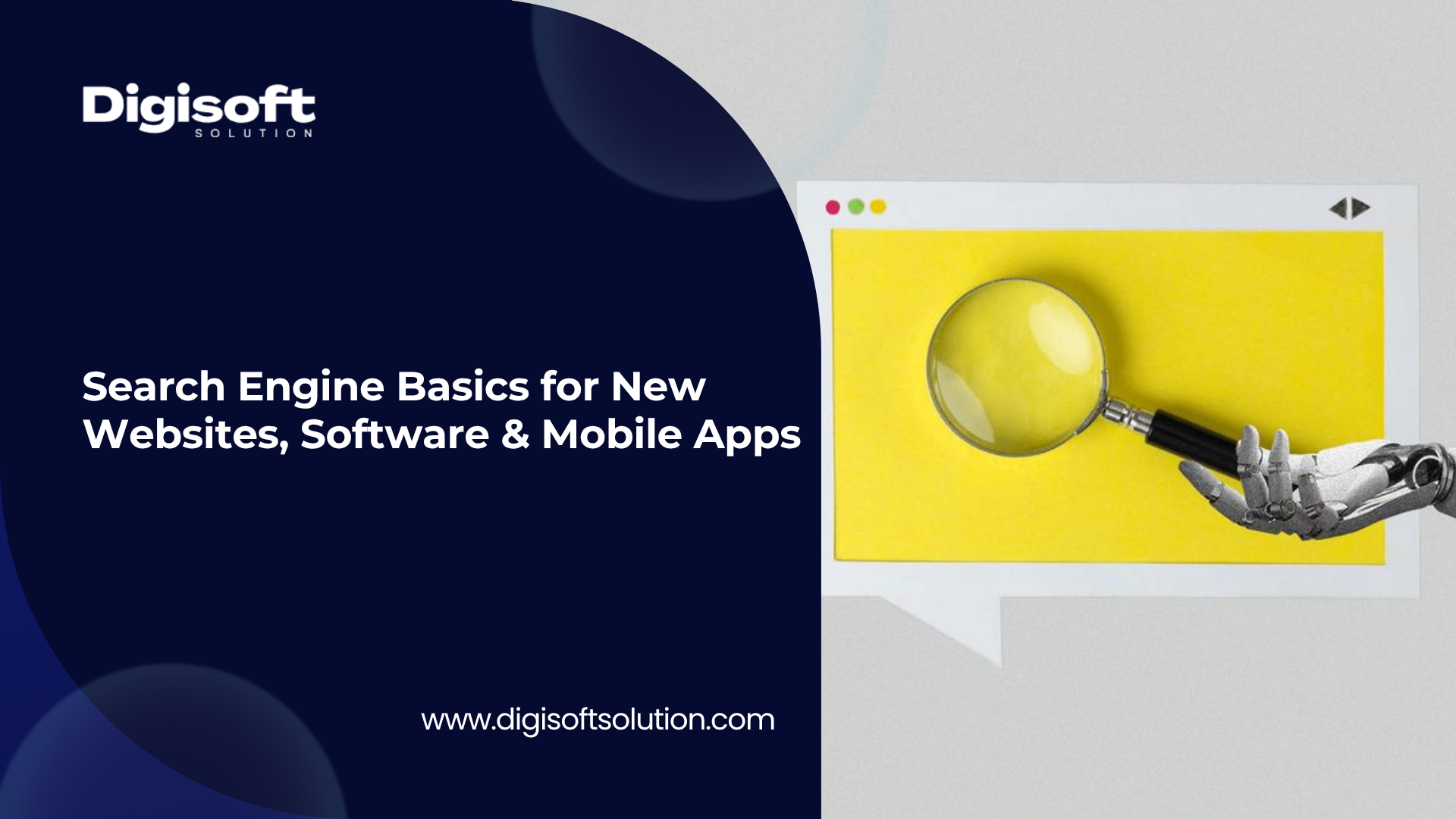
If you just launched a website, a SaaS product, or a mobile app, and you are wondering why nobody can find it, well, you are not alone. Most new digital products fail not because they are bad but because they were built without thinking about discoverability. Search engines are the single biggest traffic channel for almost every kind of product on the internet, and yet most founders treat SEO and ASO as something to think about later.
This guide is for startup founders, developers, product managers, and digital agencies who want to understand exactly how search visibility works across websites, software products, and mobile apps. We will cover everything from the very basics of how search engines actually crawl your site to the nuances of Google Play and Apple App Store rankings. No fluff, just practical and technical knowledge you can actually use.
What Are Search Engines and How Do They Actually Work?
A search engine is essentially a very large database of web content paired with a retrieval system that matches user queries to the most relevant results. Google, Bing, and DuckDuckGo are the biggest players in web search. For mobile apps, the relevant search engines are Google Play and the Apple App Store, and they work quite differently than traditional web search.
The Three Core Pillars: Crawling, Indexing, and Ranking
To understand search engine optimization, you first need to understand what search engines actually do under the hood.
Crawling is the process where search engine bots, Googlebot being the most important one, visit your website by following links from page to page. Think of it like a spider traversing a web. The bot reads your HTML, JavaScript, CSS, and other resources. If Googlebot cannot access your pages because of a blocked robots.txt file, poor internal linking, or server errors, it simply will not index them. No crawl means no index, which means no ranking. Simple as that.
Indexing is what happens after crawling. Once Googlebot reads your page, it decides whether the content is unique enough and useful enough to store in its index. Google's index is like an enormous library with billions of pages. If your content is thin, duplicated, or unstructured, Google might crawl it but choose not to index it. You can check this in Google Search Console by looking at the Coverage report.
Ranking is the most complex part. Once your pages are indexed, Google decides where to place them in search results for specific queries. This involves hundreds of ranking signals including content relevance, backlink authority, Core Web Vitals (page speed, interactivity, visual stability), mobile-friendliness, and user engagement signals.

Web Search vs App Store Search
This distinction matters a lot and most guides completely ignore it.
Web search is intent-driven. Users type a query and the algorithm matches content based on relevance, authority, and user signals. The ranking factors are complex and constantly evolving.
App Store search is simpler in some ways but has its own unique signals. When someone searches expense tracker in the App Store, Apple's algorithm considers your app name, subtitle, keyword field, ratings, reviews, download velocity, and in-app engagement metrics. It does not crawl URLs or care about your website's domain authority. It is a completely separate ecosystem with completely separate optimization strategies, which is why ASO (App Store Optimization) exists as its own discipline.
Related Read: E-commerce SEO Services and Strategies 2026
SEO Basics for New Websites
If you just launched a website, even a beautiful one built by a great team, it probably will not rank without deliberate SEO work. Here is what matters most for new websites.
Technical SEO Comes First
Before you worry about content, you need to make sure your website is technically sound. Technical SEO is the foundation. Without it, even great content will not rank. The most important technical factors for new websites include:
- Crawlability: Your robots.txt file should not accidentally block Googlebot. Check it at yourdomain.com/robots.txt. Also make sure your important pages are not marked with noindex meta tags.
- XML Sitemap: Create and submit a sitemap.xml to Google Search Console. This tells Google which pages exist on your site and helps with crawl efficiency.
- Site Speed and Core Web Vitals: Google uses Core Web Vitals as ranking signals. The three main metrics are Largest Contentful Paint (LCP), which should be under 2.5 seconds; Interaction to Next Paint (INP), which should be under 200ms; and Cumulative Layout Shift (CLS), which should be under 0.1.
- HTTPS: Every website should be on HTTPS in 2026. Not just for SEO but for trust and security.
- Mobile-Friendliness: Google's indexing is mobile-first, meaning it primarily uses the mobile version of your site for ranking. Your site must work flawlessly on mobile devices.
- Canonical Tags: If you have duplicate or near-duplicate content, use canonical tags to tell Google which version to index.
- Structured Data: Implement JSON-LD schema markup to help Google understand your content. This can unlock rich results in search which significantly improves click-through rate.
Our web development services are built with technical SEO in mind from day one, ensuring your site structure is crawlable, fast, and properly configured for search engines.
On-Page SEO for New Sites
On-page SEO refers to everything you can optimize within the actual content and HTML of each page.
- Title Tags: Every page should have a unique, descriptive title tag between 50 and 60 characters that includes the primary keyword. This is one of the most direct signals Google uses to understand what a page is about.
- Meta Descriptions: While not a direct ranking factor, a well-written meta description improves click-through rate from search results, which does indirectly affect rankings.\
- Header Tags (H1-H6): Use a single H1 per page that clearly describes the topic. Use H2 and H3 tags to structure your content logically. Search engines use these to understand content hierarchy.
- Keyword Optimization: Include your primary keyword naturally in the first 100 words, in at least one H2, and throughout the content. Do not stuff keywords. Google is smart enough to recognize unnatural repetition and it actually hurts rankings.
- Content Depth: Shallow content rarely ranks in 2026. A 300-word page about a competitive topic simply will not compete. Comprehensive, well-researched content that actually answers what users are searching for is what Google rewards.
- Image Optimization: Use descriptive alt tags for all images. Compress images to improve page speed. Use modern formats like WebP where possible.
Internal Linking Strategy
Internal linking is one of the most underrated and most under-utilized SEO tactics, especially for new websites. When you link from one page on your site to another, you pass link equity between pages and help Google understand the structure and importance of your content.
For a new website with few backlinks, internal linking is even more important because it helps distribute whatever authority you do have across your site. Make sure every page on your site can be reached from at least one other page through internal links. Use descriptive anchor text and link contextually when the topic is relevant.
Search Visibility for Software and SaaS Products
Software and SaaS products have unique SEO needs compared to traditional websites. Your homepage might explain what your product does, but that is rarely what users actually search for.
Landing Pages That Actually Convert and Rank
Most SaaS companies make the mistake of having one homepage and calling it SEO done. In reality, you need targeted landing pages for each use case, industry, integration, and feature. For example, if you build project management software, a generic homepage will not rank for project management software for construction companies. A dedicated landing page targeting that specific use case will. These pages need real content, not just a header and a signup form.
Feature Pages and How to Structure Them
Each major feature of your software deserves its own dedicated page. Users search for specific capabilities, and if you do not have a page targeting those searches, you simply will not appear. Feature pages should include a clear description of what the feature does, who it is for, screenshots or a demo video, and relevant FAQs. Adding FAQ schema markup to these pages can get you into Google's featured snippets and People Also Ask boxes.
Our software development services include proper product architecture planning that ensures your SaaS product has a scalable URL and content structure right from the start.
Documentation Indexing
For developer tools, APIs, and B2B software, documentation is a massive SEO asset that most companies completely ignore. Developers search for things like how to authenticate with your product API or how to set up webhooks. If your docs are behind a login wall or marked with noindex tags, you are missing out on a huge source of highly qualified traffic. Make sure your documentation is publicly accessible, properly structured with headers and code blocks, and canonicalized correctly if you have versioned docs.
Programmatic SEO for SaaS
Programmatic SEO involves creating large volumes of templated pages that target long-tail keyword variations at scale. For example, a software comparison platform might create pages like Your Software vs Competitor A and Your Software for Industry X for dozens of variations. This works well when the underlying data is genuinely useful, but it can get you penalized if the pages are thin and offer no real value. Done right, programmatic SEO is one of the most efficient ways for a SaaS product to build organic traffic quickly.
Related Read: SaaS Product Development: Build, Launch and Scale Successfully
Google Play Store Optimization (ASO for Android)
The Google Play Store has over 3.5 million apps, and getting found organically requires deliberate optimization. Unlike web SEO, ASO for the Play Store is more focused and has fewer variables to work with.
App Title Optimization
Your app title is the single most important ASO element on Google Play. It is weighted heavily in keyword matching. Include your primary keyword in the title if it makes sense, but do not keyword-stuff. Google Play allows up to 50 characters for the title. A good title format is: Brand Name: Primary Keyword (for example, MyBudget: Expense Tracker & Planner).
Short Description and Long Description
The short description (80 characters) appears before the read more expansion. It should be compelling and keyword-rich. The long description (up to 4000 characters) is fully indexed by Google Play's algorithm. Use your primary and secondary keywords naturally throughout the description. Front-load the most important information in the first three sentences because most users will not read beyond that.
Ratings, Reviews, and How They Impact Ranking
Higher ratings directly correlate with better Play Store rankings. Apps with an average rating below 4.0 typically see significantly lower visibility. More importantly, the recency of reviews matters. An app with 1000 reviews from three years ago will rank lower than an app with 200 recent reviews. Encourage users to leave reviews through in-app prompts, but do this contextually after a positive action, not randomly. Responding to negative reviews professionally also signals to Google that your app is actively maintained.
Screenshots and Preview Videos
Screenshots do not directly impact your search ranking in the Play Store, but they dramatically affect conversion rate once users land on your store page. A high conversion rate does influence ranking because it tells the algorithm that users who see your app listing actually want to install it. Use your first two screenshots to communicate your app's core value proposition immediately. Add brief text overlays that explain what users are looking at.
Retention Signals and Download Velocity
Google Play's algorithm tracks uninstall rates, app crashes, user session length, and daily active users. An app that gets 10,000 downloads but 8,000 uninstalls within a week will not rank well. This means that before you invest heavily in ASO, your app itself needs to be stable, useful, and engaging.
Download velocity (how many downloads you get in a short period) is another key signal. This is why launch day promotions and early user acquisition matter so much. A strong launch creates a velocity spike that can give you a sustained ranking boost.
Apple App Store Optimization (ASO for iOS)
The App Store on iOS operates on a different algorithm than Google Play, and the optimization strategy differs in some important ways.
App Name and Subtitle
The App Store allows 30 characters for the app name and 30 characters for the subtitle. Both fields are indexed for keyword search. This means you effectively have 60 characters of keyword-rich space to work with. Use the name for your brand and primary keyword, and use the subtitle for a secondary keyword or value proposition. Every word counts.
The Keyword Field
This is unique to Apple's App Store and does not exist on Google Play. Apple gives developers a 100-character keyword field that is not visible to users but is indexed by the App Store search algorithm. Use all 100 characters. Separate keywords with commas and no spaces. Do not repeat keywords that are already in your app name or subtitle. Do not include competitor brand names (it violates Apple's guidelines). Use singular forms since the algorithm handles plurals.
App Previews and Localization
App Previews (30-second video clips) can significantly improve conversion rate in the App Store. Apple shows these autoplay in search results on supported devices. A good preview can increase your conversion rate by 25% or more, which over time improves your search ranking.
Localization is also underutilized. If you localize your metadata and ideally your app itself into additional languages, Apple treats the localized metadata as separate keyword targeting opportunities. This can significantly expand your organic reach in non-English markets.
iOS-Specific Ranking Factors
Apple's algorithm weights some factors differently than Google Play. Rating and reviews are still important, but Apple gives heavier weight to ratings in the user's local market. App crashes (crash rate) are a very significant negative signal on iOS. Apple has direct data on crash rates from their systems, and unstable apps are penalized heavily.
Conversion rate in the App Store context means the percentage of users who visit your product page and then tap Get to download. Apple's TestFlight and product page optimization features allow you to A/B test your store listing, which is something you should definitely use. iOS app development and Android app development services are built with ASO considerations baked into the development and QA process.
SEO vs ASO: What Is the Actual Difference?
A lot of people conflate SEO and ASO or treat them as the same thing. They are related but meaningfully different. Here is a clear breakdown of how ranking works across the three main platforms:
|
Factor |
Google Search (Web) |
Google Play Store |
Apple App Store |
|
Primary Algorithm Input |
Relevance, authority, UX |
Keywords, ratings, retention |
Keywords, ratings, conversion |
|
Keyword Placement |
Title tags, content, headings |
App title, description |
App name, subtitle, keyword field |
|
Backlinks Matter? |
Yes, hugely |
No |
No |
|
User Engagement Signal |
Bounce rate, dwell time |
Retention rate, DAU |
Session length, crash rate |
|
Reviews / Ratings |
Indirect (schema markup) |
Direct ranking factor |
Direct ranking factor |
|
Update Frequency Impact |
Low |
High (freshness signal) |
Medium |
|
Paid Ads Integration |
Google Ads (separate) |
Google UAC |
Apple Search Ads |
|
Indexing Lag (New Content) |
Days to weeks |
24 to 72 hours |
1 to 7 days (after review) |
|
Localization Benefit |
High |
High |
Very High |
|
CTR Signal |
Strong (from SERP) |
Strong (store results) |
Strong (store results) |
The biggest conceptual difference is this: web SEO is largely about authority (who links to you, how trusted your domain is) combined with relevance. ASO is almost entirely about relevance and user behavior signals like downloads, retention, and ratings. Backlinks are irrelevant in app stores. Your domain authority means nothing to the Play Store algorithm.

Technical Basics Every Developer Should Know
This section is specifically for developers building new websites, SaaS products, or mobile apps who want to ensure they are not inadvertently sabotaging their search visibility.
Indexability and Rendering
If your website is built with a JavaScript framework (React, Vue, Angular, Next.js), you need to understand how Google crawls JavaScript. Googlebot can render JavaScript, but it does so using a secondary crawl queue that can delay indexing by days or even weeks. Server-side rendering (SSR) or static site generation (SSG) dramatically improves indexability for JS-heavy sites.
Check your site's indexability with the URL Inspection tool in Google Search Console. If pages are showing as Crawled, currently not indexed or Discovered, currently not indexed, that is a flag that something technical needs attention.
Deep Linking and App Indexing
For mobile apps, deep linking is the ability to link directly to a specific screen or piece of content within your app. From an SEO perspective, verified deep links allow Google to index app content and show it in web search results. This is called Firebase App Indexing on Android.
To implement this correctly on Android, you need to set up Android App Links using intent filters and a verified assetlinks.json file hosted on your domain. On iOS, the equivalent is Universal Links, configured through an apple-app-site-association file.
Core Web Vitals in Practice
Core Web Vitals are not just abstract metrics. Here is what actually causes issues in real projects:
- Poor LCP is most commonly caused by large unoptimized images, slow server response times, render-blocking CSS or JavaScript, or client-side rendering of above-the-fold content. Fix it by optimizing your largest above-the-fold image, improving server response time (TTFB), and eliminating render-blocking resources.
- Poor INP (which replaced FID in 2024) is caused by heavy JavaScript execution on the main thread. Long tasks that block user interaction are the culprit. Profile your JavaScript with Chrome DevTools and break up long tasks using scheduler.yield() or requestAnimationFrame.
- Poor CLS is caused by elements that shift position after the page loads, commonly images without explicit dimensions, dynamically injected content, or web fonts causing text reflow. Always set explicit width and height attributes on images and reserve space for dynamic content.
Structured Data and Schema Markup
Structured data is JSON-LD code that you add to your pages to help Google understand your content in a structured way. For software products, the most useful schema types are SoftwareApplication, FAQPage, HowTo, Review/AggregateRating, and BreadcrumbList.
A Software Application schema on your app landing page can earn you a rich result in Google search that shows your star rating, operating system compatibility, and price directly in the SERP, which can significantly improve click-through rate.
Common Mistakes New Startups Make with Search Visibility
After working with hundreds of startups and SaaS companies, these are the mistakes we see over and over again.
Launching Without Any SEO Infrastructure
This is the most expensive mistake. Many founders spend months building a product and then launch with a website that has no title tags, no sitemap, no internal linking, no structured data, and no Google Search Console setup. Even if you do not have content yet, these technical foundations should be in place on day one. They cost almost nothing to set up and take weeks or months of waiting to fix retroactively.
Ignoring Metadata Entirely
Title tags, meta descriptions, and Open Graph tags are often left as default or blank by developers focused on building features. Default titles like Untitled Document or auto-generated tags from your CMS are not going to help you rank. Every page needs intentional, unique metadata.
Thin or Vague App Descriptions
In the app stores, the description is your main opportunity to match user search queries. Yet most developers write two or three generic sentences and call it done. A well-written app store description uses the full character allowance, addresses specific user problems and search intents, and naturally incorporates the keywords users are actually searching for.
No Backlink Strategy
New websites have no domain authority. Domain authority is primarily built through backlinks from other trusted websites. Many startups launch and then wonder why they are not ranking. The answer is often simply that no one has linked to their site yet. Start building backlinks early through guest posts, press coverage, product listings on Product Hunt, Capterra, and G2, partnerships, and thought leadership content.
Thin Landing Pages for SaaS Products
A homepage that says The best project management tool. Try it free with a single CTA button is not going to rank for anything. Users searching for software solutions need to see detailed information about features, use cases, and social proof. Thin pages do not rank, and even if they did, they would not convert.
The Future of Search: What Is Coming and How to Prepare
Search is changing faster in 2025-2026 than at any point in the last decade. Here is what you genuinely need to pay attention to.
AI-Powered Search and Generative Engine Optimization (GEO)
Google's AI Overviews now appear for a large percentage of search queries. These are AI-generated summaries that appear above the traditional organic results. The challenge is that users can get their answer directly from the AI overview without clicking any link at all. This is reducing click-through rates from organic search for informational queries.
Generative Engine Optimization (GEO) is the emerging practice of optimizing content to be cited within AI-generated answers, not just to rank in traditional blue-link results. To be cited by AI overviews, your content needs to be authoritative, clearly structured, accurate, and specific. Cite sources and data. Use structured headers and concise answers.
You also need to think about Answer Engine Optimization (AEO), which is about structuring content to directly answer specific questions. This is why FAQ sections, clear definition paragraphs, and structured how-does-X-work content matter so much right now.
Voice Search Optimization
Voice search queries are typically longer and more conversational than typed queries. Traditional SEO targeting the keyword project management app will not capture this intent. To optimize for voice, create content that answers specific conversational questions. The content should use natural language, provide concise and direct answers, and ideally target a featured snippet position.
App Indexing and Search Inside AI Assistants
As AI assistants like Google Assistant, Siri, and others become more capable, they increasingly pull from indexed app content. Properly implemented Firebase App Indexing means your app content can appear not just in Google Search but in AI assistant responses and voice results. This is a competitive advantage that few apps have set up correctly.
There is also a growing trend of search within AI products. Perplexity, ChatGPT's browsing mode, and similar tools are increasingly being used as search engines. These systems favor content that is well-structured, clearly sourced, and technically accessible. Good SEO and GEO practices overlap heavily here.
How Digisoft Solution Helps New Websites, SaaS Products, and Mobile Apps Get Found in Search
At Digisoft Solution, we have been building digital products for over 12 years across more than 500 clients worldwide. One consistent thing we have seen is that the best products fail to grow because they were not built with discoverability in mind. That is something we actively help prevent.
SEO-Optimized Development from Day One
When we build your website or web application, technical SEO is not an afterthought. We implement correct URL structures, semantic HTML, proper heading hierarchy, schema markup, XML sitemaps, robots.txt configuration, and Core Web Vitals optimization as part of the standard development process.
Mobile Apps Built for ASO Success
Our mobile app development team understands that app store rankings depend heavily on app quality signals. We build apps that are performant, crash-free, and designed for high retention, all of which directly affect your Play Store and App Store rankings. We also advise clients on their app store listing, including title structure, keyword field optimization, and screenshot strategy.
SaaS Product Development with Search Visibility Architecture
Our software product development process includes information architecture planning that considers SEO from the start. Feature pages, use-case landing pages, and documentation are structured and linked in a way that supports organic discovery, not just user navigation.
UI/UX That Supports Search Rankings
User experience signals are ranking factors. Bounce rate, session duration, and pages per visit all feed back into search ranking algorithms. Our UI/UX design team creates interfaces that are genuinely intuitive and engaging, which means users stay longer and interact more, which over time improves your search standing.
Digital Marketing and SEO Strategy
Building the right technical foundation is necessary but not sufficient. You also need a content and backlink strategy. Our digital marketing team provides keyword research, content planning, on-page optimization, and link building specifically tailored for tech products, SaaS platforms, and mobile apps. We have experience with both web SEO and app store ASO, which means we can create a unified visibility strategy across all your platforms.
Testing and Quality Assurance That Protects Your Rankings
Nothing destroys your app store ranking faster than a crash spike or a sudden drop in user retention caused by a bug in a new release. Our software testing services ensure that every release is stable, performant, and ready for production, protecting the quality signals that your search and app store rankings depend on.
If you want to see real examples of the products we have built and how we have helped clients grow, visit our
You can also explore our case studies to see the actual work, and reach out through our contact page for a free consultation and technical roadmap.
Frequently Asked Questions (FAQ)
What is the difference between SEO and ASO?
SEO (Search Engine Optimization) is the practice of improving a website's visibility in search engines like Google. ASO (App Store Optimization) is the practice of improving an app's visibility in app stores like Google Play and the Apple App Store. While they share some conceptual overlap, the ranking factors are quite different. SEO relies heavily on backlinks and domain authority. ASO depends on app quality signals like retention rate, crash rate, ratings, and keyword placement in the app listing.
How long does it take for a new website to rank on Google?
This is a genuinely variable question. A technically sound, well-structured website targeting low-competition keywords can start ranking within a few weeks. For competitive terms, realistically expect 6 to 12 months of consistent SEO work before seeing significant organic traffic. Domain age, backlink profile, and content quality are the main variables.
Do mobile apps rank on Google Search?
Yes, but only if you have implemented app indexing correctly using Firebase App Indexing on Android or Universal Links on iOS. When properly set up, app content can appear in Google Search results and can be opened directly from search, benefiting both discoverability and user acquisition.
What is Core Web Vitals and why does it matter for SEO?
Core Web Vitals are a set of user experience metrics that Google uses as direct ranking signals. They measure loading performance (LCP), interactivity (INP), and visual stability (CLS). Pages that perform poorly on these metrics can be demoted in rankings compared to competitors with better UX. You can measure your Core Web Vitals using Google Search Console, PageSpeed Insights, or Chrome DevTools.
What is GEO (Generative Engine Optimization)?
GEO is the emerging practice of optimizing content to be cited or referenced within AI-generated search results, such as Google's AI Overviews or answers from Perplexity and similar AI search tools. Content optimized for GEO tends to be structured, authoritative, specific, and directly answers questions in clear language.
Should I hire a digital marketing expert or do SEO myself as a startup founder?
Honestly, the technical SEO foundation should ideally be handled by professionals who understand how to implement it correctly in your specific tech stack. Basic on-page SEO and content creation are things a founder can learn and do early on. But as your product scales, having an expert who understands both the technical side and the strategic side becomes a strong investment. Digisoft Solution's team can handle either the full scope or specific components depending on your stage and budget.
Summary and Key Takeaways
Here is what you need to remember if you have built or are building a new website, software product, or mobile app in 2026:
- Search visibility is not optional. It is how most digital products get discovered. Whether it is Google Search, the Play Store, or the App Store, search is the primary channel.
- SEO for websites is built on three pillars: technical soundness, content relevance, and backlink authority. All three are necessary.
- SaaS and software products need dedicated landing pages, feature pages, and indexed documentation to capture the specific search queries their users make.
- ASO for mobile apps requires optimizing your metadata, generating positive reviews, and building an app that users actually retain and use.
- The App Store and Google Play have meaningfully different algorithms. iOS optimization relies heavily on keyword field and subtitle strategy. Android optimization depends more on description keyword density and retention metrics.
- Technical developers should understand crawlability, Core Web Vitals, deep linking, and structured data as baseline competencies for any product they build.
- The future of search is being shaped by AI, with generative results and voice interfaces changing how users find and interact with content.
- Search visibility needs to be part of how you plan, build, and launch every digital product from the start.
Digital Transform with Us
Please feel free to share your thoughts and we can discuss it over a cup of coffee.