Table of Content
- Software Development Trends for 2026
- 1. AI-Augmented Development & Autonomous Coding Agents
- Key Technologies & Capabilities
- Business Impact
- 2. Edge Computing & Distributed Cloud Architecture
- Architecture Evolution
- Use Cases and Applications
- Performance Metrics
- 3. Zero Trust Security Architecture & DevSecOps 2.0
- Core Principles and Implementation
- DevSecOps Automation
- Security Results
- 4. Low-Code/No-Code Platform Evolution
- Platform Capabilities
- Strategic Applications
- Development Velocity
- 5. Micro-Frontends and Microservices
- Architectural Patterns
- Implementation Strategies
- Organizational Benefits
- 6. WebAssembly and High-Performance Web Applications
- Technical Capabilities
- Emerging Use Cases
- Performance Revolution
- 7. Blockchain Integration & Web3 Development
- Enterprise Applications
- Development Stack
- Business Transformation
- 8. Platform Engineering and Internal Developer Platforms
- Components of the Core
- Platform Capabilities
- Developer Experience
- 9. Quantum-Ready Software Architecture
- Quantum Computing Integration
- Post-Quantum Cryptography
- Strategic Preparation
- 10. Accessibility-First and Inclusive Design
- Technical Implementation
- Automated Testing Tools
- Inclusive Design Principles
- How Digisoft Solution Helps You Stay Ahead in Custom Software Development
Digital Transform with Us
Please feel free to share your thoughts and we can discuss it over a cup of coffee.
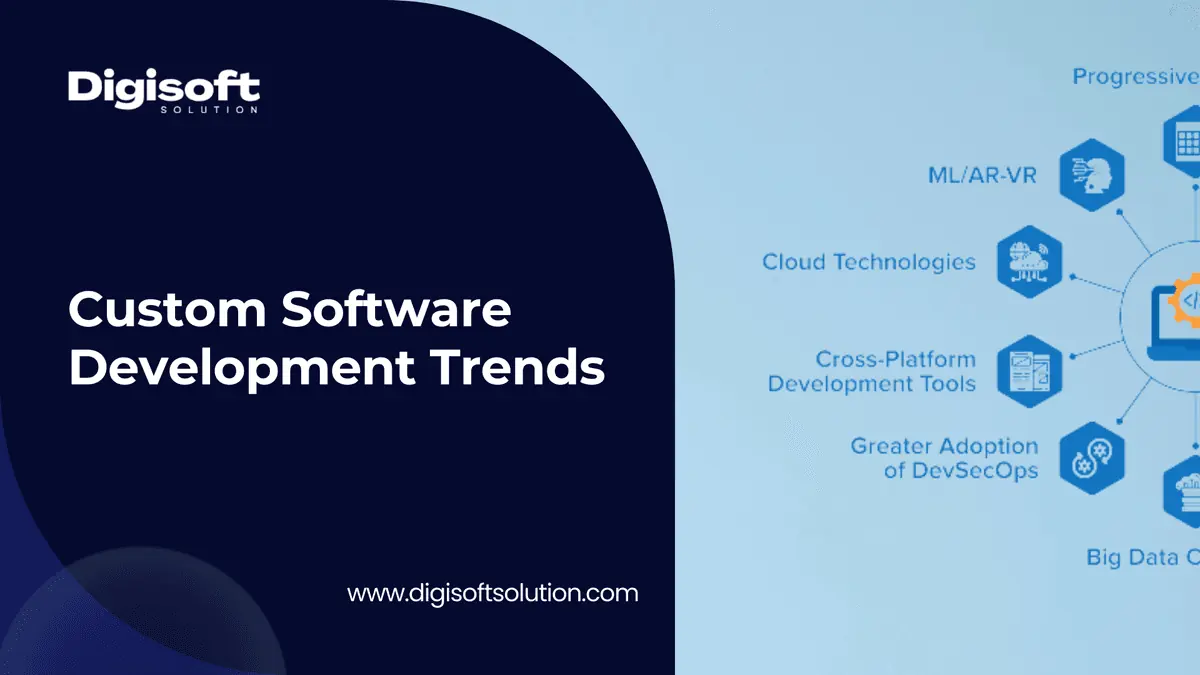
The trends in custom software development continue to evolve at an exceptional pace as we navigate 2026. The intersection of artificial intelligence, cloud-native architectures, and emerging technologies is reshaping how businesses build, deploy, and maintain software solutions. This comprehensive analysis explores the most significant trends shaping the future of the latest custom software development.
These trends represent not just incremental improvements but fundamental shifts in how we approach software engineering from AI-augmented development workflows to quantum-ready architectures. It is crucial for organizations seeking to maintain a competitive advantage in the current digital world to understand and adopt these trends early.
Software Development Trends for 2026
Let's check the most transformative trends shaping custom software development in 2026.
1. AI-Augmented Development & Autonomous Coding Agents
As we all know, AI-powered development tools have evolved beyond basic code completion. It is now autonomous agents worldwide that can recognize context, design complete feature implementations, and participate in architectural decisions. These systems fundamentally affect developers' productivity and software quality.
Key Technologies & Capabilities
- Advanced Code Generation: PRAI models can create production-ready code in a variety of frameworks, languages, and paradigms with incredible precision.
- Intelligent Refactoring: Automatic optimization of code, reduction of technical debt, and pattern recognition to improve the quality of code.
- Context-Aware Assistance: A deep knowledge of the architecture of project codes, standards for coding, and business logic to provide context-sensitive ideas.
- Automated Testing: AI-generated complete test suites that include integration, unit, and end-to-end tests.
- Bug Detection & Security Scanning: Real-time detection of weaknesses, anti-patterns, and security vulnerabilities that could be a threat.
Tools:
GitHub Copilot, Claude, GPT-4 Turbo–based coding tools, Amazon CodeWhisperer, Tabnine, Cursor
Business Impact
Companies adopting AI-augmented development see productivity improvements of 40–60%, a 35% reduction in bugs introduced into production, and significantly shorter time-to-market for new products. AI-augmented technology is revolutionizing software development, allowing small teams to compete against larger companies.
2. Edge Computing & Distributed Cloud Architecture
Edge computing has grown from a niche technology into an essential architectural pattern. By bringing data closer to the source, organizations can achieve ultra-low latency, cost-effective bandwidth, and improved privacy compliance, all of which are crucial for modern applications.
Architecture Evolution
- Hybrid Edge-Cloud Models: They smoothly distribute workloads across edge devices, regional data centers, and central cloud infrastructure.
- Edge AI Processing: The machine learning and inference on the edge to enable real-time decision making, without cloud round-trips.
- Data Sovereignty: Complying with regional regulations for data through local processing and storage.
- Resilient Systems: With this, operations continue even during network disruptions, thanks to edge autonomy.
- 5G Integration: Utilizing 5G networks to enhance edge computing capabilities, as well as MEC on the move (MEC).
Use Cases and Applications
- Industrial automation and IoT devices that require millisecond response times
- Autonomous vehicles that process sensors in real time
- Personalization and analytics for retail at the point of sale
- Healthcare applications that require privacy for patient data
- Smart connected infrastructure in cities and management
Platforms:
AWS Wavelength, Azure Edge Zones, Cloudflare Workers, Google Distributed Cloud, KubeEdge
Performance Metrics
Edge computing deployments achieve 70–90% lower latency than centralized cloud architectures, 40–60% lower bandwidth costs, and higher user satisfaction for latency-sensitive applications.
3. Zero Trust Security Architecture & DevSecOps 2.0
The concept of security is not just a checkpoint; it is a fundamental part of every phase of development. Zero Trust principles, in conjunction with automated security testing, are creating more robust, secure-by-default software systems that can withstand advanced cyberattacks.
Core Principles and Implementation
- Never trust, always check: It is for continuous verification and authentication at each connection point and during every transaction.
- Micro-Segmentation of Networks: Network segmentation at the workload level to limit lateral movement.
- Access to the Least Privilege: Just-in-time and just-enough-access (JIT/JEA) policies that are enforced programmatically.
- Continuous Monitoring: It helps with real-time threat detection and automated response systems.
- Left-Shift Security: Security testing is integrated into the very beginning stages of development.
DevSecOps Automation
- Static Application Security Testing (SAST) in IDE and CI/CD pipelines
- Dynamic Application Security Testing (DAST) for runtime vulnerability detection
- Software Composition Analysis (SCA) for managing dependency vulnerabilities
- Infrastructure as Code (IaC) security monitoring for cloud misconfigurations
- Kubernetes and Container security by enforcing policy-as-code
Tools:
Snyk, Prisma Cloud, Aqua Security, HashiCorp Vault, SonarQube, Checkmarx
Security Results
Companies that implement comprehensive Zero Trust and DevSecOps practices have reported a 60% decrease in security breaches, a 45% faster remediation of vulnerabilities, and greater compliance with regulatory frameworks.
4. Low-Code/No-Code Platform Evolution
No-code and low-code platforms have overcome their initial limitations to create powerful development environments that can produce enterprise-grade software. The combination of visual design, AI assistance, and professional-grade extensibility is revolutionizing software development.
Platform Capabilities
- Development of Visuals: Drag-and-drop interfaces using sophisticated design tools and workflow builders.
- AI-Powered Generation: Natural language conversion to applications using intelligent components that offer suggestions.
- Enterprise Integration: Native connectors for hundreds of enterprise systems, APIs, and databases.
- Scalability and Performance: Auto-scaling infrastructure, optimized runtime environments.
- Extensibility Professional: Custom-written integration points for developers to expand the platform's capabilities.
Strategic Applications
- Quick prototyping, rapid MVP creation, with the capability of instant deployment
- Automation of business processes and workflow management across departments
- Internal toolkits and administration panels, which traditionally consume developer resources
- Applications for customers that have complicated business logic
- Pipelines for data integration and transformation
Tools/Platforms:
OutSystems, Mendix, Microsoft Power Apps, Bubble, Appian
Development Velocity
Low-code platforms allow 5–10x faster application development as compared to traditional development, and citizen developers are responsible for 60–70 per cent of the innovative business apps by the year 2026. As a result, professional developers are freed to work on more complex, high-value projects.
5. Micro-Frontends and Microservices
The microservices revolution is extending to the web's frontend, enabling teams to create, deploy, and expand user interface components independently. This architectural pattern solves the scaling and team autonomy issues in modern web applications.
Architectural Patterns
- Independent Deployment: Every microfrontend can be designed and implemented separately by different teams.
- Framework Diversity: Microfrontends could use different frameworks (React, Vue, Angular, Svelte).
- Isolated Runtime: A failure at one micro-frontend does not cascade to other micro-frontends.
- Shared State Management: Event-driven communication and a shared state pattern coordinate components.
- Composition Strategies: Server-side composition, build-time integration, or runtime composition through Module Federation.
Implementation Strategies
- Webpack Module Federation for seamless JavaScript module sharing
- A framework-independent Single-SPA framework to allow framework-independent orchestration
- Web Components for true technology-independent integration
- Edge-side include (ESI) to allow server-side composition
- Iframe-based isolation for older integration of systems
Organizational Benefits
Micro-frontend architectures provide real team autonomy, 40% faster feature deployment, reduced dependence on other teams, and increased capacity for large development companies managing complex user interfaces.
6. WebAssembly and High-Performance Web Applications
WebAssembly (Wasm) is revolutionizing the performance of web-based applications by enabling near-native execution speeds in browsers. Applications that were once limited to desktops now run effortlessly in browsers, delivering performance comparable to desktops.
Technical Capabilities
- Near-Native Performance: Perform computation-intensive tasks with speeds similar to native code.
- Language Flexibility: Write web-based applications using C, C++, Rust, Go, and many other compiled languages.
- Code Portability: Use codebases for mobile, web, and server environments.
- Sandboxed Execution: Security via isolated runtime environments.
- Compilation of Streaming: Commence running before all the modules have been downloaded.
Emerging Use Cases
- Image processing and video editing applications that run entirely within the browser
- 3D modelling and CAD tools that offer desktop-class performance
- Engines for games and simulations based on physics
- Machine learning to infer at the edge
- Data visualization and scientific computing
- Cryptographic and blockchain operations
Tools:
Rust + Wasm, AssemblyScript, Blazor WebAssembly, Emscripten, wasmtime
Performance Revolution
WebAssembly applications provide 10–100x efficiency improvements for computational tasks, enabling complex desktop-style applications to run in browsers while preserving the accessibility and performance advantages of web-based apps.
7. Blockchain Integration & Web3 Development
Blockchain technology is moving beyond cryptocurrency and into real-world enterprise applications. Decentralized identities and transparent supply chains are establishing new ways to ensure security and trust in software applications.
Enterprise Applications
- Smart Contracts: Self-executing contracts that are automated in compliance and settlement.
- Decentralized Identity: Self-sovereign identity management and verifiable credentials.
- Supply Chain Transparency: Immutable tracking of products from the point of origin to the consumer.
- Digital Asset Management: NFTs for intellectual property licensing, certifications, and licenses.
- Decentralized Finance (DeFi): Financing services that are not traditional intermediaries.
Development Stack
- Ethereum and Ethereum Virtual Machine (EVM) compatible chains
- Solidity and Vyper for smart contract development
- Hardhat and Foundry for testing and deployment
- IPFS and Arweave for decentralized storage
- The Graph protocol for information indexing, querying, and analytics
- MetaMask and WalletConnect to authenticate users
Business Transformation
Blockchain implementations can reduce settlement time by 80–90%. They also eliminate intermediary costs associated with multi-party transactions and create new business models based on tokenization and decentralized coordination.
8. Platform Engineering and Internal Developer Platforms
Platform engineering is gaining momentum as an area of study focused on developing and managing Internal Developer Platforms (IDPs) with self-service capabilities that help developers be more efficient while preserving standards and governance.
Components of the Core
- Self-Service Infrastructure: Developers can provide resources without needing DevOps intervention
- Golden Paths: Pre-approved, optimized patterns for common development scenarios
- Developer Portals: Uniform interfaces to catalogues of services, documentation, and automation
- Standardized Workflows: Consistent CI/CD pipelines, tests, and deployment procedures
- Monitoring Integration with Observability: Built-in monitoring of logging, tracing, and monitoring for all services
Platform Capabilities
- Project scaffolding for services and service startups
- Automated provisioning of the environment (dev, stage, production)
- The configuration and management of secrets is managed using code
- Resource governance and cost optimisation
- Automation of compliance and security
- Metrics for developer productivity and insight
Developer Experience
Companies with advanced Internal Developer Platforms are reporting 50% less time to production for new products, a 40% increase in developer satisfaction, and a significant reduction in cognitive burden from standardization.
9. Quantum-Ready Software Architecture
As quantum computing becomes practically feasible, innovative organizations are beginning to build devices with quantum-ready capabilities. Preparation is required for both the potential quantum computing brings and the security risks it presents.
Quantum Computing Integration
- Hybrid Classical Quantum Systems: Architectures that allow offloading of specific calculations to quantum processors
- Quantum Algorithms: Exploring quantum machine learning, as well as optimization and simulation application cases
- Quantum SDKs: Frameworks for quantum algorithm development and testing
- Simulation Environments: Classical quantum simulation simulators to develop and test
- Cloud Quantum Access: Quantum computing as a cloud service for experiments
Post-Quantum Cryptography
- Transition towards quantum-resistant encryption algorithms (NIST standards)
- Crypto-agility architecture that allows the replacement of algorithms without code modifications
- Hybrid encryption strategies that mix classic and post-quantum encryption algorithms
- Key management and certificate management system updates
- Long-term data protection against "harvest now, decrypt later" attacks
Strategic Preparation
Although large-scale quantum computing is some time away, companies that invest in quantum readiness today will be able to compete in optimizing problems such as drug discovery and financial modeling, and protect against future vulnerabilities in cryptography.
10. Accessibility-First and Inclusive Design
Accessibility is not a supplementary consideration but an essential requirement, governed by law and ethics, and supported by the understanding that accessible design benefits everyone. Modern design practices incorporate accessibility right from the beginning.
Technical Implementation
- WCAG 2.2 and 3.0 Compliance: Complying with AA as well as AAA standards for accessibility of web content
- Semantic HTML: Use of HTML5 elements to ensure screen reader compatibility
- ARIA Standards: Accessible Rich Internet Applications patterns for complex interfaces
- Keyboard Navigation: Full accessibility to keyboards without the need for a mouse
- Color Contrast: Automated test for WCAG contrast ratios
- Focus Management: Clear focus indicators and an orderly tab structure
Automated Testing Tools
- Automated accessibility testing as a feature of CI/CD pipelines
- Screen reader compatibility testing(NVDA, JAWS, VoiceOver)
- Lighthouse and Axe-core integration to ensure continuous monitoring
- Audits on the accessibility of library components
- User testing for diverse ability groups
Inclusive Design Principles
- Multiple input modes are supported (touch, keyboard, voice)
- Responsive design to accommodate various sizes of screens and zoom levels
- Dark mode and custom themes to ensure visual ease
- Motion options reduced to improve vestibular sensitivities
- Localization and internationalization to reach worldwide viewers
Related Read: Top AI Trends 2026
How Digisoft Solution Helps You Stay Ahead in Custom Software Development
At Digisoft Solution, we specialize in building modern custom software tailored to your business objectives. We integrate AI, cloud-native architecture, advanced security practices, and user-centric design to deliver high-performance applications.
Our expert team ensures scalable, secure, and innovative systems that drive measurable results, whether you need enterprise software, web applications, mobile platforms, or AI-powered solutions.
We build technology that prepares your business with AI-powered solutions, cloud-native systems, secure architectures, and responsive UX, boosting your business. Now is the time to future-proof your business with cutting-edge custom software development solutions
The above software development trends 2026 represent more than incremental improvement. They represent fundamental shifts in how we design, develop, and deploy software solutions. The success of 2026 and beyond will require an intelligent assessment of the trends that align with your company's goals and technological capabilities.
Digital Transform with Us
Please feel free to share your thoughts and we can discuss it over a cup of coffee.