Table of Content
- What Is Application Modernization?
- Why Application Modernization Is Critical in 2026
- A. Legacy Systems Are Draining Your IT Budget
- B. Downtime Is Catastrophically Expensive
- C. Security Vulnerabilities Expand Daily
- D. Talent Is Departing Legacy Stacks
- E. Your Competitors Are Outpacing You
- 7 Core Application Modernization Strategies
- 1. Rehost (Lift and Shift)
- 2. Replatform (Lift, Tinker, and Shift)
- 3. Refactor/Re-architect
- 4. Rebuild
- 5. Replace
- 6. Retain
- 7. Retire
- Top Application Modernisation Trends Shaping 2026
- 1. AI-Powered Modernization
- 2. Cloud-Native as the New Default\
- 3. Microservices and API-First Architecture
- 4. DevSecOps
- 5. Low-Code and No-Code Integration
- 6. Edge Computing for Latency-Sensitive Industries
- 7. Progressive Web Apps (PWAs)
- Industry-Specific Modernization: What Each Sector Needs
- Banking and Financial Services
- Healthcare
- Retail and E-Commerce
- Logistics and Supply Chain
- Manufacturing
- The Application Modernisation Process: Step by Step
- Phase 2: Roadmap and Prioritization
- Phase 3: Architecture Design
- Phase 4: Incremental Migration and Development
- Phase 5: Testing, Security Validation, and Quality Assurance
- Phase 6: Deployment and Cutover
- Phase 7: Optimization and Continuous Improvement
- Common Application Modernisation Mistakes to Avoid
- Mistake 1: Treating Modernization as a One-Off Project
- Mistake 2: Migrating Technical
- Mistake 3: Ignoring Data Migration Planning
- Mistake 4: Ignoring Change Management
- Mistake 5: No Clear Business Metrics
- Mistake 6: Selecting an Unsuitable Partner
- How to Measure Modernization ROI
- Why Choose Digisoft Solution?
- 12+ Years of Software Engineering Experience
- Full-Stack Modernization Capability
- Deep .NET and Microsoft Stack Expertise
- Outcome-Driven Engagement Model
- Transparent, Milestone-Based Delivery
- Dedicated Development Teams
- 500+ Satisfied Clients Globally
- Application Modernization by Business Size
- Frequently Asked Questions (FAQs)
- 1. How long will application modernization take?
- 2. How much does application modernization cost?
- 3. Are we modernizing without disrupting current operations?
- 4. What Happens During Data Migration?
- Will We Need to Modernize All Applications, or Only Certain?
- Final Word
Digital Transform with Us
Please feel free to share your thoughts and we can discuss it over a cup of coffee.
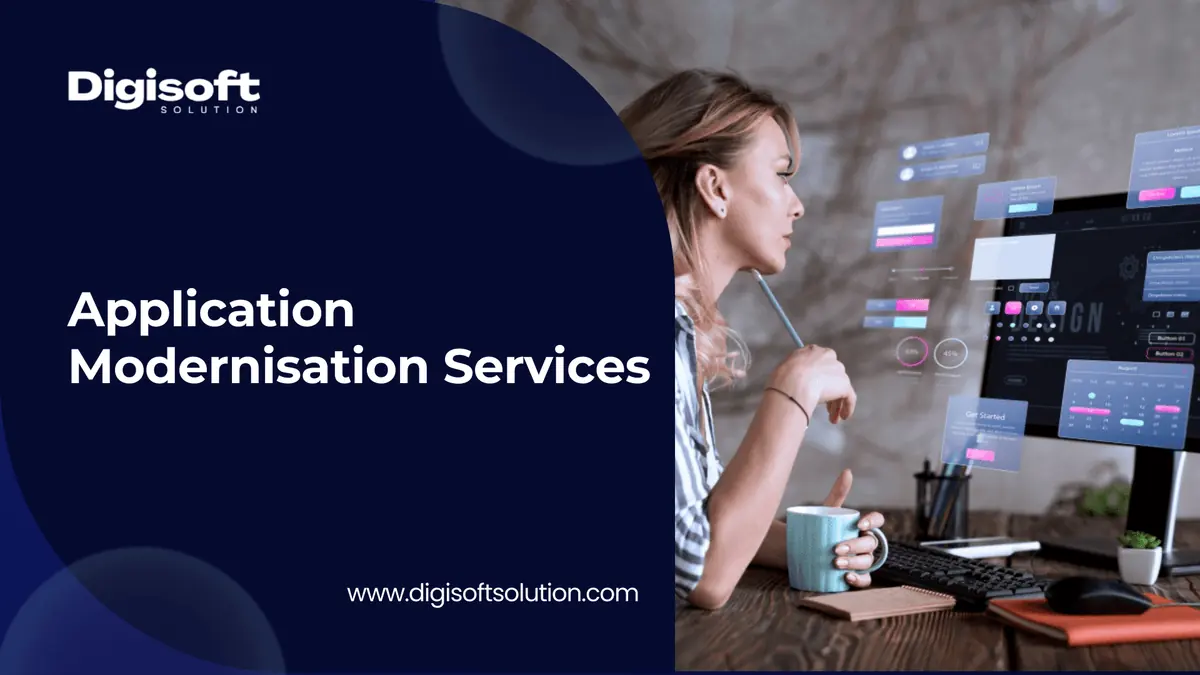
Running outdated applications in 2026 is more than a technical inconvenience - it's a business liability. Legacy systems eat into budgets, slow teams down, and introduce security risks not present among modern competitors. Application modernization is the strategic practice of updating these aging platforms into fast, scalable, cloud-ready platforms; now more than ever, this transformation process must happen in order to remain competitive in 2026.
This guide offers everything you need to know about app modernization: what it entails, why businesses in banking, healthcare, retail, and logistics are prioritizing it, which strategies work well, how to avoid common pitfalls, and how Digisoft Solution assists organizations in making this journey with confidence.
The global application modernization services market was estimated to be valued at USD 25.62 billion in 2026 and is projected to increase at a compound annual growth rate of 15.5% from 2035-2035 - providing ample opportunity to modernize now instead of waiting.
What Is Application Modernization?
Its Application modernization refers to the practice of updating, redesigning, or replacing legacy software applications to better reflect modern business needs and technology standards. This often includes migrating from outdated infrastructure onto cloud platforms; breaking apart monolithic codebases into microservices; integrating APIs; adopting DevOps practices while keeping business operations unaffected, and keeping operations running as scheduled without disruption to operations.
What Counts as a 'Legacy' Application?
- Applications built on outdated languages such as COBOL, PL/1, or RP
- Monolithic systems that cannot be updated without affecting the whole codebase
- On-premise systems that cannot integrate with modern APIs or cloud services
- Apps lacking mobile responsiveness or modern UI/UX standards
- Systems with no automated testing, CI/CD pipelines, or DevOps support
- Software that fails to meet current compliance or cybersecurity standards
Why Application Modernization Is Critical in 2026
A. Legacy Systems Are Draining Your IT Budget
Mainframe systems still account for 70-90% of global financial transactions worldwide, and maintenance of these legacy applications accounts for 60%+ of IT budgets at large enterprises. That budget could otherwise be spent on innovations, new features, and competitive differentiation, but instead, it goes towards keeping old systems alive!
B. Downtime Is Catastrophically Expensive
Outdated monolithic systems run as single units on dedicated servers, and when one component fails, everything does; the average hourly cost of unplanned downtime has exceeded $100K per business. By contrast, modern microservices architecture isolates failures to eliminate this domino effect entirely.
C. Security Vulnerabilities Expand Daily
Legacy applications contain well-documented vulnerabilities in authentication systems, unencrypted data transfers, and outdated protocols - known points of attack for hackers. Every time you rely on unmodernized systems versus their modernized competitors, you are taking risks that they do not bear.
D. Talent Is Departing Legacy Stacks
Modern developers do not prefer working with COBOL or decade-old Java frameworks, as their pool of developers who understand them gradually decreases, making maintenance harder and more expensive to find. By contrast, modernized systems attract superior engineering talent while decreasing turnover-related costs.
E. Your Competitors Are Outpacing You
Companies using cloud-native platforms can often release new features within hours, while legacy systems often take weeks or months for even small modifications to be deployed - creating an undue competitive disadvantage that compounds over time in industries like fintech, e-commerce, and healthcare tech, where rapid innovation is crucial to survival.
Organizations that implement comprehensive modernization programs typically save an average of $19.1 million over three years on application development and infrastructure costs alone.
7 Core Application Modernization Strategies
There's no single approach to application modernization that works for every situation; finding the appropriate strategy depends on factors like complexity, budget, timeline and business goals. Below are seven of the most frequently employed strategies -- often known as '7 Rs':
1. Rehost (Lift and Shift)
Transition the application directly from on-premise to the cloud without making changes to its underlying code or architecture - an efficient method for quickly realizing infrastructure savings without undertaking extensive projects.
- Ideal For: Applications that work effectively but could leverage cloud infrastructure
- Benefits: Timeline: Within weeks to months;
- Risk Level: Low
2. Replatform (Lift, Tinker, and Shift)
Approach cloud services with minor modifications -- for instance, switching from self-managed database services to managed cloud database services without altering core architecture -- while taking advantage of all their benefits without going through a comprehensive overhaul process.
- Perfect For: Applications that are mostly functional but need infrastructure upgrades
- Dateline: 2 to 6 Months:
- Risk level: Associated with such upgrades ranges from Low to Moderate
3. Refactor/Re-architect
To leverage cloud-native features optimally, reorganizing an app's code and architecture - often by breaking it apart into microservices - may require more work but can bring greater performance and flexibility gains in the long term. This approach may prove more complex but it should bring higher long-term returns on your investments.
- Best for: Applications with high scalability or performance requirements\
- Timeline: Longer: 6 to 18+ months
- Risk level: Medium to High (mitigated with phased rollout)
4. Rebuild
To achieve maximum future-proof results, discard existing code and rebuild from scratch using modern architecture and technology stacks. However, this requires substantial investment.
- Best for: Applications where the technical debt is so severe that refactoring is uneconomical
- Timeline: Long — 12 to 24+ months
- Risk level: High (mitigated with parallel operation of old and new systems)
5. Replace
To completely get rid of a legacy app and switch to an off-the-shelf (COTS) or SaaS product that fulfills the same function is to move away from it entirely and replace it with something more suitable, such as COTS products that have proven themselves in other businesses or commercially available solutions that fulfill similar business needs.
- Best for: Applications that solve common business problems already solved by vendors
- Timeline: Variable
- Risk level: Medium (data migration and integration remain key challenges)
6. Retain
Certain applications are too crucial, complex, or expensive to modernize immediately; when this is the case, taking deliberate steps to retain and revisit at a later point may be more appropriate and responsible than trying to implement modernization at once.
- Best for: Mission-critical systems, mid-project or pending regulatory changes
7. Retire
Some legacy applications no longer provide business value and should be retired in order to free up budget, reduce security surface area, and simplify the IT portfolio. By doing this, you will free up budget, decrease security surface area, and streamline portfolio structure.
At Digisoft Solution, our assessment process begins by mapping each application in your portfolio against its business value and modernization cost - to ensure we never waste resources modernizing something which should be retired or replaced altogether.
Top Application Modernisation Trends Shaping 2026
1. AI-Powered Modernization
Artificial intelligence is revolutionizing how modernization works. AI-powered tools are now capable of automatically analyzing legacy codebases - automatically detecting dependencies, mapping data flows, flagging security vulnerabilities, and suggesting refactoring strategies; work that previously took teams months of manual analysis. 91% of tech companies worldwideare prioritizing GenAI investment while over 80% plan to adopt GenAI APIs by 2026 - revolutionizing modernization efforts with faster, smarter, and lower risk results.
2. Cloud-Native as the New Default\
Cloud-native has become more than an advanced option; it is the standard expectation. According to IDC projections, by 2026, 90% of applications should have been cloud native applications utilizing Kubernetes, containers, and microservices to provide independent scaling, fault isolation, faster deployment cycles, and independent scaling strategies. At least 30% of developers deploy hybrid cloud environments while 23% utilize multi-cloud environments, indicating that cloud strategies have become more complex, not less.
3. Microservices and API-First Architecture
Microservices architecture deconstructs large applications into smaller, autonomous services that can be deployed independently from each other. Each service performs one function well and can be scaled independently without risk to other parts of the system. The microservices market is expected to reach $13.1 billion by 2033. Coupled with API first design philosophies -- where APIs are created before applications around them -- businesses create systems that integrate seamlessly with emerging technologies they have not even adopted yet, as 71% of online traffic travels via APIs today.
4. DevSecOps
Security Built In Modernization articles often gloss over an important element of modernization: embedding security directly into the modernization process itself rather than bolting it on later. Legacy modernization that simply relocates existing vulnerabilities onto more expensive infrastructure does not constitute true modernization - it merely shifts existing issues elsewhere. DevSecOps integrates security testing and compliance validation at every stage of development and deployment to ensure new systems are created securely by design.
5. Low-Code and No-Code Integration
By 2026, an estimated 70% of new apps will use low-code or no-code technologies as some component. These platforms can be especially helpful for modernization projects to bridge legacy systems with modern services, create frontends for outdated backends, automate workflows across multiple systems and automate workflows between systems. Unfortunately, most vendors fail to mention one important caveat when selling low-code technologies - it must be combined with proper governance, API standards, and architectural guardrails in order to prevent creating technical debt in other ways.
6. Edge Computing for Latency-Sensitive Industries
Edge computing is revolutionizing modernization strategies across industries like manufacturing, healthcare and logistics. By processing data closer to where it's generated -- factory floors, hospitals or distribution centers - edge computing reduces latency while simultaneously cutting bandwidth costs and speeding decision-making speed where milliseconds matter.
7. Progressive Web Apps (PWAs)
Modernization projects often prioritize backend infrastructure over user experience on the front end, leaving frontend functionality out of consideration. Progressive Web Apps bridge that gap, providing app-like experiences directly within browsers with offline support, faster loading times, and higher user engagement - at a fraction of the cost associated with building native apps from scratch. PWAs represent one of the highest return investments for legacy customer-facing legacy apps available to organizations today.
Industry-Specific Modernization: What Each Sector Needs
Banking and Financial Services
- Modernize core banking systems to support real-time digital payments and open banking APIs
- Migrate from mainframe to cloud-native infrastructure without disrupting 24/7 operations
- Implement modern encryption, multi-factor authentication, and regulatory compliance frameworks
- Build microservice layers that allow rapid deployment of new financial products
Healthcare
- Upgrade electronic health record (EHR) systems for interoperability and telemedicine integration
- Ensure HIPAA compliance and modern data encryption across all patient data systems
- Enable secure real-time data sharing across care providers
- Modernize patient portals with mobile-responsive, accessible interfaces
Retail and E-Commerce
- Modernize inventory, order management, and payment systems for omnichannel retail experiences
- Integrate AI-driven personalization and recommendation engines into existing platforms
- Migrate from monolithic e-commerce platforms to headless commerce architectures
- Build APIs that connect physical and digital retail touchpoints seamlessly
Logistics and Supply Chain
- Adopt IoT data integration and predictive analytics through modernized middleware
- Build real-time visibility dashboards, replacing legacy spreadsheet-based reporting
- Modernize warehouse management systems for integration with automated and robotic systems
- Create API-first architectures that connect suppliers, carriers, and customers in real time
Manufacturing
- Integrate legacy SCADA and MES systems with modern cloud analytics platforms
- Deploy edge computing for real-time monitoring on production floors
- Modernize quality management and compliance documentation systems
- Connect OT and IT environments securely for unified operational visibility
The Application Modernisation Process: Step by Step
A successful modernisation project follows a structured, phased approach. Rushing any phase creates risk. Here is the process Digisoft Solution follows with every client:
Phase 1: Portfolio Assessment and Discovery
Before writing a single line of new code, conduct a comprehensive audit of your existing application portfolio. Identify every application, map its business value, assess its technical health, and document its integration dependencies.
- Application inventory and dependency mapping
- Business value scoring: high, medium, low
- Technical debt quantification
- Security and compliance gap analysis
- Modernization strategy recommendation per application (Retain, Rehost, Refactor, Replace, Retire)
Phase 2: Roadmap and Prioritization
Not everything can be modernized at once. Prioritize based on business impact, risk, and cost. Quick wins, high-impact, low-complexity modernizations, build momentum and demonstrate value to stakeholders while longer-term projects are underway.
Phase 3: Architecture Design
Define the target architecture before development begins. Decisions made here, microservices vs. modular monolith, public vs. hybrid cloud, API-first vs. data-first, will affect every subsequent decision. Getting architecture right upfront prevents expensive rework later.
Phase 4: Incremental Migration and Development
Execute modernization incrementally using a strangler fig pattern when possible, gradually replacing legacy components with modern equivalents while keeping the legacy system operational. This minimizes business disruption and allows continuous delivery of value throughout the project.
Phase 5: Testing, Security Validation, and Quality Assurance
Automated testing pipelines, security scanning, performance benchmarking, and compliance validation are non-negotiable at this stage. Legacy systems often have undocumented behaviors; thorough testing catches regressions before they reach production.
Phase 6: Deployment and Cutover
Execute a carefully planned cutover with clear rollback procedures. Modern deployments use blue/green or canary release strategies to reduce cutover risk. Once the new system is live, monitor closely for performance anomalies and user experience issues.
Phase 7: Optimization and Continuous Improvement
Modernization is not a one-time event. Once the new system is live, continuous monitoring, performance optimization, and iterative feature development keep it current. Establish KPIs, uptime, deployment frequency, error rates, cost per transaction, and track them systematically.
Common Application Modernisation Mistakes to Avoid
Most modernization failures don't arise from technical challenges alone - rather, they stem from organizational decisions made during modernization projects that often backfire. Here are the mistakes businesses commonly make during this process and ways they can avoid making them:
Mistake 1: Treating Modernization as a One-Off Project
Treating modernization as one giant undertaking usually results in cost overruns, schedule delays, and business disruption. By taking gradual and phased approaches with lower risk and shorter timelines for implementation. Break up your portfolio into manageable chunks according to business priority for optimal outcomes.
Mistake 2: Migrating Technical
Debt to the Cloud: Moving an outdated application to the cloud does not make it modern - instead, it just makes running it more costly. True modernization addresses architectural problems rather than simply infrastructure location alone; so if you plan to lift and shift, be sure to include an action plan for fixing its structural flaws as part of this modernization process.
Mistake 3: Ignoring Data Migration Planning
Data migration is often underestimated when planning modernization projects, since legacy databases contain years of disparate, duplicated and undocumented information that must be moved across. A dedicated data migration strategy must form part of your modernization plan to ensure proper cleansing, validation and reconciliation efforts can occur during migration.
Mistake 4: Ignoring Change Management
People who support legacy systems have developed workarounds and institutional knowledge around them; modernization projects that offer excellent technology without prioritizing user adoption will ultimately fail. Therefore, invest in change management, training, and internal communication from day one for successful modernization projects.
Mistake 5: No Clear Business Metrics
Modernization projects without clear success criteria run the risk of becoming technically complete but non-business relevant. Establish clear, measurable outcomes prior to modernization - such as cost reduction targets, performance benchmarks, or deployment frequency goals - and monitor them throughout your program.
Mistake 6: Selecting an Unsuitable Partner
Application modernization is a long-term, high-stakes undertaking that must be carefully approached. Selecting a partner based solely on price or brand recognition alone would be foolish; rather, an ideal partner has proven domain expertise, structured methodology, transparent communications channels, and genuine accountability for results.
How to Measure Modernization ROI
One topic most competitors avoid in their articles: how do you actually prove that your modernization investment paid off?
Here are the metrics you should be tracking:
|
Metric |
Before Modernization |
Target After Modernization |
|
Deployment Frequency |
Monthly or quarterly |
Daily or weekly |
|
Mean Time to Recovery (MTTR) |
Hours or days |
Minutes to hours |
|
Infrastructure Cost |
High fixed CapEx |
Variable OpEx, 30–50% reduction |
|
Application Downtime |
Frequent unplanned outages |
99.9%+ uptime SLA |
|
Security Incident Rate |
High exposure surface |
Dramatically reduced vulnerabilities |
|
Developer Onboarding Time |
Weeks to months |
Days |
|
Feature Delivery Speed |
Months per feature |
Weeks or days per feature |
Related Read: Application Modernization Companies in 2026
Why Choose Digisoft Solution?
There are many vendors offering application modernization services. Here is why businesses choose Digisoft Solution for their modernization programs:
12+ Years of Software Engineering Experience
Since our founding, we have delivered over 700+ successful software projects across diverse industries. That accumulated experience means we have seen — and solved — the edge cases and unexpected challenges that derail modernization projects at less experienced firms.
Full-Stack Modernization Capability
From cloud migration and microservices re-architecture to UI/UX redesign, quality assurance, and digital marketing, Digisoft Solution provides end-to-end modernization support. You work with one accountable partner instead of coordinating between multiple specialized vendors.
Deep .NET and Microsoft Stack Expertise
As a leading .NET development firm, we have particular depth in modernizing applications built on Microsoft stacks, migrating legacy ASP.NET, WinForms, and classic MVC applications to modern .NET Core, cloud-native microservices, and Azure-hosted platforms.
Outcome-Driven Engagement Model
We do not bill hours and deliver code. We define business outcomes with you upfront, performance targets, cost reduction goals, and deployment metrics, and structure our engagement around achieving them. Your success is our scorecard.
Transparent, Milestone-Based Delivery
Every modernization engagement is broken into defined phases with clear deliverables, milestones, and sign-off points. You always know what is being built, when it will be delivered, and how much it will cost. No surprise invoices. No scope creep without your explicit approval.
Dedicated Development Teams
Our dedicated team model means you get consistent engineers who understand your codebase deeply over time, not a rotating cast of consultants who are always climbing a learning curve at your expense.
500+ Satisfied Clients Globally
Our client base spans startups, SMEs, and large enterprises across North America, Europe, and Asia-Pacific. Whatever your industry, scale, or technology stack, we have almost certainly modernized something similar before.
Ready to start your modernization journey? Schedule a free consultation and application portfolio assessment.
Application Modernization by Business Size
For Startups and Growing SMEs
If you built your initial product quickly to get to market and are now struggling with technical debt that slows new feature development, modernization at this stage means re-architecting your core product for scale before the debt compounds further. The earlier you address it, the cheaper it is.
- Priority: API-first architecture, CI/CD pipeline establishment, cloud migration
- Common challenge: Limited budget requiring phased, incremental approach
- Digisoft Solution advantage: Flexible engagement models with milestone-based billing
For Mid-Market Enterprises
Mid-market companies often have a mix of newer SaaS tools and legacy operational systems that were never designed to work together. Modernization here focuses heavily on integration architecture, data unification, and creating a platform that scales with growth without proportional increases in operational costs.
- Priority: Integration layer modernization, data platform consolidation, workflow automation
- Common challenge: Multiple disconnected systems with overlapping functionality
- Digisoft Solution advantage: Experience designing enterprise integration architectures across complex tech stacks
For Large Enterprises
Enterprise modernization is a portfolio-level program spanning multiple years and hundreds of applications. The challenge is not just technical — it is organizational: aligning business units, managing change across thousands of users, and maintaining governance across a sprawling IT estate.
- Priority: Portfolio rationalization, mainframe migration, cloud center of excellence establishment
- Common challenge: Political complexity, risk aversion, and fear of disrupting mission-critical systems
- Digisoft Solution advantage: Proven phased methodology with parallel operation strategies that minimize business risk
Frequently Asked Questions (FAQs)
1. How long will application modernization take?
Timelines vary significantly based on scope. Rehosting one application typically takes 4-8 weeks while revamping an entire enterprise application portfolio can take 2 to 4 years via phased delivery programs. Most organizations see significant early results within three to six months through these methods of modernization.
2. How much does application modernization cost?
The answer depends on factors like application complexity, strategy chosen, team size and timeline. Simple rehost projects typically range between $10,000 and $30,000. Complex enterprise system re-architecture programs may cost from $100,000 up to multiple millions dollars - the real comparison should always be "what would the cost of not modernizing be?" This includes ongoing maintenance expenses, security incidents, lost revenues due to outages as well as competitive erosion.
3. Are we modernizing without disrupting current operations?
Yes - with the appropriate strategy. Phased approaches such as the strangler fig pattern allow you to gradually replace legacy components while keeping existing systems operational during cutover periods, with both systems continuing operations concurrently as standard practice for mission-critical applications.
4. What Happens During Data Migration?
Data migration is one of the cornerstones of modernization projects, necessitating careful and dedicated planning which includes profiling, cleansing, transformation mapping, migration testing and reconciliation validation. At Digisoft Solution, data migration planning is treated as an integral component of every engagement and not an afterthought.
Will We Need to Modernize All Applications, or Only Certain?
Not all applications merit equal modernization efforts; portfolio assessment helps prioritize apps based on business value and technical health - some may require being rearchitected, rehosted, replaced with commercial products or even retired entirely as appropriate measures of modernization are pursued. A good modernization strategy should focus on selective modernization rather than blanket modernization plans.
Application modernization does not correspond with cloud migration in its entirety; rather, cloud migration is one strategy used in application modernization - specifically, the rehosting or replatforming approach. True modernization may involve changing microservice architectures, rebuilding user interfaces, implementing DevOps practices, incorporating AI capabilities, or strengthening security beyond simply moving to the cloud.
Related Read: Legacy System Modernization in Healthcare and Pharma
Final Word
Every time you delay application modernization, your technology capabilities lag further behind those of competitors. Legacy systems accumulate more technical debt, security vulnerabilities and fall further behind modern integration standards; modernizing costs increase as workarounds become deeper entangled, while opportunity costs -- features not shipped, customers not served and talent unhired -- continue to compound silently but steadily
Digital Transform with Us
Please feel free to share your thoughts and we can discuss it over a cup of coffee.