Table of Content
- The Scale of the Problem Has Gotten Bigger
- Digital Transformation Demands It
- Regulatory Compliance Is Trickier Without It
- Point-to-Point Integration
- Hub-and-Spoke Architecture
- Enterprise Service Bus (ESB)
- Event-Driven Architecture (EDA)
- API-Led Connectivity
- Data Integration Services
- Application Integration Services
- B2B Integration Services
- Cloud Integration Services
- Microservices Integration
- What Is iPaaS?
- Leading iPaaS Platforms in 2026
- MuleSoft Anypoint Platform
- Dell Boomi
- Workato
- Microsoft Azure Integration Services
- AWS EventBridge and AppFlow
- Apache Kafka
- The Hidden Cost Problem
- iPaaS Platform Pricing Comparison
- Custom Integration Development Cost Breakdown
- 3-Year Total Cost of Ownership Example
- Define Your Integration Complexity First
- Evaluate Based on These Technical Criteria
- Consider Total Cost, Not Just License Cost
- Proof of Concept Before Full Commitment
- Underestimating Legacy System Complexity
- Neglecting Error Handling
- Treating Integration as a One-Time Project
- Choosing Platform Based on Marketing, Not Architecture Fit
- Ignoring Data Governance
- Enterprise Application Integration (EAI)
- Enterprise Service Bus (ESB)
- API Management
- iPaaS
- What We Actually Do
- Integration Architecture and Assessment
- Custom API Development and Integration
- iPaaS Implementation and Configuration
- Event-Driven Architecture Design
- Legacy System Integration
- Ongoing Integration Monitoring and Support
- Why Clients Choose Digisoft Solution for EAI
- Our Integration Technology Stack
- What is the difference between EAI and API integration?
- How long does enterprise application integration take?
- What is an enterprise integration platform as a service?
- Is EAI only for large enterprises?
- What is the ROI of enterprise application integration?
- How does EAI relate to digital transformation?
Digital Transform with Us
Please feel free to share your thoughts and we can discuss it over a cup of coffee.
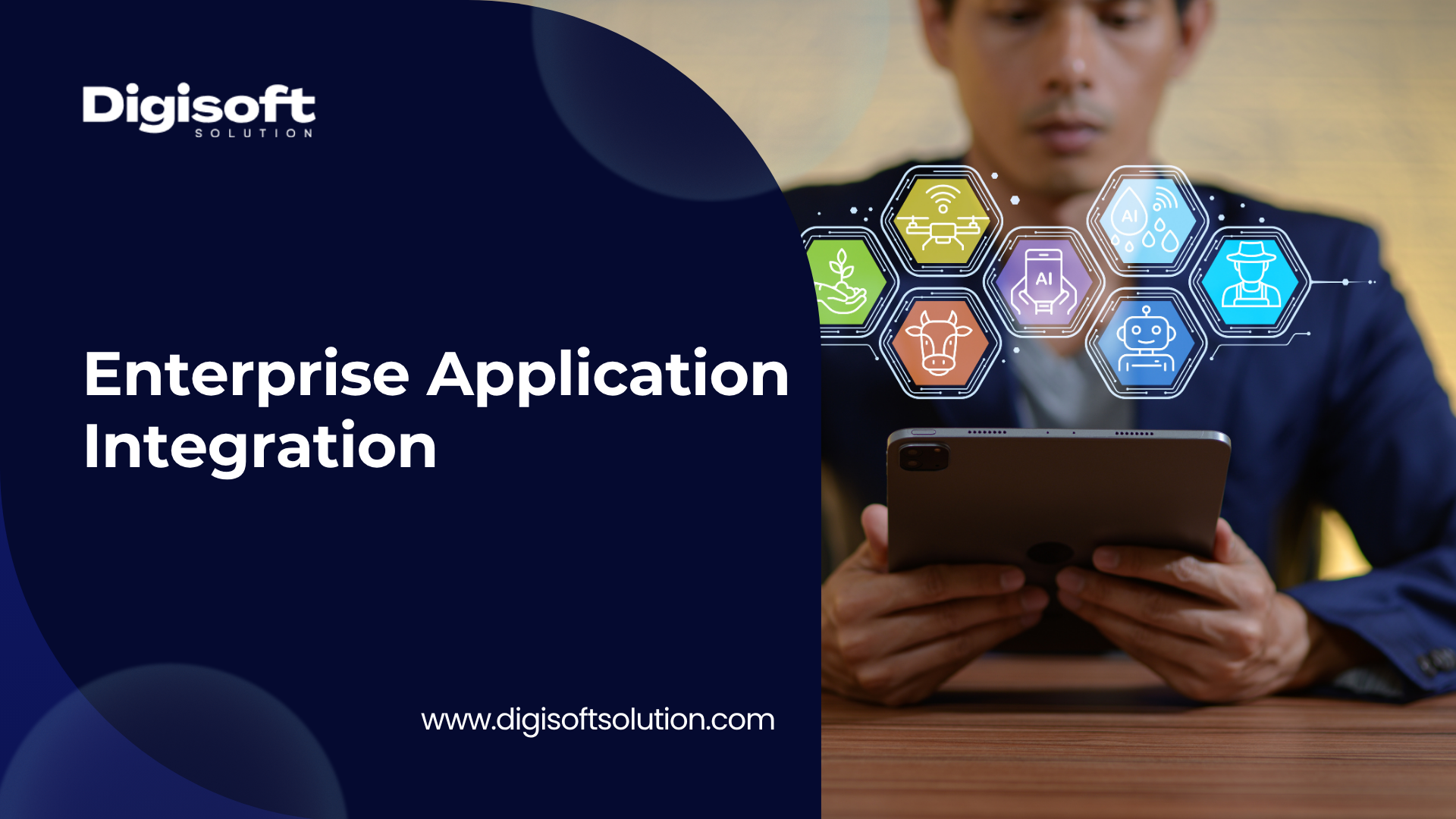
Enterprise Application Integration (EAI) is basically the process of connecting different software systems inside an organization so they can share data, trigger actions, and work together as one unified digital environment instead of sitting around as isolated silos.
In plain terms, EAI is what lets your CRM know when a new order comes in from your e-commerce platform. Its what allows your HR system to automatically provision accounts when you onboard a new hire. Its what stops your finance team from manually exporting Excel files every Monday morning.
From a technical standpoint, EAI involves a few key things:
- A middleware layer that sits between applications and manages message routing
- Data transformation logic that converts formats between systems (like JSON to XML)
- Connectors and adapters for each application in your ecosytem
- Orchestration rules that define when and how data flows
- Error handling and retry mechanisms to handle failures gracefully
Large organizations can have anywhere from 50 to over 500 individual software applications. Without enterprise integration services, each of those systems basically becomes its own island. Business decisions slow down. Data becomes inconsistent. Employees duplicate work. And IT teams spend more time firefighting than actually building things.
Why Enterprise Integration Services Matter in 2026
The Scale of the Problem Has Gotten Bigger
A decade ago, most businesses had maybe a dozen software tools to manage. Today, the average enterprise runs well over 200 SaaS applications, legacy systems, cloud platforms, and custom-built tools. Every time you add a new tool without integrating it properly, you're adding another silo.
According to integration research, only about 29% of enterprise applications are actually synchronized in real time. That means 71% of data across most enterprises is either stale, duplicated, or sitting in a system that nobody else can see. That's a pretty big deal when you think about it.
Digital Transformation Demands It
Cloud migration, microservices architectures, AI-powered workflows, IoT deployments, these all require robust integration underneath. You really can't build a modern digital business on top of disconnected systems. Enterprise application integration services are quite literally the plumbing that makes digital transformation possible.
Regulatory Compliance Is Trickier Without It
For businesses in healthcare, finance, or government, data governance and audit trails depend on knowing where data lives and how it moves. Integrated systems make it far easier to demonstrate compliance with GDPR, HIPAA, SOC 2, and similiar frameworks.

Core EAI Patterns and Architectures
Point-to-Point Integration
This is the simplest and also the most dangerous approach at scale. You connect System A directly to System B with a custom script or API call. It works fine for two or three connections. But as the number of systems grows, you end up with what architects call a "spaghetti architecture". N systems = N*(N-1)/2 potential point-to-point connections. For 20 systems, thats 190 individual integrations to maintain.
Hub-and-Spoke Architecture
In a hub-and-spoke model, all systems communicate through a central hub rather than directly with each other. The hub handles routing, transformation, and orchestration. This dramatically reduces complexity. Instead of N*(N-1)/2 connections, you have N connections total. The downside is that the hub becomes a single point of failure, and it can become a bottleneck at high data volumes.
Enterprise Service Bus (ESB)
An ESB evolved from the hub-and-spoke model but adds more sophistication. Think of it like a city's transit system. Instead of one central hub, there's a distributed bus network with defined routes and stops. Applications publish messages to the bus, and the bus routes them to the appropriate subscribers.
ESBs support things like:
- Message transformation and enrichment
- Protocol conversion (REST to SOAP, for example)
- Content-based routing
- Orchestration of multi-step workflows
- Message queuing and guarenteed delivery
Traditional ESBs like IBM MQ, Oracle Service Bus, and TIBCO are powerful but expensive, and they tend to be pretty heavy to manage.
Event-Driven Architecture (EDA)
This is increasingly how modern enterprise integration works. Instead of systems polling each other for data changes, systems emit events when something happens. Other systems subscribe to the events they care about and react accordingly.
Kafka, RabbitMQ, and AWS EventBridge are common event streaming platforms. EDA enables real-time integration, is easier to scale horizontally, and keeps systems loosely coupled — which makes individual systems easier to replace or upgrade without breaking everything else.
API-Led Connectivity
Made popular by MuleSoft, API-led connectivity organizes integration into three layers:
- System APIs: Unlock data from core systems like ERP, CRM, or databases
- Process APIs: Orchestrate multiple system APIs to implement business processes
- Experience APIs: Deliver tailored data to specific channels like mobile apps, portals, or partner integrations
This approach creates reusable building blocks that accelerate future integrations significantly.
Types of Enterprise Application Integration Services
When people talk about enterprise application integration services, they're actually referring to several different service categories. Knowing the difference matters when your evaluating vendors or planning a project.
Data Integration Services
These services focus on moving and synchronizing data between systems. This includes ETL (Extract, Transform, Load) pipelines, real-time data synchronization, and data quality management. Tools like Azure Data Factory, AWS Glue, Informatica, and Fivetran live in this space.
Application Integration Services
This is the broader category that connects applications at the process and workflow level, not just the data level. A sales order in your e-commerce platform triggering a fulfillment workflow in your ERP and a notification in your CRM, that's application integration.
B2B Integration Services
This specifically handles integration with external partners, suppliers, or customers. EDI (Electronic Data Interchange) is still common here, especially in retail, logistics, and manufacturing.
Cloud Integration Services
Connecting on-premises systems to cloud applications, or connecting multiple SaaS platforms to each other. Tools in this category include MuleSoft Anypoint, Dell Boomi, Workato, and Zapier (for lighter use cases).
Microservices Integration
As organizations decompose monolithic systems into microservices, they need patterns like service meshes, API gateways, and event streaming to keep services connected. If your doing enterprise software development, this is increasingly the default architecture.
Enterprise Integration Platform as a Service (iPaaS)
What Is iPaaS?
Enterprise integration platform as a service (iPaaS) is a cloud-delivered platform that provides the tools, connectors, and runtime environment for building and managing integrations. Instead of installing and maintaining middleware on your own servers, you subscribe to a platform that handles the infrastructure.
iPaaS providers typically offer:
- Pre-built connectors for hundreds of popular applications
- Visual drag-and-drop workflow designers for non-technical users
- API management capabilities
- Monitoring, logging, and alerting dashboards
- Security and compliance features
Leading iPaaS Platforms in 2026
MuleSoft Anypoint Platform
MuleSoft is widely considered the most powerful enterprise iPaaS on the market. Gartner has named it a Leader in API Management for over 10 consecutive years. However, power comes with cost — which we'll break down in detail below. It uses a proprietary transformation language called DataWeave, which creates developer dependency and switching costs over time.
Dell Boomi
Boomi is often compared to MuleSoft but is generally considered more accessible to mid-market companies. It has strong low-code capabilities, a large connector library, and more transparent pricing. Entry-level plans start around $99/month, though enterprise deployments cost significantly more.
Workato
Workato has gained significant traction for being business-user-friendly while still handling genuinely complex enterprise workflows. Pricing is task-based rather than vCore-based, which can make costs more predictable for certain use cases.
Microsoft Azure Integration Services
For organizations already invested in the Microsoft ecosytem, Azure's suite (Logic Apps, API Management, Service Bus, Event Grid) provides native integration capabilities with strong Azure DevOps and Microsoft 365 synergies.
AWS EventBridge and AppFlow
Amazon's offerings work best for AWS-centric architectures. EventBridge handles event routing between AWS services and SaaS applications, while AppFlow simplifies data integration between AWS and common SaaS platforms.
Apache Kafka
Not technically an iPaaS but worth mentioning. For high-throughput, real-time event streaming, Kafka is the industry standard. Its open source, highly scalable, and battle-tested at massive scale. Confluent offers a managed cloud version if you don't want to self-host.
Real Cost of Enterprise Application Integration
The Hidden Cost Problem
Many blog posts cite entry-level prices that sound reasonable. "$99/month for Boomi!" or "MuleSoft starts at just..." But these numbers are genuinely misleading for real enterprise deployments. The total cost of ownership (TCO) for EAI is almost always 2 to 4 times the platform licensing fee in year one alone — and that's before you account for ongoing maintainance.
Here's what actually goes into the cost:
- Platform licensing (what vendors quote you)
- Implementation and configuration (often 2-3x the license cost in year 1)
- Specialist developer salaries or consultant fee
- Training and certification
- Ongoing maintenance, monitoring, and support
- Infrastructure costs if self-hosting any components
iPaaS Platform Pricing Comparison
|
Platform |
Entry-Level Cost |
Mid-Market Annual |
Enterprise Annual |
Notes |
|
MuleSoft Anypoint |
Free trial only |
$50,000–$120,000 |
$200,000–$600,000+ |
No public list pricing; negotiated contracts. Median ~$55,150/yr |
|
Dell Boomi |
$99/mo + $0.05/msg |
$15,000–$40,000 |
$60,000–$150,000+ |
More transparent pricing than MuleSoft |
|
Workato |
Contact sales |
$10,000–$25,000 |
$120,000–$300,000+ |
Task-based pricing; 283% reported 3-yr ROI |
|
Zapier Enterprise |
$799/mo (~$9,588/yr) |
$20,000–$72,000 |
Custom |
Better for simple automations, not full EAI |
|
Azure Integration Services |
Pay-as-you-go |
$5,000–$30,000 |
$50,000–$200,000+ |
Cost varies by message volume and services used |
|
Integrate.io |
$1,999/mo |
$24,000/yr flat |
Custom |
Flat-rate, unlimited data volumes |
Custom Integration Development Cost Breakdown
|
Integration Type |
Typical Development Cost |
Notes |
|
Simple one-way API integration (2 systems) |
$2,000–$15,000 |
Basic webhook or REST API connection |
|
Moderate multi-step workflow (3-5 systems) |
$15,000–$40,000 |
Includes data transformation and error handling |
|
CRM to ERP integration with legacy systems |
$20,000–$50,000 |
Legacy data compatibility adds significant complexity |
|
Complex multi-system enterprise hub |
$50,000–$150,000+ |
Full orchestration, error handling, monitoring |
|
Fintech or healthcare with compliance requirements |
$150,000–$800,000 |
Regulatory adherence adds substantial validation work |
Note: These are development costs only. Add 20-30% annually for ongoing maintenance and monitoring.
3-Year Total Cost of Ownership Example
Let's say a mid-sized business builds a moderately complex integration (5 systems, bidirectional sync, error handling):
|
Year |
Cost Component |
Amount |
|
Year 1 |
Development / implementation |
$40,000 |
|
Year 1 |
iPaaS platform license (e.g., Boomi mid-tier) |
$25,000 |
|
Year 1 |
Training and onboarding |
$5,000 |
|
Year 2 |
Annual license renewal |
$25,000 |
|
Year 2 |
Maintenance and updates |
$10,000 |
|
Year 3 |
Annual license renewal |
$28,000 (typical 10-15% increase) |
|
Year 3 |
Maintenance and additional integrations |
$15,000 |
|
3-Year Total |
|
$148,000 |
Many businesses look at the $25,000/year platform fee and think that's their budget. The 3-year TCO in this example is nearly 6x that. Budget accordingly.
How to Choose the Right EAI Partner or Platform
Define Your Integration Complexity First
Before talking to any vendor, you should map out:
- How many systems need to be connected
- Whether you need real-time or batch processing
- The data volumes involved (messages per day/month)
- Whether you have legacy systems with non-standard protocols
- Your internal technical capabilities and team size
This scoping exercise will immediately rule out certain platforms and zero in on the right tier.
Evaluate Based on These Technical Criteria
- Connector library: Does the platform have pre-built connectors for your specific systems? Building connectors from scratch adds significant cost.
- Transformation capability: How well does the platform handle data mapping and transformation? Complex schemas need powerful tools.
- Error handling and retry logic: What happens when an integration fails mid-flow? You need guarenteed delivery for business-critical data.
- Monitoring and observability: Can you see exactly what's happening across all your integrations in real time?
- Security and compliance: Does the platform support OAuth 2.0, field-level encryption, data masking, and your specific compliance frameworks?
- Scalability: Can it handle 10x your current message volume without a platform upgrade or re-architecture?
Consider Total Cost, Not Just License Cost
Ask vendors for a full TCO breakdown including implementation, required headcount, training, and typical first-year costs. Get it in writing. If they resist, that tells you something.
Proof of Concept Before Full Commitment
Before signing any enterprise contract, run a proof of concept on your two or three most complex integration scenarios. The POC will surface hidden complexity and cost overruns before you're locked into a contract.

Common Mistakes Companies Make With EAI
Underestimating Legacy System Complexity
Legacy systems often have no documented APIs, use proprietary protocols, and have data schemas that evolved organically over decades. What looks like a two-week integration project in a demo environment can turn into a six-month engagement once your team actually touches the legacy system.
Neglecting Error Handling
Most integration demos show the happy path, where data flows perfectly every time. In production, APIs go down, messages get malformed, duplicate records appear, and timeouts happen. If your integration doesn't have robust error handling, retry logic, and dead-letter queues, you will lose data in production. This is one of the most common and costly oversights.
Treating Integration as a One-Time Project
Integration is not a project with a finish line. Systems get upgraded. APIs change. New tools get added. New compliance requirements appear. Integration needs ongoing management, monitoring, and maintenence as a continuous operational function — not a one-time IT project.
Choosing Platform Based on Marketing, Not Architecture Fit
Some vendors have very large marketing budgets and impressive demo environments. Always evaluate based on your actual technical requirements and documented use cases. Ask for reference customers with similiar architecture to yours.
Ignoring Data Governance
When you start moving data between systems automatically, data quality and governance become critical. Who owns the master record when two systems have conflicting data? What happens if personally identifiable information flows to a system that isn't compliant? These questions need answers before go-live, not after.
EAI vs. ESB vs. API Management: What's the Actual Difference?
A lot of people use these terms interchangeably and that's not quite right. Here's a clear breakdown:
Enterprise Application Integration (EAI)
The broadest term. EAI describes the overall discipline and goal of connecting enterprise applications. It encompasses every approach and technology used to achieve application connectivity.
Enterprise Service Bus (ESB)
A specific architectural pattern and category of software for implementing EAI. An ESB is the middleware that routes messages between applications. It's one approach to EAI, not a synonym.
API Management
API Management is specifically about managing the lifecycle of APIs — including design, documentation, security, rate limiting, analytics, and developer portals. It's often a component within a larger EAI or iPaaS solution but solves a narrower problem.
iPaaS
iPaaS is a cloud-hosted platform that typically includes ESB-like integration capabilities plus API management, workflow automation, and a pre-built connector library. MuleSoft, Boomi, and Workato are iPaaS platforms.
How Digisoft Solution Helps With Enterprise Application Integration
At Digisoft Solution, we've been building and integrating enterprise software systems for over 12 years. We've delivered more than 700 digital platforms, and we know that integration is usually the hardest part of digital transformation. Not because the concepts are complex, but because the details are messy, legacy systems are unpredictable, and getting data flows right in production takes real engineering discipline.
What We Actually Do
We don't just connect systems. We architect integration solutions that are maintainable, observable, and built to scale. Here's what that looks like in practice:
Integration Architecture and Assessment
Before writing a single line of code, we map your existing application ecosystem, document data flows, identify dependencies, and design an integration architecture that fits your actual technical environment. Many clients come to us after a failed integration project. The diagnosis is almost always the same — they skipped the architecture phase.
Custom API Development and Integration
We build RESTful APIs, GraphQL endpoints, webhook handlers, and custom connectors for applications that don't have standard integration points. Our developers have experience connecting everything from modern cloud-native SaaS platforms to 30-year-old mainframe systems.
iPaaS Implementation and Configuration
If your requirements fit an iPaaS platform like MuleSoft, Boomi, or Azure Integration Services, we can implement, configure, and manage it for you. We'll also help you evaluate platforms objectively so you don't overpay for capabilities you don't need.
Event-Driven Architecture Design
For organizations that need real-time data flows at scale, we design and implement event-driven architectures using Kafka, RabbitMQ, AWS EventBridge, or Azure Service Bus.
Legacy System Integration
Legacy systems are our speciality, not our nightmare. We have experience building adapters, middleware layers, and ETL pipelines that bridge the gap between outdated on-premises systems and modern cloud platforms, without requiring a full legacy system replacement.
Ongoing Integration Monitoring and Support
We don't disappear after go-live. Our managed support teams monitor integration pipelines, handle failures, manage upgrades, and ensure your integrations keep working as your underlying systems evolve.
Why Clients Choose Digisoft Solution for EAI
- 12+ years of enterprise engineering experience across diverse industries and tech stacks
- 700+ digital platforms delivered, including complex multi-system enterprise applications
- 95%+ client retention rate because we build relationships, not just integrations
- Senior engineers (5-15+ years experience) assigned to your project, not juniors learning on your budget
- Transparent project scoping with realistic cost and timeline estimates before you commit
- Agile delivery with 2-week sprint cycles and continuous visibility into progress
Our Integration Technology Stack
- API Frameworks: REST, GraphQL, gRPC, SOAP, WebSockets
- Message Brokers: Apache Kafka, RabbitMQ, AWS SQS/SNS, Azure Service Bus
- iPaaS Platforms: MuleSoft, Dell Boomi, Azure Integration Services, AWS AppFlow
- Languages and Runtimes: .NET/C#, Node.js, Python, Java, Go
- Cloud Platforms: AWS, Azure, Google Cloud, hybrid and multi-cloud environments
Frequently Asked Questions
What is the difference between EAI and API integration?
API integration is a specific technique — where two systems communicate via APIs. EAI is the broader discipline of connecting enterprise applications and includes API integration as one of many approaches. EAI can also involve message queues, event streaming, ETL pipelines, ESBs, and custom middleware.
How long does enterprise application integration take?
It depends heavily on complexity. A simple point-to-point integration between two modern cloud applications can take 2 to 4 weeks. A comprehensive multi-system integration hub for a large enterprise with legacy systems involved can take 6 to 18 months. Most real-world enterprise integration projects fall somewhere in between.
What is an enterprise integration platform as a service?
Enterprise integration platform as a service (iPaaS) is a cloud-hosted solution that provides pre-built connectors, workflow designers, API management, and a runtime environment for building and managing integrations without hosting your own middleware infrastructure. Examples include MuleSoft Anypoint Platform, Dell Boomi, Workato, and Azure Integration Services.
Is EAI only for large enterprises?
No. Mid-sized businesses with as few as 10-20 applications can benefit significantly from structured integration. The tools have matured and there are solutions at every price point. Even small businesses using several SaaS tools can benefit from lighter integration tools like Zapier or Make for simpler automation scenarios.
What is the ROI of enterprise application integration?
This varies widely but documented benefits include: elimination of manual data entry (often saving hundreds of hours monthly), faster business decisions from real-time data, reduced error rates from data duplication, faster onboarding of new systems, and improved customer experience from connected business processes. Workato has published a verified 283% ROI over three years for typical deployments, with payback in under six months. Results depend heavily on how many manual processes are being automated.
How does EAI relate to digital transformation?
EAI is fundamental infrastructure for digital transformation. You cannot modernize your business processes, move to cloud systems, or deploy AI and analytics tools without robust integration between your data sources and applications. Integration is the connective tissue of digital transformation — and without it, transformation efforts stall.
Final Thoughts
Enterprise application integration is not an optional IT project anymore. It is the operational foundation that determines how fast your business can move, how reliable your data is, and how quickly you can adopt new technology.
The key things to remember:
- EAI is a discipline, not a single tool or platform
- The real cost of integration is 2 to 4x what vendors quote you upfront
- Architecture decisions made early have a massive impact on long-term cost and maintainability
- Error handling, observability, and governance are as important as the integration logic itself
- The right partner understands both the technology and the messy realities of your specific environment
Enterprise integration done well is genuinely a competitive advantage. Done badly, it becomes a long-running technical debt problem that slows everything down. Choose your approach and your partner carefully.
Digital Transform with Us
Please feel free to share your thoughts and we can discuss it over a cup of coffee.