Table of Content
- Fixed-Price Model
- Key Features
- Advantages
- Disadvantages
- When to Use
- Time & Materials (T&M) Model
- Key Features:
- Advantages
- Disadvantages
- When to Use
- Cost-Plus (Dedicated Team) Model
- Key Features:
- Advantages:
- Disadvantages
- When to Use
- Comparing the Models
- Comparison Table: Fixed vs. T&M vs. Cost-Plus
- Why Digisoft Solution Is a Strong Partner Under All Models
- Practical Recommendations
- Fixed-Price
- Time & Materials
- Cost-Plus (Dedicated Team)
- Conclusion
Digital Transform with Us
Please feel free to share your thoughts and we can discuss it over a cup of coffee.
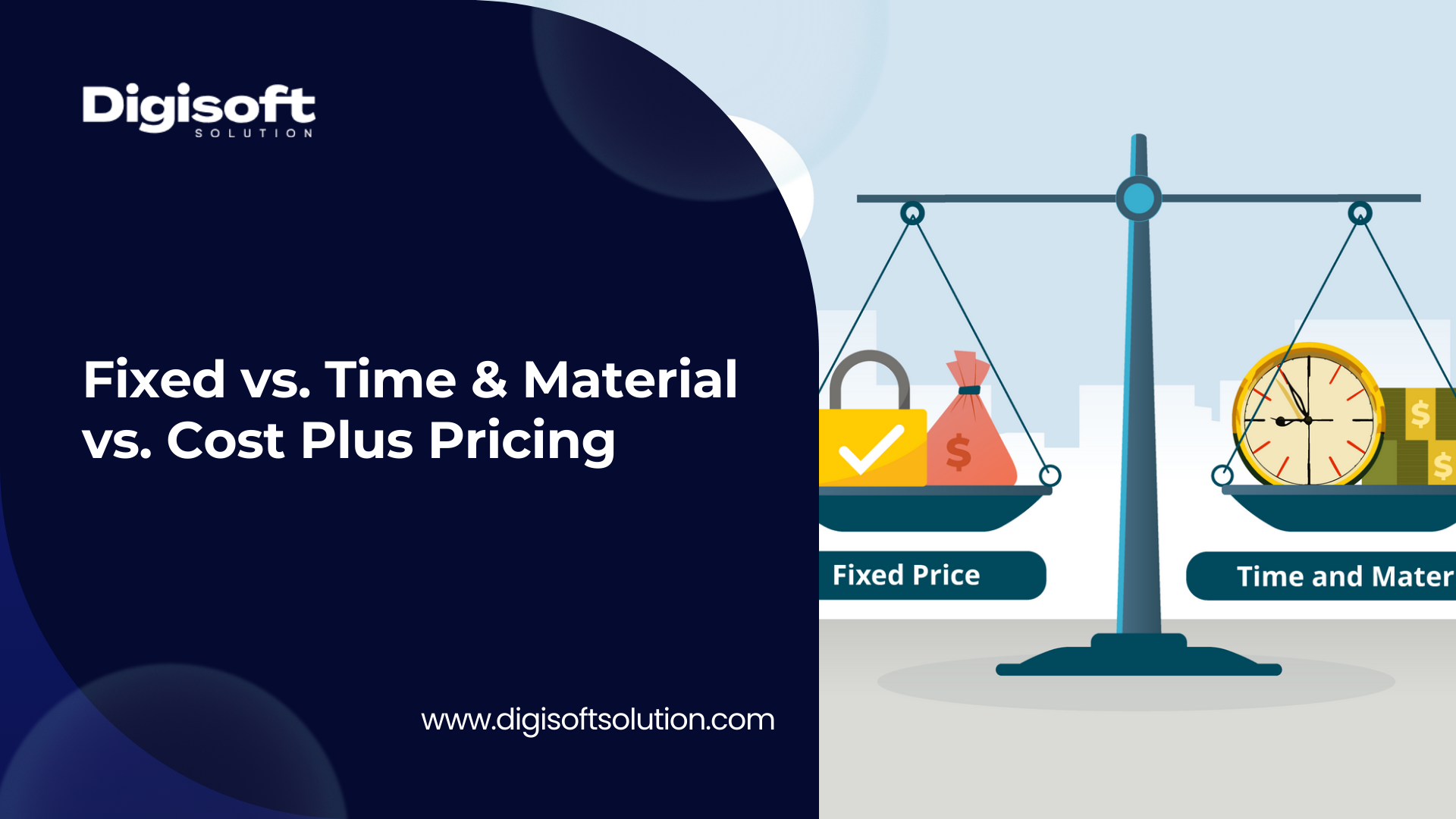
Software development projects can be contracted under various pricing models, Fixed-Price, Time & Materials (T&M), or Cost-Plus (Dedicated team), each balancing cost predictability, flexibility, and risk differently. Choosing the right model is crucial: it affects budget planning, project control, and vendor incentives. Startups, CTOs, and enterprises often decide based on project size, scope stability, and in-house expertise.
For example, Digisoft Solution (a trusted offshore software development company with a strong USA presence) offers all three models: Fixed, T&M, and Dedicated (Cost-Plus), enabling clients to pick the best fit. Below, we compare each model’s features, use cases, advantages, and pitfalls to help you make an informed choice.
Fixed-Price Model
A Fixed-Price contract sets a single, agreed-upon cost for the entire project, defined before work begins. All requirements, features, and timelines must be documented in detail (usually via a Statement of Work). This model works best when the project scope is well understood and unlikely to change. Typical use-cases include small or short-term projects (e.g. an 8–12 week MVP) with clear specs.
Key Features
- Scope and deliverables are fixed upfront
- Detailed requirements and milestones are locked in before development begins.
- The vendor assumes most of the delivery risk.
- Any cost overruns must be absorbed by the vendor.
- Clients pay only after completing the predefined milestones as per the contract.
Advantages
- Budget and timeline are fixed and known from the start.
- You know the exact project cost and the features that will be delivered.
- Reduces the need for active client oversight.
- Allows a more “hands-off” approach, except during milestone reviews.
- Simplifies financial planning and forecasting.
- Makes it easier to compare bids from different vendors on equal terms.
- The vendor bears most of the financial risk, including delays or cost overruns.
Disadvantages
- Very low flexibility once the contract is signed.
- Scope cannot be changed on demand without formal change orders.
- Any new requirements must be negotiated as extra scope (usually at additional cost).
- Preparing a Fixed-Price quote requires a lengthy discovery phase.
- You may spend weeks refining specifications before development can start.
- Vendors often add a 20–50% buffer to protect their margin.
- This buffer can make the project more expensive than flexible models.
- Vendors will deliver only what is documented in the SOW, nothing more.
- Better ideas that appear during development are usually not incorporated without extra cost.
- Fixed-price projects sometimes suffer quality issues as teams rush to fit work within the fixed budget and scope.
When to Use
- Choose Fixed-Price when requirements are very clear and stable.
- Works best when you have a limited budget or a strict timeline.
- Ideal for well-defined add-on features, small enhancements, or MVPs with finalized specifications.
- Suitable for small startups that lack deep technical oversight but need budget certainty.
- Commonly used by enterprises for pilot projects or modules with completed designs.
- Best choice when budget certainty and minimal scope changes are top priorities.
Time & Materials (T&M) Model
In a Time & Materials contract, you pay for the actual hours worked by the development team (at agreed hourly or daily rates) plus any materials or tools used. There is no set total price up front. This model is very flexible: you can adjust requirements, add features, or change direction at any time during the project. T&M contracts align well with Agile development: work is divided into short iterations or sprints, and the client reviews progress regularly.
Key Features:
- There is no fixed total cost
- Scope is expected to evolve throughout the project.
- Planning is done in rolling waves (e.g., Agile sprints).
- The client typically appoints a Product Owner or Project Manager for frequent interaction with the vendor.
- Billing is done periodically (e.g., monthly).
- Timesheets and work logs are transparent for full visibility.
Advantages
- Offers maximum flexibility to adjust the scope at any time.
- You can add, remove, or reprioritize features based on user feedback or market changes.
- Projects can start very quickly, the team begins once basic requirements are defined.
- You pay only for actual work completed.
- No extra charges for vendor overhead (e.g., vacations, internal buffers).
- Hourly or monthly rates remain constant throughout the engagement.
- Encourages innovation since scope is not locked; teams can experiment freely.
- Enables continuous improvement in product quality.
- Best for cutting-edge or complex projects (e.g., AI/ML, R&D, integrations).
- Ideal for startups and long-term products with evolving roadmaps due to its adaptability.
Disadvantages
- Budget is unpredictable because scope and effort can expand during development.
- Final project cost remains unknown until completion.
- Requires active client involvement through frequent reviews and decisions.
- Without strong project management, tasks and timelines may creep, increasing costs.
- Clients bear more risk since the vendor is paid for all hours regardless of efficiency.
- Vendor has less incentive to finish quickly: they get paid whether the release happens or not.
- To mitigate risks, clients must monitor spending through timesheets and regular budget reviews.
- Works best when the client can closely oversee progress and is comfortable with an open-ended budget.
When to Use
- Best suited for projects where the scope is uncertain or likely to change
- Ideal for startups with evolving product ideas or exploratory features.
- Recommended for long-term projects (6–12+ months) where flexibility is essential.
- Commonly chosen by CTOs for Agile teams and fast-changing markets.
- Works well when you already have an experienced technical team (in-house or external) to manage outsourced developers.
- Great for scale-ups adding complex AI features or experimentation-heavy development.
- Perfect for SaaS products with continuous releases and iterative roadmaps.
- Often delivers better speed, quality, and final cost when requirements aren’t fully defined upfront.
Cost-Plus (Dedicated Team) Model
The Cost-Plus model (often implemented as a dedicated development team) is a long-term engagement where you essentially lease a team of vendor-employed specialists who work exclusively on your projects. You pay their salaries (at vendor country rates) plus a fixed overhead fee to the vendor. This is ideal for lengthy projects (1+ year) or when you need to augment an existing in-house team. In practice, Cost-Plus is similar to staff augmentation or a dedicated offshore team – the client manages the team as if in-house, while the vendor handles employment.
Key Features:
- You hire dedicated developers/testers on fixed monthly wages.
- The cost includes vendor overhead such as office space, HR, admin, and infrastructure.
- You select or approve each team member before onboarding.
- The team works under your direction, using Agile, Kanban, Waterfall, or any process you choose.
- Since you pay their salaries, you can scale the team up or down based on workload.
- The vendor provides the personnel, tools, and environment needed for daily operations.
- Pricing is fully transparent; you see the exact salary + vendor fee for every resource.
Advantages:
- High cost efficiency: offshore vendor-country salaries are much lower, often saving clients ~40% or more vs. local hiring.
- Full control: you select, interview, and approve every team member before they join.
- Vendor support: the vendor’s HR team handles sourcing and shortlisting, reducing your workload.
- Fast productivity: dedicated team members often have experience working together, so they “hit the ground running.”
- High performance: teams stabilize quickly and deliver consistently due to familiarity and long-term engagement.
- Knowledge retention: keeping the same developers long-term is ideal for complex, evolving products.
- Scalable capacity: you gain extra expertise and manpower without the cost or hassle of hiring locally
Disadvantages
- High internal responsibility: your organization handles most management, coordination, and day-to-day oversight.
- Potential internal resistance: In-house staff may feel threatened by an offshore team, requiring clear communication and change management.
- Fixed monthly costs: You continue paying salaries, leave, and benefits even during low-work periods or downtime.
- Lower delivery pressure: because the model is month-to-month, the team may have less built-in incentive for rapid delivery.
- Requires strong oversight: Productivity must be monitored closely through proper management, planning, and KPIs.
- Reduced vendor flexibility: You take on more responsibility in exchange for greater control and cost transparency.
- Team operates like your own staff: You effectively “lease” long-term developers: you save on fees but must manage them almost as internal employees.
When to Use
- Best for large or long-term projects where ongoing development capacity is required
- Commonly used by medium-to-large companies that already have an internal engineering team and want to augment it with additional or specialized talent
- Ideal when you have a big feature backlog and need a dedicated offshore team to speed up delivery while staying aligned with your in-house developers
- A strong fit for funded startups or teams with a technical founder who can manage the day-to-day work of offshore engineers.
- Useful when you want to expand your engineering capabilities without the expenses and delays of hiring locally.
- Perfect for organizations that prefer full control over development but still want the cost advantage of offshore talent.
Comparing the Models
- Budget Predictability: Fixed-Price has the highest predictability – the total cost is agreed up-front. You know the maximum you’ll pay before starting. T&M and Cost-Plus are variable; you must monitor hours and expenses closely.
- Scope Flexibility: Fixed-Price is rigid – changes require formal change orders (with added cost/time). T&M and Cost-Plus are flexible by design – you can adapt scope as you go.
- Risk Allocation: Under Fixed-Price, vendor bears most risk (unexpected work overruns come out of their margin). Under T&M or Cost-Plus, client takes more risk (you pay for extra effort or idle time). In T&M, risk is somewhat shared: the client funds any unforeseen challenges.
- Client Involvement: Fixed-Price requires less day-to-day involvement (mainly oversight via milestone reviews). T&M and Cost-Plus demand active management – clients often act as Product Owner, reviewing work and making quick decisions.
- Vendor Incentives: Fixed-Price vendors are incentivized to meet deadlines and stay under budget (which can unfortunately lead to cutting corners). T&M vendors are incentivized to produce quality (since they bill by effort) but may lack urgency. In Cost-Plus, the dynamic is similar to T&M, but with the commitment of dedicated personnel.
- Ideal Scenarios: Fixed-Price fits small, well-defined projects (e.g. adding a simple feature or launching a stable MVP). T&M is best for complex, evolving projects (e.g. new product development, R&D, AI integration, or startups still finding product-market fit). Cost-Plus works for long-term initiatives or staff augmentation (e.g. enterprise system migration or continuous product development) where you need sustained team continuity.
Comparison Table: Fixed vs. T&M vs. Cost-Plus
|
Factor |
Fixed-Price |
Time & Material |
Cost-Plus (Dedicated Team) |
|
Budget Predictability |
Highest |
Mid |
Low |
|
Scope Flexibility |
Low |
Highest |
High |
|
Time to Start |
Slow |
Fast |
Moderate |
|
Vendor Risk |
High |
Medium |
Low |
|
Client Involvement |
Low |
High |
Very High |
|
Quality Control |
Vendor-controlled |
Shared |
Client-controlled |
|
Best For Project Type |
Small, clear scope |
Evolving, complex scope |
Long-term scaling |
|
Examples |
CRM module, simple app |
New product, AI features |
Multi-year SaaS |
Why Digisoft Solution Is a Strong Partner Under All Models
Throughout 2026, Digisoft Solution has established itself as a highly reliable, full-stack software development partner supporting:
- Fixed-Price delivery for well-defined MVPs and enterprise modules
- Agile Time & Material teams for evolving products
- Dedicated (Cost-Plus) engineering squads to extend in-house capabilities
Their strengths align especially well with modern CTO needs:
- Expertise across front-end (React, Angular, Vue)
- Deep backend capability (.NET, Node.js, PHP, Java)
- Ability to scale teams quickly across all pricing models
- Strong governance: documentation, sprint discipline, reporting
- Transparent pricing and structured communication
This combination positions Digisoft Solution as an excellent partner, whether your priority is a fixed budget, flexible evolution, or long-term team growth.
Practical Recommendations
Fixed-Price
Use when requirements are clear and unlikely to change. Ensure you invest in a thorough discovery phase: document features, user stories, wireframes, and acceptance criteria before signing. Negotiate a detailed contract that includes clear deliverables, milestones, and a formal change-control process. Build in quality checks (design reviews, prototypes) so “what you see” matches what you need – vendors will only build to spec. Be aware that the vendor will likely add contingency to the price, so fixed bids can be higher.
Time & Materials
Use when the scope is open or evolving. Establish strong project governance: set up regular demos, sprint reviews, and a clear chain of approval to control scope creep. Negotiate transparent billing: require detailed timesheets or task-based time tracking in tools like JIRA (Saigon Tech’s guide notes “transparent monthly invoice with full timesheet export”). You may cap weekly hours or include periodic budget thresholds. Clarify upfront the hourly rates per role and currency. Also discuss how scope changes are handled (even though flexibility is allowed, it’s wise to prioritize tasks collaboratively).
Cost-Plus (Dedicated Team)
Use when you want a long-term team extension. Agree on the composition of the team (roles, seniority) and review candidates. Define the overhead fees and what they cover (e.g. office, equipment, administration). Include terms for scaling the team up/down (how fast can you add or release members) and for replacing resources if needed. Since you manage the team, set expectations for reporting (daily/weekly updates) and communication (tools, meeting cadence). Clarify intellectual property and confidentiality (the dedicated model often involves sharing knowledge, so good IP clauses are important).
In all contracts, ensure clear exit clauses and warranty periods. For instance, require final acceptance testing at the end of each milestone. For Fixed-Price, include a provision for handling late or changed requirements (change orders). For T&M and Cost-Plus, include soft caps or regular budget reviews to alert both parties if the burn rate is high. Finally, verify the vendor’s track record: check references or case studies (Digisoft’s site, for example, shows they’ve delivered projects across healthcare, e-commerce, SaaS, etc., as offshore teams).
Conclusion
Each pricing model has trade-offs. Fixed-Price offers strict budget control and is simplest for clients with limited technical bandwidth, but it can be inflexible. Time & Materials provides maximum flexibility and is often best for innovative, uncertain projects, but requires diligent management to avoid overruns. Cost-Plus (Dedicated Teams) blends steady budgeting with client control, ideal for long-term or high-complexity work. The “better” model depends entirely on your project’s needs: clarity of requirements, tolerance for change, and how much risk you can absorb.
As you weigh these options, remember that leading development partners accommodate all models. For example, Digisoft Solution (2026) is recognized for its flexible engagement models: they offer Fixed-Price projects, Time & Materials contracts, and fully dedicated teams, tailoring the approach to your project size and risk profile. Their teams have full-stack expertise (front-end frameworks like React/Angular and back-end platforms like .NET, Node.js), so whether you need a quick fixed-scope app or an evolving product built with an offshore agile team, Digisoft can adjust to your requirements.
By matching the contract type to your project’s reality and by negotiating clear scopes and safeguards, you can minimize surprises and keep development on track. Armed with the insights above and guidance from experienced partners, startups and CTOs can confidently choose a pricing model that balances cost, control, and collaboration.
Digital Transform with Us
Please feel free to share your thoughts and we can discuss it over a cup of coffee.