Table of Content
- What Is Artificial Intelligence in Business?
- AI vs. Automation vs. Machine Learning: Clearing the Confusion
- Why Are Businesses Adopting AI Right Now?
- Key Areas Where AI Is Transforming Business Operations
- 1. Customer Service and Support
- 2. Sales and Revenue Optimization
- 3. Marketing and Customer Acquisition
- 4. Finance and Accounting
- 5. Human Resources and Talent Management
- 6. Supply Chain and Operations
- 7. Software Development and IT
- 8. E-Commerce and Retail
- Real Costs of AI Implementation in Business (The Honest Breakdown)
- What Drives AI Implementation Cost?
- AI Implementation Cost by Tier
- Hidden Costs Most Businesses Don't Budget For
- Is the Cost Actually Worth It?
- How to Actually Implement AI in Your Business: A Step-by-Step Approach
- Step 1: Identify the Right Problem
- Step 2: Audit Your Data
- Step 3: Build vs. Buy Decision
- Step 4: Start with a Pilot
- Step 5: Scale Thoughtfully
- Common AI Myths in Business (That Are Costing You Money)
- Myth 1: "AI Will Replace Most of Our Staff"
- Myth 2: "AI Is Too Expensive for Small Businesses"
- Myth 3: "AI Decisions Are Always Accurate"
- Myth 4: "You Can Just Buy an AI Tool and It Will Work"
- Myth 5: "ROI Will Be Immediate"
- AI Challenges and Risks Businesses Must Understand
- Data Privacy and Security
- Bias and Fairness
- Vendor Lock-In
- Skill Gaps
- Shadow AI
- Industry-Specific AI Applications Worth Knowing
- Healthcare
- Legal and Professional Services
- Education and Training
- Manufacturing
- Financial Services
- How Digisoft Solution Helps Businesses Adopt AI the Right Way
- AI Readiness Assessment
- Custom Software Development with AI Integration
- Web and Mobile Applications with Intelligent Features
- E-Commerce AI Integration
- UI/UX Design for AI-Powered Products
- Digital Marketing with AI-Assisted Strategy
- Software Testing for AI Systems
- Dedicated Teams for AI Projects
- Why Work With Us for AI Adoption?
- The Future of AI in Business: What to Prepare For
- Agentic AI
- Multimodal AI
- Smaller, More Specialized Models
- AI Governance as a Business Function
- Frequently Asked Questions About AI in Business
- What is the best first AI use case for a small business?
- How long does AI implementation take?
- Do I need a lot of data to use AI?
- What's the difference between AI software and an AI strategy?
- Is AI safe for handling customer data?
- Can AI help with SEO and content marketing?
- Final Thoughts: AI in Business Is a Journey, Not a Switch
Digital Transform with Us
Please feel free to share your thoughts and we can discuss it over a cup of coffee.
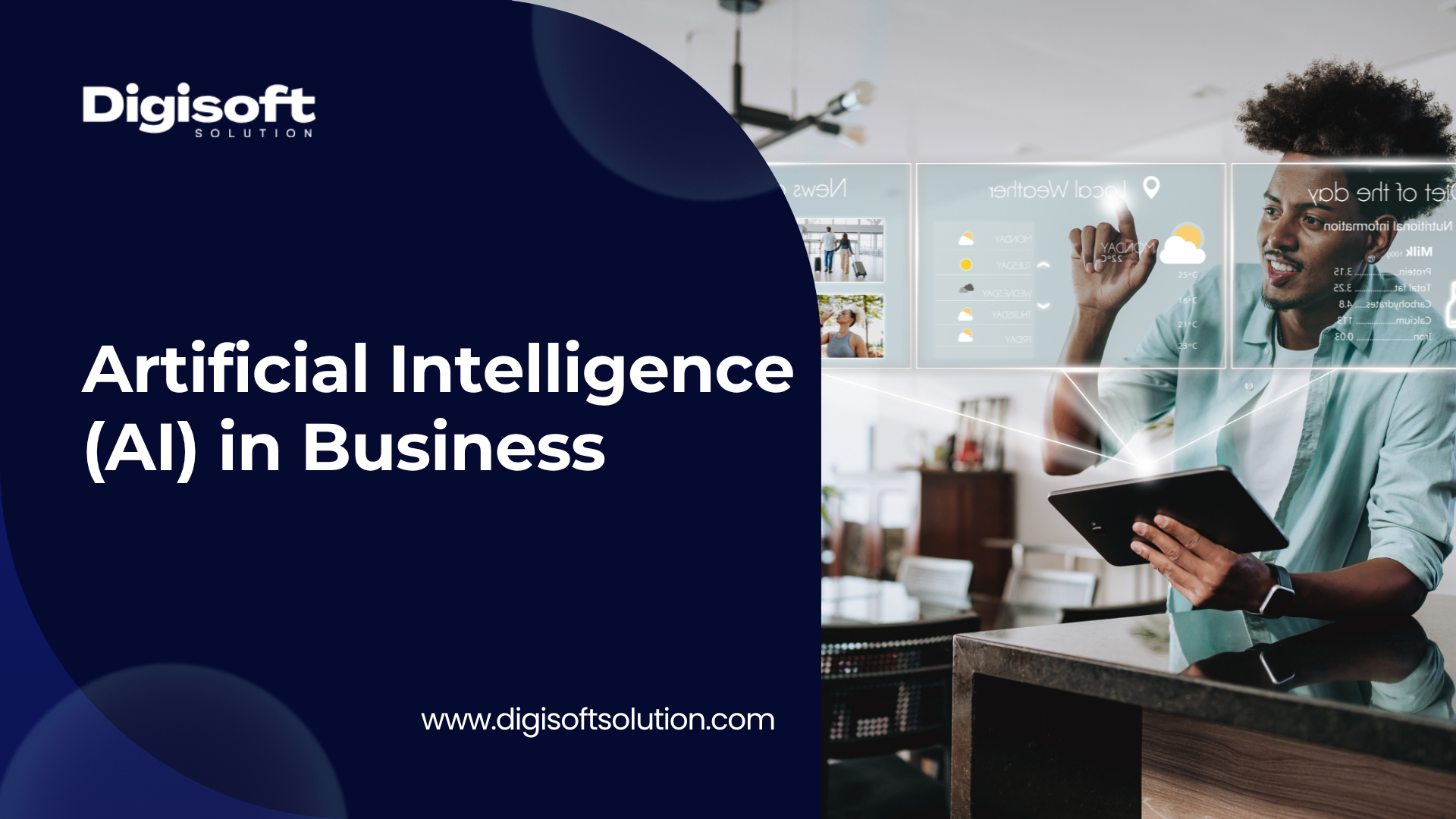
Let's be honest. Artificial intelligence has been hyped to death. You've probably read dozens of articles that say something like "AI will revolutionize everything" without ever telling you what that actually means for your business, how much it will cost, or whether it's even worth it.
This article is different.
We're going to walk you through AI in business in plain language. Not buzzword soup. Not cherry-picked success stories from Fortune 500 companies. Real information that helps you make an informed decision, whether you're a startup founder, a mid-sized business owner, or an enterprise decision-maker trying to figure out where to start.
And yes, we'll talk about cost, because that's the number one question every business owner actually has.
What Is Artificial Intelligence in Business?
Artificial intelligence in business refers to using machine learning algorithms, natural language processing, computer vision, and related technologies to automate decisions, analyze data, and improve operational efficiency across business functions.
In practice, this can look like:
- A chatbot that handles 60% of your customer queries without human help
- A software system that predicts which invoices will be paid late
- An algorithm that recommends which leads your sales team should call first
- A machine that detects defects on a factory line faster than any human eye
AI is not a single tool. It's a category of technologies, and the right one for your business depends on what problem you're trying to solve.
AI vs. Automation vs. Machine Learning: Clearing the Confusion
These three terms get mixed up constantly, and it matters to understand the difference before you commit any budget.
Traditional Automation: Rule-based. "If X happens, do Y." No learning involved. Think scheduled email sequences or invoice generation.
Machine Learning (ML): A subset of AI where systems learn patterns from data and improve over time without being explicitly programmed for every scenario.
Artificial Intelligence (AI): The broader umbrella. It includes machine learning, deep learning, NLP, computer vision, and more. AI systems can handle unstructured data, make judgment calls, and adapt.
Most businesses don't need "AI" in the full technical sense. Many of them need good automation plus some machine learning layered on top. Understanding this distinction saves you from overpaying for capabilities you won't use.
Why Are Businesses Adopting AI Right Now?
The timing isn't coincidental. A few things came together between 2022 and 2025 that made AI accessible to businesses that couldn't have touched it five years ago:
- Cloud computing dropped the cost of training and running AI models dramatically
- Large language models (LLMs) like GPT and Claude became commercially available via API
- No-code and low-code AI tools entered the market
- Competitive pressure: companies that adopted AI started outperforming those that didn't
According to McKinsey's State of AI 2025 report, 78% of organizations now use AI in at least one business function, up from just 55% in 2023. That's a massive shift in a short time.
But here's the uncomfortable truth: enterprise-wide bottom-line impact from AI is still rare. Only about 6% of organizations are classified as "AI high performers" who see EBIT impact of 5% or more from AI. The rest are still figuring it out.
The opportunity is real. The path is not automatic.
Key Areas Where AI Is Transforming Business Operations
1. Customer Service and Support
AI is probably most visible in customer service. Chatbots, virtual assistants, and AI-powered ticketing systems are handling front-line queries at scale.
What actually works:
- AI chatbots for FAQ handling, order status, basic troubleshooting
- Sentiment analysis to flag frustrated customers before they churn
- AI-assisted agents that suggest responses in real time (agent copilots)
What people overestimate: Full AI replacement of customer service teams. Complex issues, emotional conversations, and high-stakes decisions still need humans. The sweet spot is AI handling volume, humans handling complexity.
Real-world numbers: Companies using AI in customer service report 40-70% efficiency gains. Some achieve 60%+ ticket deflection rates. That means more than half of incoming queries never need a human.
2. Sales and Revenue Optimization
AI in sales is about reducing wasted effort. Sales reps spend a shocking amount of time on low-value activities: logging calls, updating CRM, chasing leads that will never convert.
AI applications in sales include:
- Lead scoring: ranking prospects by likelihood to convert based on behavioral data
- Sales forecasting: predicting quarterly revenue with greater accuracy
- Email personalization at scale
- Churn prediction: flagging customers likely to cancel before they do
- CRM data enrichment and automation
3. Marketing and Customer Acquisition
AI-powered marketing isn't just about running better ads. It's about understanding what content to create, when to send it, and to whom.
Use cases that deliver real ROI:
- Programmatic advertising: AI bidding systems that optimize ad spend in real time
- Content personalization: showing different website content to different visitor segments
- Predictive analytics: identifying which marketing channels drive the highest-value customers, not just the most conversions
- AI-generated content drafts that your team edits and publishes
An important note on AI content: Google has clarified that AI-generated content isn't penalized as long as it's helpful, accurate, and demonstrates expertise. But thin, unedited AI content does perform poorly. The companies winning with AI content are the ones using it to support human writers, not replace them entirely. If you're thinking about this for your digital presence, Digisoft Solution's digital marketing services include AI-assisted content workflows that maintain quality and search performance.
4. Finance and Accounting
Finance is one of the highest-ROI areas for AI adoption. Why? Because financial data is structured, decisions are rule-heavy, and errors are expensive.
What AI does in finance:
- Accounts payable automation: extracting data from invoices, matching to purchase orders, flagging exceptions
- Fraud detection: identifying unusual transaction patterns in real time
- Cash flow forecasting: predicting shortfalls weeks in advance
- Financial reporting: generating reports, summaries, and variance analyses
- Expense management: auto-categorizing expenses and flagging policy violations
Cost savings of 26-31% have been reported in finance and accounting operations when AI is properly deployed. These are real numbers from organizations that have moved beyond pilots to actual production systems.
5. Human Resources and Talent Management
HR departments spend a disproportionate amount of time on administrative tasks that AI can handle well.
Applications include:
- Resume screening: filtering applicants based on defined criteria at scale
- Interview scheduling automation
- Employee sentiment analysis: identifying disengagement before someone resigns
- Onboarding automation: personalized onboarding checklists and training recommendations
- Workforce planning: predicting hiring needs based on business growth models
6. Supply Chain and Operations
Supply chain disruptions over the past several years accelerated AI adoption in operations more than any other factor. Businesses needed to predict disruptions, not just react to them.
AI in supply chain and operations:
- Demand forecasting: reducing overstock and stockouts
- Supplier risk scoring: identifying which suppliers are likely to fail or face delays
- Route optimization for logistics
- Predictive maintenance: flagging equipment likely to fail before it does, reducing downtime
- Quality control using computer vision
7. Software Development and IT
AI coding assistants have changed how development teams work. Tools like GitHub Copilot and similar solutions help developers write code faster, catch bugs earlier, and navigate unfamiliar codebases.
For businesses with technical teams, AI in development means:
- Faster feature delivery
- Automated code review
- AI-generated test cases
- Documentation generation
- Legacy code modernization assistance
If your business needs custom software built with AI-assisted development practices, Digisoft Solution's software development services are built on modern engineering approaches that incorporate these efficiencies into project delivery.
8. E-Commerce and Retail
E-commerce is one of the best testing grounds for AI because everything is measurable and the feedback loops are fast.
AI applications in e-commerce:
- Product recommendation engines (the "customers also bought" systems)
- Dynamic pricing: adjusting prices based on demand, competition, and inventory
- Visual search: letting customers find products by uploading photos
- Personalized email and push notification timing
- Returns prediction: identifying orders likely to be returned
If you run an e-commerce business and want to explore how intelligent automation can improve conversion and retention, Digisoft Solution's e-commerce development services can integrate these capabilities into your existing platform.
Real Costs of AI Implementation in Business (The Honest Breakdown)
This is the section most articles either skip entirely or fill with vague ranges that mean nothing. We've reviewed the real data and we'll give you actual numbers, plus tell you what determines where you'll fall in the range.
A word of caution: many pricing guides you'll find online are written by agencies that want your budget to sound "affordable." Some of them list entry-level AI chatbot costs starting at a few thousand dollars, which is technically true for a very basic FAQ bot, but that's not what most businesses actually need. Let's be specific.
What Drives AI Implementation Cost?
Before any number makes sense, you need to understand the five cost drivers:
-
Complexity of the use case: A simple rule-based chatbot is fundamentally different from a predictive churn model that trains on your customer data.
-
Data readiness: If your data is clean, structured, and accessible, you can move fast. If your data is scattered across five systems, in spreadsheets, and inconsistently formatted, you'll spend significant time and money on data preparation before any AI can learn from it.
-
Integration requirements: Plugging an off-the-shelf AI tool into a modern system is straightforward. Integrating it with a legacy ERP from 2009 is not. Legacy integration can add $30,000 to $200,000 to any project.
-
Build vs. buy: Using a pre-built AI platform (like OpenAI, AWS AI services, or Google Vertex AI) is dramatically cheaper than training a custom model from scratch. Most businesses don't need custom models.
-
Ongoing maintenance: AI is not a "deploy and forget" technology. Models drift over time as real-world patterns change. You need to budget for monitoring, retraining, and updates.
Related Read: Top Use Cases of Generative AI in Product Development
AI Implementation Cost by Tier
The following table reflects real 2025 market data based on research across 500 organizations:
|
Tier |
What It Covers |
Typical Cost Range |
Timeline |
|
Basic |
Pre-built AI tools, SaaS integrations, chatbots using existing platforms |
$5,000–$50,000 + SaaS fees ($200–$3,000/mo) |
1–3 months |
|
Intermediate |
Custom AI workflows, ML models trained on your data, API integrations |
$50,000–$250,000 |
3–9 months |
|
Advanced |
Multi-system AI integration, custom model training, enterprise-scale deployment |
$250,000–$1,000,000+ |
9–18 months |
Note: These are total project costs for initial implementation. They do not include ongoing operational costs, which typically run 15-25% of the initial project cost per year.
Hidden Costs Most Businesses Don't Budget For
This is where most AI projects go over budget. These costs are real and they're commonly underestimated:
-
Data preparation and labeling: For supervised learning models, you need clean, labeled training data. Basic classification tasks cost around $10,000 per 100,000 samples. Complex tasks like medical imaging annotation can exceed $90,000 for the same volume. Even for general business data, expect $5,000 to $50,000 in data preparation costs.
-
Change management: Your team needs to trust and adopt the AI system. Training, documentation, and change management typically adds 15-20% to a project budget. Organizations that invest here achieve 2-3x higher ROI than those that treat AI as a purely technical implementation.
-
Compliance and governance: Depending on your industry, AI systems that touch customer data, financial decisions, or healthcare information have regulatory requirements. Compliance setup is not optional.
-
Model monitoring: AI models degrade over time. 81% of organizations fail to budget adequately for ongoing model maintenance. If your churn prediction model was trained on 2023 behavior patterns, it may perform poorly in 2026. Retraining and monitoring are recurring costs.
-
Infrastructure: Depending on your volume, cloud AI costs can scale quickly. A natural language processing model that handles thousands of requests per day has real compute costs.
Is the Cost Actually Worth It?
Let's be direct here, because most articles just tell you AI gives "amazing ROI" without doing the math.
The average ROI from AI implementation in 2025 is 3.5x, with top performers reaching 8x. But here is the critical caveat: most organizations achieve satisfactory returns within 2 to 4 years, not in the first year.
Only 6% of organizations see payback in under 12 months. The standard technology payback period for IT systems is 7 to 12 months. AI takes 3 to 4 times longer.
What does this mean practically?
If you spend $100,000 implementing an AI customer service system that reduces your support costs by $40,000 per year, your payback period is about 2.5 years. That's a reasonable investment if the system performs well and your business is stable. It's a bad investment if you're burning cash and need immediate returns.
The businesses that see the highest AI ROI:
- Commit more than 20% of their digital budgets to AI (not just experimenting)
- Redesign workflows around AI, rather than layering AI onto broken processes
- Scale AI across the organization rather than keeping it in one department
- Invest in people and process change, not just the technology
For small businesses specifically, focused implementations with clear, measurable goals can deliver 200-500% ROI within 1-2 years. The keyword is "focused." Pick one high-impact problem, solve it well, and build from there.
How to Actually Implement AI in Your Business: A Step-by-Step Approach
Step 1: Identify the Right Problem
Don't start with "we need AI." Start with "what is our most expensive, most time-consuming, or most error-prone business process?"
The best AI candidates share these characteristics:
- High volume (enough data to train on and enough throughput to justify the cost)
- Repetitive decision-making (the same judgment is applied over and over)
- Clear inputs and outputs (you can define what success looks like)
- Currently done by humans at significant cost
Bad AI candidates:
- One-off strategic decisions
- Creative work that requires genuine originality
- Relationship-driven sales at the enterprise level
- Processes you haven't documented and don't understand yourself
Step 2: Audit Your Data
AI learns from data. Before you build anything, you need to understand what data you have, where it lives, how clean it is, and whether you have enough of it.
Questions to answer in your data audit:
- What data do we currently collect and where is it stored?
- Is it structured (databases, spreadsheets) or unstructured (emails, documents, PDFs)?
- How consistent and clean is the data?
- Are there data privacy requirements we need to consider (GDPR, HIPAA, etc.)?
- Do we have at least 12-18 months of historical data for the process we want to automate?
If your data infrastructure isn't in good shape, address that first. Cloud application development services from Digisoft Solution can help you build a proper data foundation before AI gets layered on top.
Related Read: Top 10 AI Tools Every Software Development Company
Step 3: Build vs. Buy Decision
For most businesses, especially small and mid-sized ones, the right answer is to buy or configure rather than build from scratch.
Buy (use existing AI platforms): Faster, cheaper, lower risk. Best for standard use cases like customer support chatbots, email automation, or basic analytics.
Configure (take an AI platform and customize it): Moderate cost and timeline. Best for businesses with specific workflows that don't fit off-the-shelf tools.
Build custom: Slow, expensive, high risk. Only justified when your use case is genuinely unique and you have a clear competitive advantage at stake, or when you're in a regulated industry where existing tools don't meet compliance requirements.
Step 4: Start with a Pilot
Before committing your full budget, run a time-limited pilot on a defined use case with clear success metrics.
A good pilot:
- Has a specific business question it's answering ("can we reduce invoice processing time by 40%?")
- Runs for a defined period (typically 30 to 90 days)
- Has human oversight built in (you're learning, not trusting the system blindly yet)
- Measures business outcomes, not just technical metrics
An average of 46% of AI proof-of-concepts are scrapped before going to production. High-performing organizations flip this ratio by being ruthless about which use cases they prioritize. Better to kill a pilot early than to invest in scaling something that doesn't work.
Step 5: Scale Thoughtfully
Once your pilot succeeds, plan the scale-up carefully. This is where most organizations stumble. They scale the technology but not the processes, training, or governance around it.
Scaling checklist:
- Updated workflows and standard operating procedures
- Training for all affected staff
- Clear escalation paths for when AI gets it wrong
- Monitoring dashboards for ongoing performance
- Data governance policies for the AI system
- A human review process for high-stakes decisions
Common AI Myths in Business (That Are Costing You Money)
Myth 1: "AI Will Replace Most of Our Staff"
Reality: Most of the organizational impact of AI is manifesting through selective displacement of outsourced functions and constrained hiring, not broad-based layoffs. Companies are replacing BPO contracts and cutting external agency fees rather than firing existing employees at scale.
Myth 2: "AI Is Too Expensive for Small Businesses"
Reality: Entry-level AI tools are genuinely accessible today. Basic AI chatbots using platforms like Intercom, Freshdesk, or Tidio start at a few hundred dollars a month. AI writing assistants, basic analytics tools, and automation platforms are affordable even for small businesses. The $250,000+ price tags apply to custom, enterprise-scale deployments.
Myth 3: "AI Decisions Are Always Accurate"
Reality: 77% of businesses worry about AI hallucinations and inaccuracies, and rightly so. AI systems make mistakes, especially with unusual inputs or edge cases they weren't trained on. Every AI system in production needs human oversight for decisions that matter.
Myth 4: "You Can Just Buy an AI Tool and It Will Work"
Reality: 70-85% of AI projects fail. The technology is the easy part. The hard parts are data quality, workflow integration, change management, and sustained commitment. An AI tool sitting on top of broken processes doesn't fix the processes, it just automates the chaos.
Myth 5: "ROI Will Be Immediate"
Reality: Only 6% of AI implementations pay back within the first year. Most businesses should plan for a 2-4 year ROI timeline. If your business case requires immediate payback, AI is probably the wrong solution.
AI Challenges and Risks Businesses Must Understand
Data Privacy and Security
AI systems that learn from customer data must comply with applicable data protection laws. This includes GDPR in Europe, CCPA in California, and sector-specific regulations like HIPAA for healthcare. The cost of a data breach or a non-compliant AI decision can far exceed the cost of the AI system itself.
Bias and Fairness
AI models learn from historical data. If that data reflects historical biases (in hiring, lending, or customer service, for example), the AI will reproduce and potentially amplify those biases. This is both an ethical issue and a legal risk.
Vendor Lock-In
Many AI platforms create dependencies that are hard to escape. If you build your entire customer service operation on a single vendor's AI platform, switching later becomes very expensive. Always understand the portability of your data and the flexibility of your architecture.
Skill Gaps
AI implementation requires skills your current team may not have: data science, ML engineering, prompt engineering, AI governance. Either you hire for these skills, train existing staff, or partner with a firm that has them.
Shadow AI
An often-overlooked risk. Workers from over 90% of companies report using personal AI tools for work tasks even when their company hasn't officially deployed any. This "shadow AI" creates data security and compliance risks that organizations need to address with clear policies.
Industry-Specific AI Applications Worth Knowing
Healthcare
AI in healthcare is moving fast. Medical imaging analysis (detecting tumors, fractures, and abnormalities in X-rays and MRIs) now matches or exceeds radiologist accuracy in specific tasks. AI is also being used for clinical documentation, patient triage, and predictive readmission models.
Legal and Professional Services
Contract review and analysis, legal research, and document due diligence are being transformed by AI. Firms are using AI to review thousands of documents in hours rather than weeks, dramatically changing the economics of legal work.
Education and Training
Personalized learning platforms that adapt content to individual student performance, AI tutors for immediate feedback, and automated grading for objective assessments are changing how organizations deliver training at scale. If you're building educational software, a web application development approach with AI features built in from the start produces better results than trying to bolt them on later.
Manufacturing
Predictive maintenance (using sensor data to predict equipment failure before it happens) has some of the highest documented ROI in any industry. Some manufacturers report reducing unplanned downtime by 30-50% with well-implemented predictive maintenance systems.
Financial Services
Fraud detection, credit scoring, algorithmic trading, and regulatory compliance are all mature AI application areas in finance. Newer applications include AI-powered financial advice and real-time risk monitoring.
How Digisoft Solution Helps Businesses Adopt AI the Right Way
We want to be transparent about who we are and what we actually do, because it's relevant to how we approach AI for clients.
Digisoft Solution is an IT consulting and software development company with 12+ years of experience building custom web, mobile, and enterprise applications. We've delivered over 700 projects and currently serve 500+ clients worldwide. Our team of 100+ developers, designers, and technical specialists has worked across industries including healthcare, e-commerce, finance, and SaaS.
When it comes to AI adoption, here's specifically how we help:
AI Readiness Assessment
Before recommending any AI investment, we start by understanding your business processes, your data infrastructure, and your actual goals. Many clients come to us thinking they need "AI" when what they really need is better data management or workflow automation. We'll tell you honestly which applies.
Custom Software Development with AI Integration
Our software development services include building AI capabilities into custom applications from the ground up. Whether it's a web application, a mobile app, or an enterprise system, we architect solutions that can incorporate AI features like recommendation engines, predictive analytics, or natural language interfaces.
This is different from buying an off-the-shelf AI tool. Custom software means the AI logic is designed around your specific business rules, your data structure, and your workflows. It's more expensive upfront but produces substantially better results for businesses with unique processes.
Web and Mobile Applications with Intelligent Features
We build web applications and mobile apps (including iOS and Android) that incorporate AI-driven features, from personalized user experiences to real-time data analysis. Our development team stays current with AI APIs and services from major providers, which means we can integrate best-in-class AI capabilities without reinventing the wheel.
E-Commerce AI Integration
For e-commerce businesses, we integrate AI features like product recommendations, dynamic content, search personalization, and customer behavior analysis into e-commerce platforms. Our e-commerce development work includes both custom builds and platform-based solutions where AI features can be added.
UI/UX Design for AI-Powered Products
AI products have unique design challenges. If users don't understand what the AI is doing, they won't trust it. If the interface exposes too much AI complexity, users get confused. Our UI/UX design services specifically account for how users interact with AI-driven features, building interfaces that feel intuitive rather than intimidating.
Digital Marketing with AI-Assisted Strategy
Our digital marketing services use AI-assisted tools for content optimization, keyword research, audience targeting, and campaign performance analysis. We use AI as a tool in our workflow, not as a replacement for strategic thinking. This means clients get the efficiency benefits without the quality compromises that come from poorly supervised AI content.
Software Testing for AI Systems
Testing AI systems is fundamentally different from testing conventional software because AI behavior isn't fully deterministic. Our software testing services include validation approaches for AI-driven features, making sure the system behaves correctly across different input scenarios and edge cases.
Dedicated Teams for AI Projects
For businesses that want ongoing AI development capacity without building a full in-house team, our dedicated developer model provides access to developers with experience in AI integration at a predictable monthly cost. This is often the most cost-effective path for businesses with multiple AI initiatives they want to execute over 12-24 months.
Why Work With Us for AI Adoption?
We're not an AI vendor with a product to sell you. We're a development partner whose job is to figure out what actually makes sense for your business and then build it. That means we'll tell you when AI is the right solution, when automation without AI is sufficient, and when the right answer is fixing your data infrastructure before doing either.
We also understand that cost matters. Our development teams operate with competitive rates while maintaining quality standards, which is one of the reasons clients from the US, UK, and Canada choose to work with us rather than with local agencies at significantly higher rates.
If you want to explore what AI adoption could realistically look like for your business, including honest cost estimates and a practical roadmap, contact Digisoft Solution for a free consultation.
The Future of AI in Business: What to Prepare For
Agentic AI
The next significant shift is from AI that responds to queries to AI that takes actions autonomously. "Agentic AI" systems can plan, execute multi-step tasks, use tools, and work toward goals with minimal human instruction. They currently account for about 17% of AI-related business value and are expected to reach 29% by 2028.
For businesses, this means AI that can actually do things, not just recommend them. A sales AI agent that identifies a prospect, researches them, drafts a personalized outreach email, schedules a follow-up, and updates the CRM, all without a human initiating each step.
This is powerful and it comes with governance challenges. Organizations that build responsible oversight frameworks now will be better positioned to deploy agentic AI safely.
Multimodal AI
Current AI systems are increasingly capable of processing text, images, audio, and video simultaneously. For businesses this opens up applications like visual quality control that also reads product labels, customer service that can analyze a photo of a damaged product while having a conversation, and document processing that handles mixed text and image content.
Smaller, More Specialized Models
The AI landscape is shifting from massive general-purpose models to smaller, specialized models that are faster, cheaper to run, and better at specific tasks. For business AI, this is a positive trend. It means lower operational costs and more predictable behavior in specific domains.
AI Governance as a Business Function
As AI becomes embedded in more business decisions, governance, which covers bias monitoring, explainability, audit trails, and human oversight requirements, is becoming a business function rather than just an IT concern. Regulated industries are already seeing formal requirements. Others will follow.
Frequently Asked Questions About AI in Business
What is the best first AI use case for a small business?
Start with wherever you have the highest volume of repetitive, rule-based work. For most small businesses, this is either customer support (a basic AI chatbot for FAQs) or marketing (AI-assisted email personalization or social media content drafting). Both have accessible, affordable tools available today.
How long does AI implementation take?
Basic implementations using off-the-shelf tools can take 1-3 months. Intermediate custom solutions typically take 3-9 months. Enterprise-scale deployments can take 12-18 months or longer. The timeline includes data preparation, integration, testing, and staff training, not just the technical build.
Do I need a lot of data to use AI?
It depends on the approach. Pre-trained AI models (like large language models) don't require you to supply training data. Custom ML models that learn your specific patterns do require data, typically at least 12-18 months of historical records for the process you're automating.
What's the difference between AI software and an AI strategy?
AI software is a tool. An AI strategy is a plan for which tools to use, in which business processes, in what sequence, with what governance, and toward what measurable goals. Most failed AI projects have software but no strategy.
Is AI safe for handling customer data?
It can be, but it requires deliberate architecture. You need to understand where your customer data goes when it's processed by an AI system, whether that's a third-party vendor's servers or your own infrastructure. Data residency, access controls, and vendor data policies all matter.
Can AI help with SEO and content marketing?
Yes, and it already is for most competitive businesses. AI tools can help with keyword research, content briefs, first drafts, meta descriptions, and performance analysis. The businesses winning with AI content are using it to increase production volume while maintaining human editorial oversight, not publishing raw AI output without review.
Final Thoughts: AI in Business Is a Journey, Not a Switch
If there's one thing this guide should leave you with, it's this: AI in business is a process, not a purchase.
The companies seeing the best results aren't the ones who bought the most expensive tools. They're the ones who identified real problems, built the right data foundation, started with focused pilots, invested in their people, and iterated over time.
The technology is now genuinely accessible. The barriers that remain are mostly organizational: clarity about what you're trying to achieve, willingness to change how processes work, and patience to let ROI develop over a realistic timeline.
Whether you're just starting to explore AI or you're ready to build, the important thing is to start with the right questions rather than the right vendor.
What problem are we solving? What does success look like? What do we need in place before we can build this responsibly?
If you want help thinking through those questions for your specific business, that's exactly the kind of conversation Digisoft Solution is built for. Our team has the technical background to evaluate what's realistic and the business sense to tell you when simpler solutions will work just as well.
Digital Transform with Us
Please feel free to share your thoughts and we can discuss it over a cup of coffee.