Table of Content
- Quick answer
- CRM or ERP: Know What You're Actually Buying First
- What Actually Matters When Evaluating a Partner
- Real Integration Experience, Not Just a Feature List
- In-House Team vs. Marketplace Model
- A Real Discovery Process Before Any Quote
- Security and Compliance Handled From Day One
- A Clear Post Launch Support Model
- Questions Worth Asking Before You Sign Anything
- What This Actually Costs, and Whether the Price Is Fair
- Red Flags When Evaluating a Partner
- How Digisoft Solution Helps With Custom CRM and ERP Development
- Frequently Asked Questions
- Should I build a custom CRM, or customize an off the shelf platform like Salesforce or HubSpot?
- How long does it take to build a custom CRM or ERP?
- What is the biggest hidden cost in these projects?
- Is it cheaper to hire an offshore development team?
Digital Transform with Us
Please feel free to share your thoughts and we can discuss it over a cup of coffee.
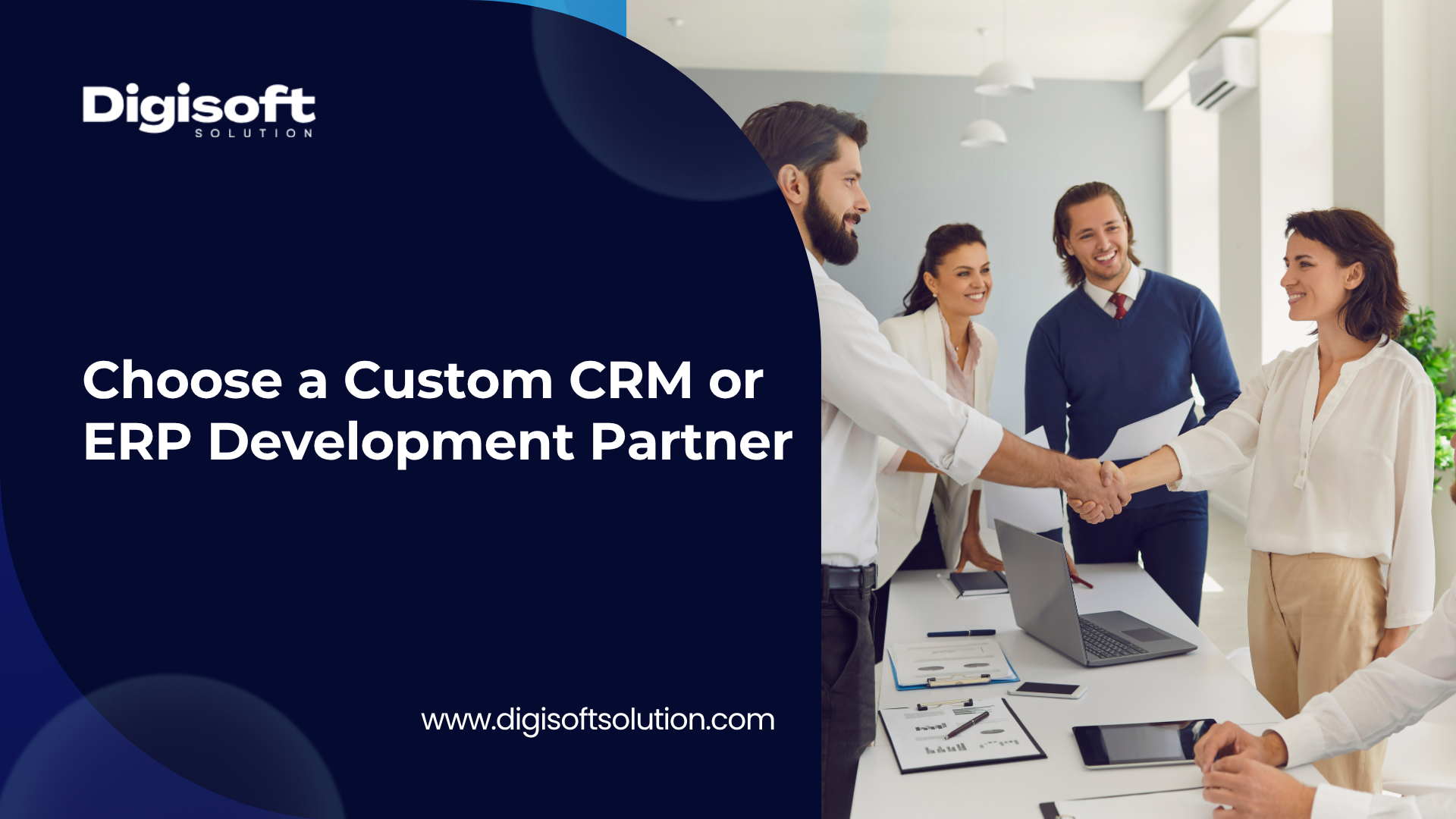
At some point Salesforce, HubSpot, or whatever ERP you bolted together five years ago stops fitting how your business actually runs. Maybe it is a sales process with three approval steps that the platform cannot represent without ugly workarounds. Maybe it is an ERP that still cannot talk to your warehouse system without someone manually re keying numbers every week. Once you decide custom is the right move, the harder question shows up fast. Who do you actually trust to build it, and how do you tell a firm that will do this well from one that will not find out until month six.
Quick answer
The right CRM or ERP development partner is judged less by their portfolio screenshots and more by three things, whether they have handled integrations as complex as yours before, whether they own the code and process end to end with an in-house team rather than a marketplace of freelancers, and whether they can clearly explain how they handle data migration, security, and support after launch. Cost for a genuinely custom mid sized build typically runs 60,000 to 150,000 dollars, and the biggest, most commonly underquoted cost is integration work, not the visible screens.
This guide walks through how to actually evaluate a partner, the questions worth asking before you sign anything, and an honest, checked read on cost, since almost every published number on this topic is technically true and still not that useful for budgeting your specific project.
CRM or ERP: Know What You're Actually Buying First
These two get used almost interchangeably in casual conversation, which causes real scoping problems later. A CRM manages relationships and the sales pipeline, contacts, deals, communication history, follow ups. An ERP manages the operational core of the business, inventory, accounting, procurement, sometimes manufacturing or HR. Plenty of businesses eventually need both connected to each other, which is exactly the kind of bidirectional integration that tends to get underestimated in a first conversation with a vendor. Getting clear internally on which system is actually causing the pain, or whether it is really the missing connection between two systems you already have, changes who you should even be talking to.
What Actually Matters When Evaluating a Partner
Real Integration Experience, Not Just a Feature List
Almost every agency's homepage says they do CRM and ERP integrations. What matters is whether they have actually connected systems as messy as yours. Ask for a specific example of a bidirectional sync they built between a CRM and an ERP or legacy system, not a one way data export. The difference between pushing data one direction and keeping two systems in sync in real time is a completely different engineering problem, and it is where most budget and timeline overruns actually happen.
In-House Team vs. Marketplace Model
Some firms that look like a development company are really a marketplace matching your project to whichever freelancer is available that month. That is not automatically bad, but it does mean less continuity if your point of contact changes mid project, and less accountability if something goes wrong. A team of full time, in-house developers who stay on the project from discovery through post launch support tends to produce more consistent results, especially on something as central to daily operations as a CRM or ERP.
A Real Discovery Process Before Any Quote
If a vendor gives you a firm number before auditing your existing systems, current data, and integration needs, that number is a guess dressed up as a quote. A proper discovery phase, mapping your current workflows, data quality, and what needs to connect to what, should happen before a real proposal, not after the contract is signed.
Security and Compliance Handled From Day One
If your business touches healthcare data, payment information, or any regulated industry, security cannot be an add-on discussed after the core build is done. Retrofitting compliance features like audit logging, encryption standards, or access controls into a system that was not designed with them from the start typically costs two to three times more than building them in from the beginning. A partner worth hiring will ask about your compliance requirements in the first conversation, not the final one.
A Clear Post Launch Support Model
A CRM or ERP is not a one time delivery, it is software your business will depend on for years. Ask exactly what happens after go live. Is there a support retainer. What is the response time for a critical bug. Who owns bug fixes six months after launch versus who owns new feature requests. Vendors who cannot answer this clearly in the sales conversation tend to disappear just as clearly after the invoice is paid.
Questions Worth Asking Before You Sign Anything
- Can you show me a system you built with a similar integration to what we need, not just a similar looking dashboard
- Who exactly will be working on our project, and are they full time employees or contracted for this engagement only
- What does your discovery process actually involve before you give us a firm quote
- How do you handle data migration from our current system, and what happens if our existing data turns out to be messier than expected
- What is included in support after launch, and what costs extra
- Can you walk us through a project that went over budget or timeline, and what happened
That last question tends to be the most revealing one in the whole conversation. Every experienced vendor has had a project slip. The ones worth hiring can tell you why and what they changed afterward.
What This Actually Costs, and Whether the Price Is Fair
Most articles on this topic either quote a range so wide it is useless, twenty thousand to two hundred thousand dollars is technically accurate and tells you almost nothing, or they quietly skip the line items that actually blow up budgets. Here is a more honest breakdown, checked against what multiple 2026 industry sources actually charge, along with whether each number holds up as fair pricing or not.
|
Scope |
Realistic cost range |
Timeline |
Our technical take |
|
Basic CRM or ERP MVP (core records, one workflow, minimal integrations) |
$20,000 to $45,000 |
2 to 4 months |
Reasonable for validating whether custom is even the right call before committing bigger budget. Do not skip this step just to get to the full build faster. |
|
Mid range SMB build (multiple workflows, a handful of integrations, reporting) |
$60,000 to $150,000 |
4 to 8 months |
This is where most legitimate mid sized business projects land. Priced fairly when integrations are itemized individually rather than bundled into one vague line. |
|
Enterprise grade platform (deep ERP or legacy sync, compliance, AI features) |
$150,000 to $300,000 or more |
7 to 12 months |
Justified when the integration and compliance requirements are genuinely complex. A red flag if a vendor quotes this tier without first auditing your existing systems. |
|
Per integration (each ERP, accounting, or legacy system connection) |
$1,500 for a simple API, up to $25,000 for a complex bidirectional legacy sync |
Varies, often 2 to 6 weeks each |
The single most underquoted line item in this entire industry. If a proposal treats integrations as an afterthought, expect the timeline and budget to both slip. |
A few things worth stating plainly instead of hedging. The integration cost range is not padding, it reflects genuinely different engineering problems. A simple one way API connection to an email tool is a few days of work. A bidirectional sync with an aging ERP that was never built with modern APIs in mind can take weeks per connection, and pricing it the same as the email integration is where a lot of vendor quotes fall apart later. Data migration, commonly budgeted at three to fifteen thousand dollars, gets left out of roughly eight in ten initial quotes according to industry cost breakdowns, not because it is optional but because it is easy to forget until your old data turns out to be messier than anyone assumed. And on the buy versus build question specifically, custom development is not automatically the expensive option. A fifty seat Salesforce Enterprise subscription runs roughly seventy five thousand dollars a year in licensing alone. Over five years that is more than a mid range custom build plus its annual maintenance, and at the end of it you own the system outright instead of renting it. Custom tends to become the financially smarter choice once a company passes around twenty to thirty regular users with workflows that do not fit a generic platform cleanly.
Red Flags When Evaluating a Partner
- A fixed price quote given before any discovery call or system audit
- No clear answer about who specifically will be doing the development work
- Integration work bundled into one vague line item instead of itemized per system
- Security and compliance treated as a later phase rather than part of the initial architecture
- No mention of a post launch support plan unless you ask directly
- A portfolio full of screenshots but no willingness to discuss a project that had real challenges
How Digisoft Solution Helps With Custom CRM and ERP Development
Digisoft Solution builds custom CRM and ERP systems as part of its broader enterprise software development work, for businesses whose processes have outgrown what an off the shelf platform can represent. Here is what that actually looks like when you work with us:
- Discovery before quoting: existing systems, data quality, and integration needs are mapped before a number is put on paper, not after
- An in-house development team, not a rotating freelancer pool, so the people who scoped the project are the ones building and supporting it
- Real experience with bidirectional ERP, accounting, and legacy system integrations, including the kind of aging systems that were never built with modern APIs in mind
- Security and compliance considered from the architecture stage, not retrofitted after launch, for businesses in healthcare, fintech, and other regulated industries
- Flexible engagement models depending on scope: a full custom build, or staff augmentation to add CRM or ERP integration specialists to an existing internal team for a specific module
- A defined post launch support plan agreed before the project starts, not negotiated after go live
If a custom CRM or ERP build is on the table, the most useful next step is usually a discovery conversation about your current systems and workflows before anyone throws out a number.
Frequently Asked Questions
Should I build a custom CRM, or customize an off the shelf platform like Salesforce or HubSpot?
For smaller teams with fairly standard sales processes, customizing an off the shelf platform is usually faster and cheaper to start. Once your workflows, integration needs, or data ownership requirements stop fitting cleanly into a generic platform, and especially once you are paying five figures a year in per seat licensing for a team of twenty or more, custom development starts to make more financial sense over a multi year horizon.
How long does it take to build a custom CRM or ERP?
A basic version focused on core workflows typically takes two to four months. A mid sized build with several integrations runs four to eight months. Enterprise grade systems with deep legacy integration and compliance requirements can take seven to twelve months, usually delivered in phases rather than one large release.
What is the biggest hidden cost in these projects?
Integration work, consistently. Vendors and buyers both tend to underestimate how much engineering effort a real bidirectional connection to an existing ERP or legacy system takes, especially when that system was never built with modern APIs in mind. Data migration from messy legacy records is the second most common budget surprise.
Is it cheaper to hire an offshore development team?
Often yes on an hourly basis, offshore rates can run sixty to seventy percent lower than US or UK based teams. Whether that translates into a cheaper project overall depends heavily on communication quality and how well the team documents and manages scope, since rework from miscommunication can erase the hourly savings quickly on a complex integration heavy project.
Digital Transform with Us
Please feel free to share your thoughts and we can discuss it over a cup of coffee.