Table of Content
- What Factory Digitization Software Actually Covers
- How Data Actually Moves Through a Connected Factory
- The Brownfield Problem: Why Older Factories Are Harder to Digitize
- OEE: The Metric Almost Every Digitization Project Starts With
- Predictive Maintenance: Catching Failures Before They Happen
- Build vs. Buy: Enterprise MES, Cloud Native Platforms, or Custom Software
- What Factory Digitization Actually Costs, and Whether That Is Reasonable
- Common Mistakes We See in Factory Digitization Projects
- How Digisoft Solution Helps With Factory Digitization
- Frequently Asked Questions
- What is the difference between MES and SCADA?
- Do I need to replace old machines to digitize a factory?
- How long does a factory digitization project actually take?
- What is a realistic first OEE target after digitizing a line?
- Is a digital twin necessary for a first digitization project?
Digital Transform with Us
Please feel free to share your thoughts and we can discuss it over a cup of coffee.
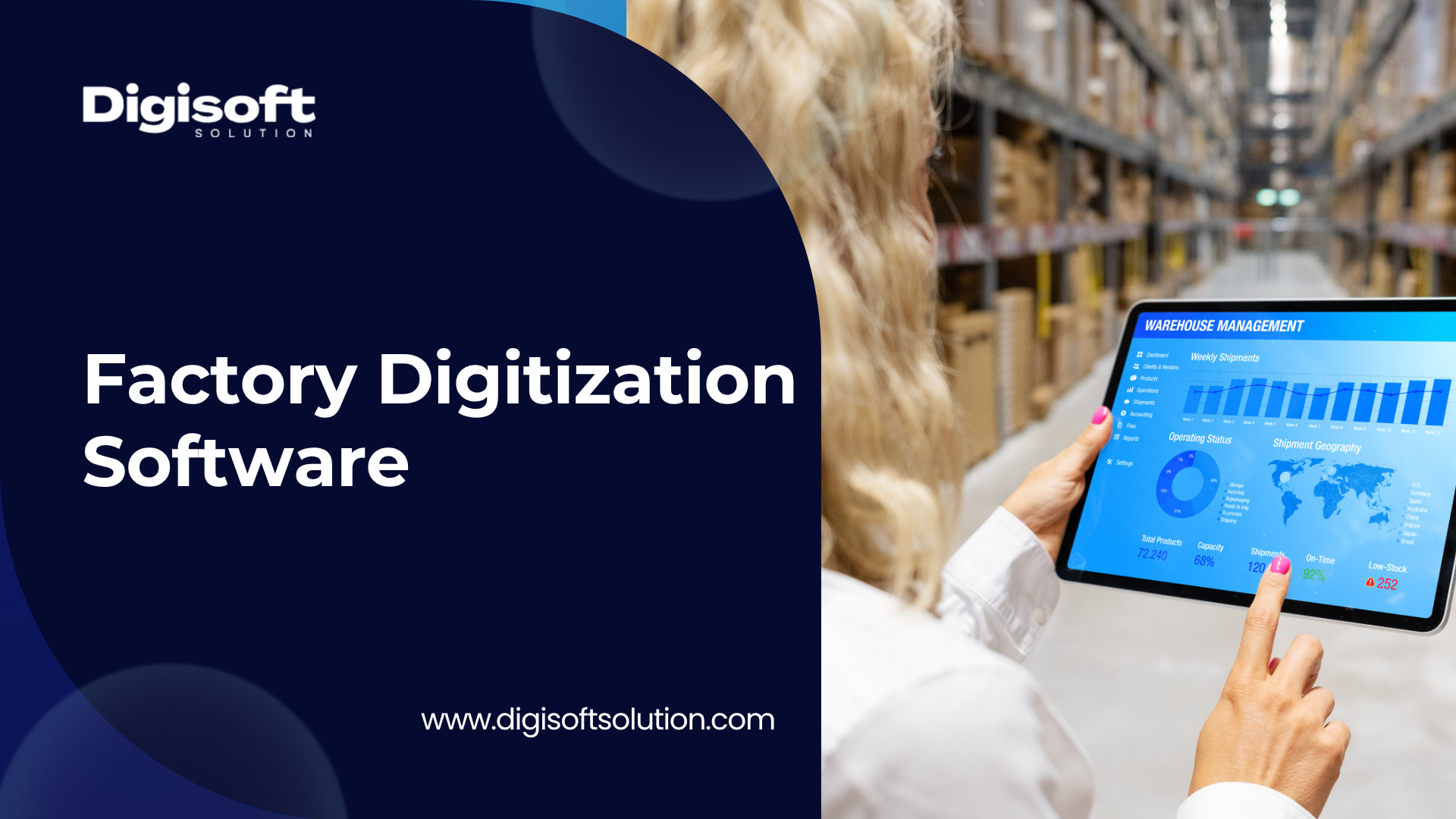
Walk onto most mid sized factory floors today and you will still see a lot of the same machines that have been running for fifteen or twenty years, just with a tablet bolted somewhere nearby and a supervisor squinting at a spreadsheet that is already two hours out of date. That gap, between what is actually happening on the line right now and what the office finds out about it, is basically the whole problem factory digitization software exists to solve. It is not about replacing machines. It is about giving the ones you already own a way to talk.
Factory digitization software connects machines, sensors, and production systems so that what happens on the shop floor, output, downtime, quality, machine health, becomes visible in real time instead of showing up in a report the next morning. It typically combines an IIoT connectivity layer, a manufacturing execution system (MES) for shop floor execution, and increasingly a digital twin or predictive maintenance layer on top. For most mid sized manufacturers, a cloud native platform that connects to existing machines without rewiring PLCs gets real data flowing within weeks, while a fully custom build usually takes four to nine months for a first working release.
This article gets into what these systems actually do layer by layer, why older factories are harder to digitize than newer ones, what a build vs buy decision really looks like, and yes, what it costs, with an honest read on whether those numbers are actually reasonable rather than just repeating whatever a vendor page says.
What Factory Digitization Software Actually Covers
The phrase gets used loosely, so it helps to separate it into the layers that actually make up a connected factory:
- Industrial IoT (IIoT) connectivity, which pulls data off machines, sensors, and PLCs and gets it somewhere useful
- Manufacturing execution systems (MES), which manage production orders, work instructions, and shop floor execution in real time
- SCADA, which handles direct supervisory control and monitoring of equipment, usually at the machine or line level
- Digital twin platforms, which build a virtual model of a machine or line for simulation and what if analysis without touching the live equipment
- Predictive maintenance tools, which read vibration, temperature, and current draw data to flag a failing bearing or motor before it actually fails
- Quality and traceability systems, which log inspections, non-conformances, and genealogy records tied to each batch or unit
Most real digitization projects touch two or three of these layers at once rather than one in isolation, since a predictive maintenance alert is not that useful if it cannot also trigger a work order inside the MES.
How Data Actually Moves Through a Connected Factory
It helps to think about this in layers rather than as one big system, because that is genuinely how it is architected in practice. The ISA-95 model, which is the standard most manufacturing software still gets built around, splits it roughly like this:
- Level 0 and 1: the physical machines, sensors, and PLCs doing the actual work on the floor
- Level 2: SCADA, supervising and controlling equipment in near real time
- Level 3: MES, coordinating production orders, resources, and execution across a shift or a line
- Level 4: ERP, handling the business side, orders, planning, and financials
Two communication protocols do most of the heavy lifting between these layers now, OPC UA and MQTT. OPC UA is the more structured, industrial standard for exchanging data between machines and higher level systems, while MQTT is lighter weight and is often used for streaming sensor data efficiently, especially over less reliable networks. You do not need to memorize the protocol names to run a factory, but if a software vendor cannot clearly explain which one they use and why, that is worth asking about directly.
The Brownfield Problem: Why Older Factories Are Harder to Digitize
This is the part that most generic articles on this topic gloss over, and it is honestly the crux of most real projects. A brand new factory built in the last few years usually has modern, network ready equipment that speaks a standard protocol out of the box. Most factories are not that. They are running a mix of machines from three or four different decades, and a meaningful share of them were never built to output data at all.
An MES or IIoT platform that only supports modern OPC UA compatible equipment can leave a large chunk of a typical plant's machine park unconnected, which means your production data, and any OEE number calculated from it, is incomplete before you even start. This is exactly why non intrusive retrofit sensors, the kind that clip onto a machine's power line or read a signal light rather than requiring a rewire, have become the more practical starting point for older plants. They connect in under an hour per machine instead of requiring an electrician and a shutdown window.
OEE: The Metric Almost Every Digitization Project Starts With
Overall Equipment Effectiveness, OEE, is the number most factory digitization projects are ultimately trying to improve, and it is worth understanding because it will show up on every vendor's homepage. It is calculated as Availability multiplied by Performance multiplied by Quality:
- Availability: how much of the scheduled production time the machine was actually running, versus down for changeovers, breakdowns, or waiting on material
- Performance: how close the machine ran to its ideal cycle speed while it was running
- Quality: what percentage of what it produced was actually good, first pass, without rework or scrap
A factory that has never measured OEE formally is often surprised by the real number once sensors start reporting it honestly. It is common for a plant that assumed it was running in the 80s to actually be closer to 55 or 60 percent once micro stoppages and slow cycles get counted properly instead of estimated from memory.
Predictive Maintenance: Catching Failures Before They Happen
Once machine level data is flowing, predictive maintenance is usually the next layer manufacturers add, and it tends to have the clearest return on investment of anything on this list. By tracking vibration patterns, temperature drift, and current draw over time, software can flag a bearing or motor that is trending toward failure days or weeks before it actually breaks down mid shift. Reducing unplanned downtime by meaningful double digit percentages is a realistic outcome once a plant has a few months of clean sensor history to train the model against, though the first few months are mostly about collecting good data rather than seeing dramatic results immediately.
Build vs. Buy: Enterprise MES, Cloud Native Platforms, or Custom Software
This is genuinely a three way decision, not two, and which one makes sense depends heavily on plant size and how standard your process is:
- Enterprise MES suites from vendors like Siemens, SAP, or Rockwell are built for large, complex, multi plant operations, usually ones already standardized on that vendor's broader ecosystem.
- Cloud native or IoT first platforms are built to get live data flowing fast without a major infrastructure project, which fits most single plant or small multi plant manufacturers well.
- Custom built software makes sense when your production process, batching logic, or compliance requirements genuinely do not fit a packaged system, which is common in food and beverage, pharma, and specialized discrete manufacturing.
What Factory Digitization Actually Costs, and Whether That Is Reasonable
A lot of articles on this topic either avoid numbers entirely or repeat a vendor's marketing page without checking whether the number makes sense. Here is a straight comparison, along with an honest read on whether each price point is actually justified for what you get, not just what is typically charged.
|
Approach |
Typical cost |
Typical timeline |
Our technical take |
|
Enterprise MES (Siemens Opcenter, SAP DMC, Rockwell Plex) |
$500,000 to well over $1,000,000 including licenses, consulting, and integration |
12 to 24 months |
Fair pricing if you are a large multi plant operation already standardized on that ERP vendor. Oversized and financially hard to justify for a single mid sized plant. |
|
Cloud native or IoT first MES (Tulip, TeepTrak style platforms) |
Roughly $12,000 to $30,000 a year for a 10 line plant, priced per connected interface or machine |
Live data in 48 hours to a few weeks |
Genuinely good value for most mid sized manufacturers. Non intrusive sensors avoid rewiring old PLCs, which is the real cost driver in traditional projects. |
|
Custom built factory digitization software |
$50,000 to $300,000 or more for the core build, with MES to ERP integration alone often running $25,000 to $150,000 |
4 to 9 months for a phased first release |
The integration line item being the biggest cost is correct, not a markup. Worth it when your production process, batching, or compliance needs do not fit a packaged system. |
A few things worth being direct about. The enterprise MES number sounds alarming at first glance, five hundred thousand dollars and up, but for a large operation already running Siemens or SAP across multiple plants, that cost is proportionate to what the system actually replaces and connects. It becomes a bad deal specifically when a single plant with thirty machines buys it anyway because a consultant recommended the big name brand. On the other end, the cloud native pricing genuinely does look too good at first, twelve to thirty thousand dollars a year for a ten line plant, but the reason it is cheaper is structural, not a discount. It skips the expensive part of traditional projects, the rewiring and the twelve month consulting engagement, by using retrofit sensors and a subscription model instead. That is a legitimate cost reduction, not a corner being cut. For custom builds, the fact that MES to ERP integration alone can run twenty five to a hundred and fifty thousand dollars is also correct pricing rather than padding, since that integration work is where almost all of the real engineering effort goes, not the dashboard screens everyone sees in the demo.
The one number worth remembering above all the others: across nearly every source on this topic, the sticker price of the software itself is only twenty to thirty percent of what a project actually costs once implementation, integration, and training are included. Budgeting for the license fee alone is the single most common way factory digitization projects run over budget.
Common Mistakes We See in Factory Digitization Projects
- Buying an enterprise-grade platform sized for a much larger operation than the one actually being digitized
- Assuming every machine on the floor can connect the same way, without first auditing what is actually running out there and how old it is
- Treating OEE as a vanity number to report upward instead of a tool to find the specific line or shift losing the most time
- Rolling out to every line at once instead of proving the system on one bottleneck line first, which is how most successful projects actually start
- Skipping operator training and change management, which is consistently the real reason digitization projects stall after go live, not the technology itself
How Digisoft Solution Helps With Factory Digitization
Digisoft Solution builds connected factory systems as part of its broader manufacturing software development work, covering MES, IIoT connectivity, predictive maintenance, digital twin, and quality management modules for discrete, process, and hybrid manufacturers. For a plant evaluating a digitization project, here is what that looks like in practice:
- Machine audit before anything is proposed: cataloging what equipment actually exists on the floor, how old it is, and what it can already output, so the scope reflects the real plant rather than an assumed one
- Experience bridging old and new equipment: connecting legacy PLCs and modern sensors into the same data layer without requiring a full rewiring project
- MES, quality, and predictive maintenance built to work together: shop floor execution, non conformance tracking, and machine health monitoring designed as one connected system rather than three disconnected tools
- Flexible delivery models: a full custom build, or staff augmentation to add manufacturing software specialists to an existing internal team for a specific integration or module
- Pilot first rollout: proving the system on one line or one bottleneck area before scaling plant wide, which keeps risk and budget contained
If a factory digitization project is on the roadmap, the most useful next step is usually a short conversation to walk through what is currently running on the floor before anyone proposes a specific platform or price.
Frequently Asked Questions
What is the difference between MES and SCADA?
SCADA operates closer to the machine, handling direct supervisory control and monitoring in near real time. MES sits a layer above it, coordinating production orders, work instructions, and execution across a full shift or line. Most factories eventually run both, connected to each other.
Do I need to replace old machines to digitize a factory?
No, in most cases. Non intrusive retrofit sensors can pull useful data, power state, cycle counts, vibration, from machines that are decades old without any rewiring. Full replacement is rarely the first step, and jumping straight there is one of the more expensive mistakes a plant can make.
How long does a factory digitization project actually take?
A pilot on one line using a cloud native platform can show live data within a few weeks. A full custom built system connecting an entire plant to ERP typically takes four to nine months for a first phased release, with additional lines or plants added afterward.
What is a realistic first OEE target after digitizing a line?
This varies a lot by industry, but many plants find their true baseline OEE is lower than assumed once it is measured accurately, sometimes in the 55 to 65 percent range. A realistic early goal is usually closing the gap to 75 to 85 percent within the first year by fixing the specific losses the data reveals, rather than chasing a generic industry benchmark from day one.
Is a digital twin necessary for a first digitization project?
Not usually. Digital twins are valuable once you have reliable real time data flowing and want to simulate changes before making them on the physical line. Most manufacturers get more immediate value starting with MES and predictive maintenance first, then adding a digital twin layer once the underlying data is solid.
Digital Transform with Us
Please feel free to share your thoughts and we can discuss it over a cup of coffee.