Table of Content
- What Is Multimodal AI, In Plain Terms
- How It Differs From Traditional, Single-Input AI
- Why Multimodal AI Actually Matters for Businesses Right Now
- Key Multimodal AI Use Cases Across Industries
- Document Intelligence (The Highest-ROI Use Case, By Far)
- Healthcare
- Retail and E-Commerce
- Banking and Finance
- Manufacturing and Logistics
- Real Estate
- Multimodal AI and Agentic Workflows: The Part Most Articles Skip
- Leading Multimodal AI Models in 2026 (Quick Comparison)
- The Real Cost of Multimodal AI (This Is Where Most Articles Get It Wrong)
- API-Level Costs (as of mid-2026, per million tokens)
- Is That Cost Actually Good or Bad? Here's the Technical Take
- How to Keep Multimodal AI Costs Under Control
- What Does It Cost to Build a Custom Multimodal AI Application?
- Common Challenges in Multimodal AI Development (Be Honest About These Upfront)
- How Digisoft Solution Helps With Multimodal AI Application Development
- A Couple of Our Own Case Studies
- Frequently Asked Questions
- What is multimodal AI in simple terms?
- Is multimodal AI worth the extra cost compared to text-only AI?
- How much does it cost to build a custom multimodal AI application?
- Which multimodal AI model should my business use?
- Can multimodal AI handle ongoing, multi-turn conversations?
- Final Thought
Digital Transform with Us
Please feel free to share your thoughts and we can discuss it over a cup of coffee.
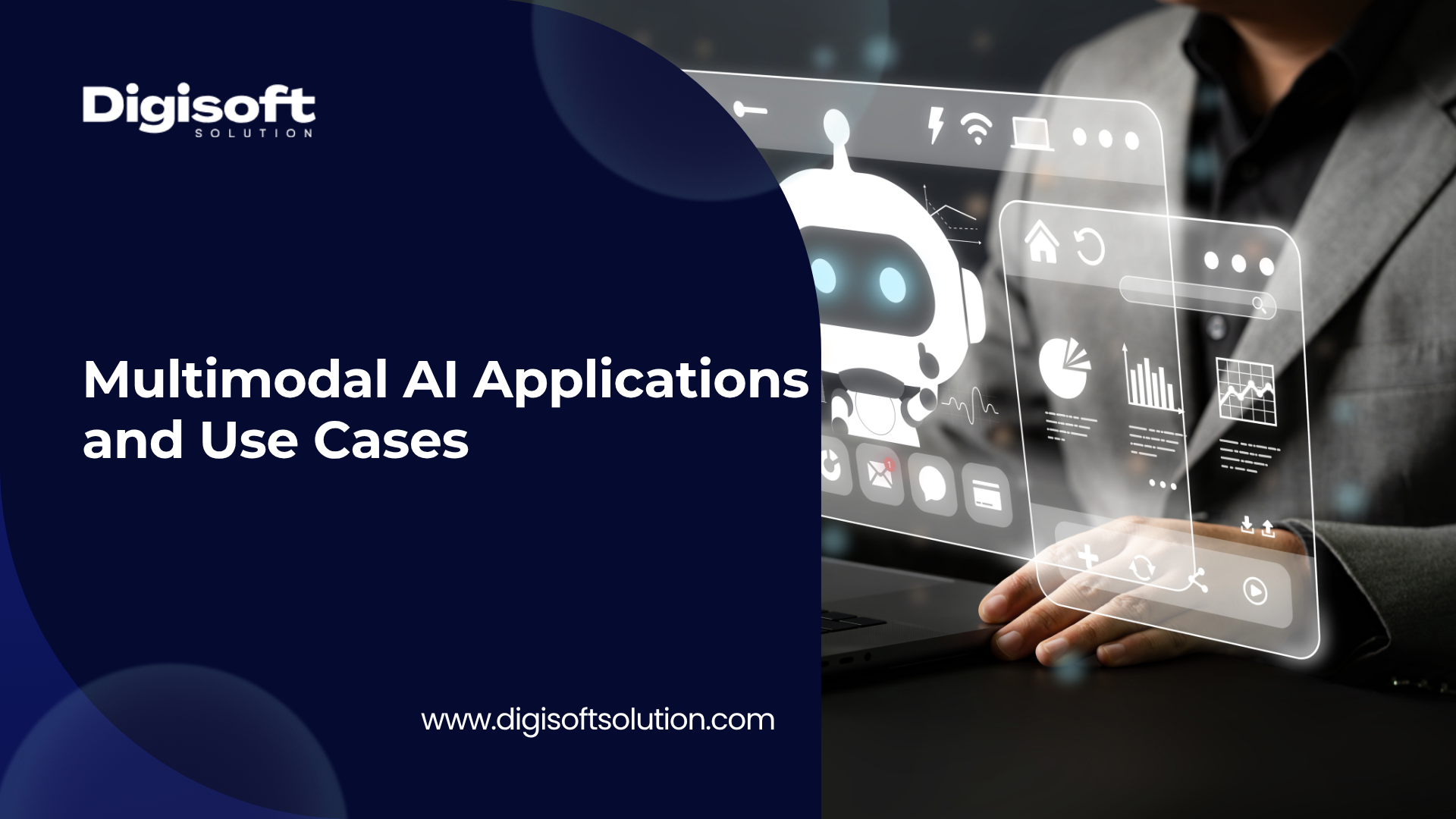
If you have been reading about AI for the last two years, you already know the story. First there was text-only AI, then came chatbots, and now everyone is talking about "multimodal AI" like it's the next big thing businesses can't ignore. And honestly, it kind of is, but not for the reasons most articles tell you.
Most guides on this topic list use cases (healthcare, retail, banking, and so on) and stop there. Very few actually sit down and ask the harder question: what does this stuff cost, and is that cost actually worth paying? That's the gap we're trying to close in this article. We'll cover what multimodal AI is, where it genuinely creates business value, what it costs to run and build, and whether that cost is reasonable compared to what you're replacing.
What Is Multimodal AI, In Plain Terms
Multimodal AI is a type of artificial intelligence system that can understand and process more than one kind of data at the same time, text, images, audio, video, and sometimes even sensor data, all within a single model call. It doesn't process each input separately and stitch the answers together later. It reasons across them together, in one pass.
Here's an example that shows the difference clearly. A text-only AI model can answer a question like "what is our return policy?" A multimodal model can answer "this customer sent a photo of the item they received, is it damaged, and if yes, which return policy applies here?" The second question simply cannot be answered by text alone, you need the model to actually look at the image and reason about it alongside the text.
How It Differs From Traditional, Single-Input AI
- Traditional AI systems work with one data type at a time (text in, text out, or image in, label out)
- Multimodal AI accepts image + text, audio + text, or even video + text in a single request
- Traditional systems need separate pipelines stitched together with custom code
- Multimodal systems handle the reasoning natively inside one model, which cuts engineering complexity
Why Multimodal AI Actually Matters for Businesses Right Now
This isn't hype for hype's sake. Enterprises are adopting this because it solves problems that text-only AI genuinely could not touch. According to recent industry survey data, well over half of large enterprises are now actively testing or running multimodal AI in production, not just experimenting with it in a lab setting.
A few reasons this is happening now rather than three years ago:
- Frontier models like GPT-4o, Gemini 3.1 Pro, and Claude Opus now handle text, images, and in some cases audio and video, natively, without needing five separate APIs glued together
- Inference costs have come down significantly compared to 2023 and 2024, making production use financially realistic
- Mixture-of-Experts architecture lets these models scale up capability without scaling up cost for every single query
- Document-heavy and image-heavy workflows (invoices, claims, ID verification, product photos) are everywhere in business, and these are exactly the workflows multimodal AI is good at
Key Multimodal AI Use Cases Across Industries
Let's get specific, because vague use cases don't help anyone plan a real project.
Document Intelligence (The Highest-ROI Use Case, By Far)
This is where the money actually is for most businesses. Multimodal models can look at a scanned invoice, contract, or handwritten form and pull out structured data with accuracy well above 90%, replacing manual data entry.
- Invoice and receipt processing, extracting vendor, amount, line items, and dates automatically
- Contract review, flagging clauses and cross-referencing them against templates
- ID and KYC document verification for banks and fintech apps
- Insurance claims processing from scanned forms and photos of damage
Healthcare
- Combining medical imaging (X-rays, scans) with patient history and lab notes for faster, more informed diagnosis support
- Clinical documentation that listens to doctor-patient conversations and turns them into structured notes
- Remote patient monitoring that combines wearable sensor data with patient-reported symptoms
Retail and E-Commerce
- Visual search, a customer uploads a photo of a product they liked elsewhere, and the system matches it against your catalogue by category, colour, and style
- Personalization engines that combine browsing behaviour, purchase history, and product imagery
- Automated product description and tagging from photos alone
Banking and Finance
- Loan and mortgage document processing, matching scanned ID documents against filled forms
- Fraud detection that combines transaction patterns with document authenticity checks
- Customer support that reads screenshots customers send in along with their chat message
Manufacturing and Logistics
- Visual quality inspection on the production line, detecting defects in real time from camera feeds
- Predictive maintenance combining sensor logs, machine data, and visual inspection footage
- Warehouse and delivery verification, matching photos of delivered goods against orders
Real Estate
- Property photo analysis paired with listing text to auto-generate accurate descriptions
- Document processing for lease agreements and property inspection reports
If you want a deeper technical breakdown of AI specifically applied to property platforms, our blog on AI in real estate applications covers this in more detail, and our banking software development page goes deeper into fintech-specific implementations.
Multimodal AI and Agentic Workflows: The Part Most Articles Skip
This is where it gets genuinely interesting, and where a lot of the current conversation is heading in 2026. Multimodal AI on its own just understands. Agentic AI takes that understanding and acts on it, running multi-step tasks, adapting mid-conversation, and continuing a workflow across many turns without a human clicking "next" every time.
Think of it this way: a multimodal model can look at a damaged product photo and tell you it's damaged. An agentic multimodal workflow can look at that photo, cross-check the order in your system, decide the correct return policy applies, generate a replacement order, and message the customer, all without a human touching it, and it can hold that conversation across multiple back-and-forth messages while keeping context.
This is what "ongoing conversations" really means in practice for businesses. The AI isn't answering one question and forgetting everything. It's holding state across a session, sometimes across days, and combining that memory with new images, documents, or voice input as they come in.
We've written a more focused explainer on this if you want to understand the mechanics better: types of AI agents and how agentic automation is already being used in healthcare workflows.
Leading Multimodal AI Models in 2026 (Quick Comparison)
|
Model |
Modalities Supported |
Best Suited For |
|
GPT-4o / GPT-5.x |
Text, image, some audio |
General business automation, customer support, document reading |
|
Gemini 3.1 Pro |
Text, image, audio, video (strongest video understanding) |
Meeting recordings, inspection footage, video-heavy pipelines |
|
Claude Opus / Sonnet family |
Text, image, long-context reasoning |
Contract review, compliance-heavy document analysis, careful reasoning |
|
Meta Llama 4 Scout (open-weights) |
Text, image, huge context window |
Companies that want to self-host for data privacy and avoid recurring API fees |
None of these is universally "the best." The right one genuinely depends on your use case, your data sensitivity requirements, and your budget, which brings us to the part almost no one covers properly.
The Real Cost of Multimodal AI (This Is Where Most Articles Get It Wrong)
Here's something that barely anyone talks about honestly: processing a multimodal input costs meaningfully more than a text-only call, often 3 to 8 times more per request, depending on the model and image resolution. A single high-resolution image alone can consume anywhere from a few hundred to over a thousand tokens before the model even reads your text prompt.
So the real question isn't "what does multimodal AI cost," it's "is that extra cost actually worth it compared to what you're replacing." Let's break down the numbers honestly instead of just quoting a price list.
API-Level Costs (as of mid-2026, per million tokens)
|
Model |
Input Cost |
Output Cost |
Image Handling |
|
GPT-4o |
~$2.50 |
~$10.00 |
Tile-based, ~85 to 765 tokens per image depending on detail level |
|
GPT-4o Mini |
~$0.15 |
~$0.60 |
Cheaper, good for simple visual tasks |
|
Gemini 3.1 Pro |
~$2.00 |
~$12.00 |
Flat ~258 tokens per image tile, predictable pricing |
|
Gemini 3 Flash |
~$0.50 |
~$3.00 |
Budget tier, strong price to performance |
|
Claude Opus 4.x |
~$5.00 |
~$25.00 |
~1,400 tokens for a standard photo, premium tier for careful reasoning |
|
Claude Sonnet / Haiku tier |
~$1.00 to $3.00 |
~$5.00 to $15.00 |
Good middle ground for most production workloads |
Note: pricing on all of these shifts every few months, so treat this as a directional guide, not a locked-in quote. Always confirm current rates directly with the provider before budgeting a project.
Is That Cost Actually Good or Bad? Here's the Technical Take
This is the part we think matters most, and it's the part most "AI cost" articles skip entirely. A price tag by itself tells you nothing. You have to compare it against the process it replaces.
Take invoice processing as a real example. A mid-size company processing 50,000 invoices a month manually spends roughly $3.50 per invoice in labour, which comes out to about $175,000 a month. Run the same volume through a multimodal pipeline (scan the invoice image, extract structured data, validate against your purchase order database) and the cost typically lands somewhere between $0.02 and $0.05 per invoice. That is not a small improvement, that's a cost reduction of over 99%, with accuracy that regularly exceeds 90% before any human review, and closer to 99% after a light review pass on the low-confidence cases.
So in that scenario, yes, the "3 to 8 times more expensive than text-only" framing is genuinely misleading if you stop there. The comparison that actually matters is multimodal AI versus manual human processing, and in document-heavy, image-heavy workflows, multimodal AI wins by a wide margin.
Where the cost stops making sense is when a business reaches for a top-tier multimodal model for a problem a plain text model, or even simple OCR, could have solved for a fraction of the price. That's the mistake we see most often when businesses come to us after trying to build something in-house. Sending every request, no matter how simple, to your most expensive model is the single most common way companies overspend on AI.
How to Keep Multimodal AI Costs Under Control
- Route by complexity. Simple lookups and classification tasks should go to a cheap model tier (Gemini Flash, GPT-4o Mini, Claude Haiku), reserving the expensive frontier models for genuinely hard reasoning tasks. This alone typically cuts spend by 60 to 80% on mixed workloads.
- Resize and compress images before sending them. Most vision models don't need a 4K image, feeding them a smaller, well-cropped version cuts token usage without hurting accuracy.
- Use batch processing for anything that doesn't need an instant response. Overnight document runs, end-of-shift quality checks, and daily reporting are all cheaper in batch mode.
- Cache stable context. If your system prompt or reference documents don't change often, caching can cut those token costs by up to 90%.
- Audit your actual data before choosing a model. A model that works fine on clean test data may struggle on the messy scans, low-light photos, or accented audio your business actually generates, which leads to expensive rework later.
What Does It Cost to Build a Custom Multimodal AI Application?
API pricing is only one half of the cost picture. Building the actual application, the pipeline that captures the image or document, calls the model, validates the output, and pushes it into your existing systems, is where most of the real budget goes.
|
Project Scope |
Typical Timeline |
Approximate Cost Range |
|
Proof of concept / pilot (single use case, one modality) |
3 to 6 weeks |
$8,000 to $20,000 |
|
MVP with two modalities and basic integration |
2 to 4 months |
$20,000 to $60,000 |
|
Full production system with existing system integration (ERP, CRM, EHR) |
4 to 8 months |
$60,000 to $150,000 |
|
Enterprise-grade, multi-department, agentic workflow with ongoing support |
8+ months |
$150,000 and up |
These ranges genuinely depend on your data quality, how many systems you need to connect to, and whether you're using a hosted API or self-hosting an open-weights model like Llama 4 Scout for data privacy reasons (self-hosting shifts cost from a per-token API fee to GPU infrastructure, roughly $0.50 to $5.00 an hour depending on model size, which can be cheaper at high volume but adds DevOps overhead).
If you're weighing custom development against buying an off-the-shelf tool, this comparison on AI versus traditional software development is a useful read before you commit budget either way.
Common Challenges in Multimodal AI Development (Be Honest About These Upfront)
- Data quality across modalities. Data that a human reviewer can work with (a blurry scan, a noisy audio clip) often doesn't meet the consistency a production pipeline needs. Audit before you build, not after.
- Integration complexity. Multimodal outputs still need to land somewhere, your CRM, your ERP, your EHR, and that integration work is usually underestimated in initial project quotes.
- Evaluation is harder than text-only AI. Measuring "did the model correctly read this damaged product photo" is a different evaluation problem than measuring text accuracy, and needs its own testing process.
- Compliance and data privacy. Medical images, biometric data, and financial documents all carry regulatory weight (HIPAA, GDPR, and similar), so your architecture needs to account for that from day one, not bolt it on later.
How Digisoft Solution Helps With Multimodal AI Application Development
This is where we'd like to talk a bit about our own work, because we think proof matters more than promises in this space.
At Digisoft Solution, we've spent over 13 years building custom software for businesses worldwide, and multimodal and agentic AI has become a growing part of that work over the last two years. Our approach mirrors exactly what we've argued for in this article: we don't default to the most expensive model for every task, we scope the actual business problem first, figure out which modalities genuinely matter, and build a pipeline that is cost-efficient at production scale, not just in a demo.
Our software development services team handles everything from the initial architecture decision (hosted API versus self-hosted model) through to production deployment and ongoing monitoring. For businesses that need this hosted on scalable infrastructure, our cloud application development team builds the backend that supports it, and if you're building an entirely new AI-powered product from scratch, our product development team can take you from idea to a shipped MVP.
We also bring industry-specific expertise. Our healthcare software development practice has built HIPAA-compliant systems that combine patient records with visual and document data, and our retail software development team has implemented visual search and personalization pipelines for e-commerce clients. If your business needs strategic guidance before committing to a build, our IT consulting services team runs a proper discovery phase first, so you're not guessing at scope or cost.
A Couple of Our Own Case Studies
We'd rather show you real, delivered work than just describe our capabilities in the abstract.
- Veridian Urban Systems, we built an AI-driven urban intelligence platform with real-time dashboards and KPI tracking that gave city planners faster, more accurate insights from combined data sources. You can read the full breakdown in our Veridian Urban Systems AI smart city case study.
- PeaceMappers, an AI-driven peace intelligence platform that connects governance, economic, and social data to detect instability roughly 42% faster than prior manual analysis methods. Full details are in the PeaceMappers AI peace intelligence case study.
Both of these projects involved pulling together multiple data types into one coherent, actionable system, which is really the whole point of multimodal AI in practice. You can browse our complete portfolio on the case studies page if you want to see more examples across industries.
If you're still figuring out where AI fits into your existing systems rather than building from scratch, our guide on how to integrate AI into existing software and our broader look at artificial intelligence in business are both good starting points.
Frequently Asked Questions
What is multimodal AI in simple terms?
Multimodal AI is an AI system that can understand more than one type of data, like text, images, audio, or video, at the same time, and reason across them together instead of handling each one separately.
Is multimodal AI worth the extra cost compared to text-only AI?
It depends on the task. For document-heavy or image-heavy workflows like invoice processing, claims handling, or visual inspection, the cost is almost always justified because it replaces expensive manual labour at a fraction of the price. For simple tasks a text model could already handle, paying the multimodal premium usually isn't worth it.
How much does it cost to build a custom multimodal AI application?
A pilot or proof of concept typically runs $8,000 to $20,000. A production-ready MVP with real system integration usually falls between $20,000 and $150,000, depending on complexity, number of modalities, and how many existing systems it needs to connect with.
Which multimodal AI model should my business use?
There isn't one universal answer. Gemini 3.1 Pro currently leads on video understanding, GPT-4o is a strong general-purpose option for document and image tasks, and Claude's Opus and Sonnet models are often preferred for careful, compliance-sensitive reasoning. The right choice depends on your specific use case and budget.
Can multimodal AI handle ongoing, multi-turn conversations?
Yes, when paired with agentic workflows. The model can hold context across a session, incorporate new images, documents, or voice input as the conversation continues, and take autonomous actions based on that combined understanding, rather than just answering one question at a time.
Final Thought
Multimodal AI isn't a buzzword anymore, it's a practical tool that's already replacing expensive manual work in document processing, visual inspection, and customer support. But the businesses that get the most value from it are the ones that think about cost honestly from the start, matching the model to the task instead of defaulting to the most powerful (and most expensive) option every time.
If you're trying to figure out where multimodal AI actually fits into your business, and what it would realistically cost to build, our team at Digisoft Solution is happy to walk through it with you. You can get in touch with our experts for a free technical consultation and a straightforward cost estimate, no inflated numbers, just an honest scope.
Digital Transform with Us
Please feel free to share your thoughts and we can discuss it over a cup of coffee.