Table of Content
- What Is Data Warehouse Implementation
- Why Businesses Need This in 2026 (Not 2020)
- Key Components of a Data Warehouse Implementation
- 1. Data Sources and Ingestion Layer
- 2. Storage Layer
- 3. Transformation Layer (ELT/ETL)
- 4. Data Modeling Layer
- 5. BI and Reporting Layer
- 6. Governance, Security, and Access Control
- 7. Monitoring and Observability
- Data Warehouse Implementation Plan: Step by Step
- Step 1: Requirement and Source Audit
- Step 2: Choose the Right Architecture
- Step 3: Select the Platform
- Step 4: Build the Ingestion Pipelines
- Step 5: Build the Transformation and Modeling Layer
- Step 6: Connect BI Tools and Build Core Dashboards
- Step 7: Set Up Governance and Access Rules
- Step 8: Test, Validate, and Reconcile
- Step 9: Go Live and Monitor
- Choosing a Data Warehouse Platform: What the Cost Actually Looks Like in 2026
- Common Mistakes in Data Warehouse Implementation
- How Digisoft Solution Helps With Custom Retail Software Development and Data Warehouse Implementation
- Case Studies: How This Plays Out in Real Projects
- McGrocer: Global Retail Data Aggregation at Scale
- Veridian Urban Systems: AI Driven Data Intelligence Platform
- Frequently Asked Questions
- How long does a typical data warehouse implementation take?
- Which is cheaper, Snowflake, BigQuery, or Redshift?
- Do I need a data warehouse if I already use spreadsheets and basic dashboards?
- What is the difference between a data warehouse and a data lake?
- Can a data warehouse implementation fail?
- Final Thoughts
Digital Transform with Us
Please feel free to share your thoughts and we can discuss it over a cup of coffee.
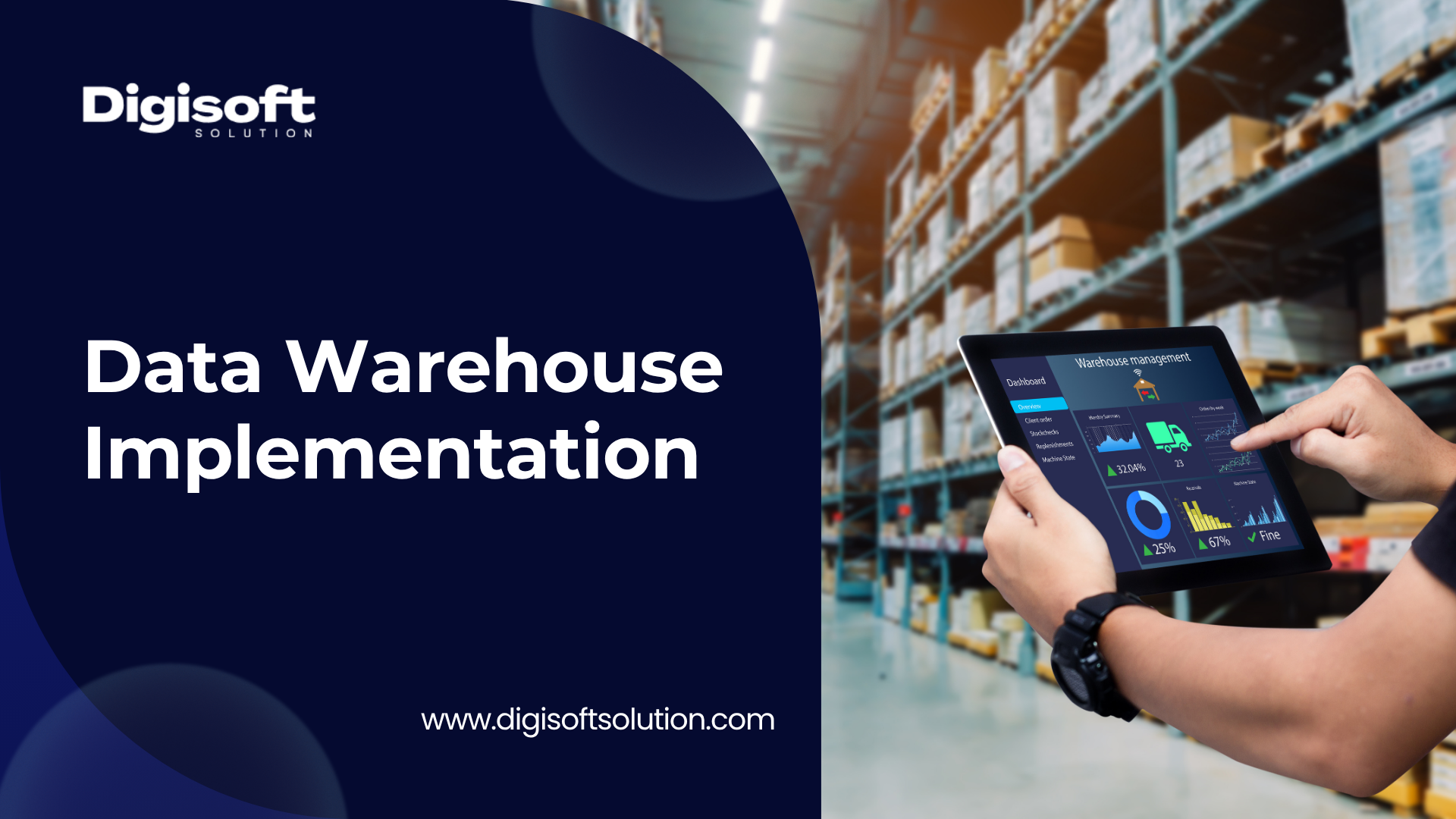
If you're reading this, you're probably past the "should we build a data warehouse" question and stuck on the harder one: how do we actually implement it without wasting six months and a big chunk of budget. That's the real query behind most searches like this, and honestly, most articles online just give you a textbook definition and a generic 5 step diagram. We're not gonna do that here.
This guide covers the actual implementation plan, the components you need, the platforms worth comparing (with real 2026 pricing, not 2021 numbers that every blog keeps copy pasting from each other), and where teams usually mess it up. We've also broken down whether the "cheap" option is actually cheap once you factor in query patterns, egress, and team overhead, because a low sticker price and a low total cost are two very different things.
What Is Data Warehouse Implementation
Data warehouse implementation is the process of designing, building, and deploying a centralized system that collect data from multiple sources, your CRM, ERP, POS, e-commerce platform, mobile app, third party APIs, and organizes it into one structured environment for reporting, analytics, and decision making.
In simple words: instead of your sales team looking at one dashboard, your inventory team looking at another spreadsheet, and finance pulling numbers from a third system that never quite matches, a data warehouse pulls all of it into a single source of truth.
A modern data warehouse implementation in 2026 usually means:
- A cloud based warehouse (Snowflake, BigQuery, Redshift, or similar)
- An ELT/ETL pipeline that moves and transform data
- A modeling layer (dbt or similar) that turns raw data into business logic
- A BI or dashboarding layer on top (Looker, Power BI, Tableau, or a custom dashboard)
- Governance, access control, and monitoring around all of it
Why Businesses Need This in 2026 (Not 2020)
A few things changed that makes this more urgent than it was a few years back:
- Data volume from omnichannel retail, IoT, and mobile apps has grown a lot faster than headcount in most data teams.
- AI and LLM based tools (including internal copilots and forecasting models) need clean, structured, queryable data. They can't work off scattered spreadsheets, no matter how good the spreadsheet is.
- Real time decision making (inventory, pricing, fraud detection) needs a warehouse that can serve near live data, not a monthly batch export that's already three weeks stale by the time someone opens it.
- Compliance requirements (GDPR, CCPA, PCI DSS depending on your industry) are easier to enforce from one governed system than a dozen disconnected tools that nobody fully remembers the login for.
If your business runs on more than 3-4 core systems and leadership is still asking "can someone pull that number for me" over Slack, you probably need this already, and maybe needed it a year ago.
Key Components of a Data Warehouse Implementation
1. Data Sources and Ingestion Layer
This is where data enters the system, from databases, SaaS tools, event streams, files, or APIs. Ingestion can be:
- Batch (scheduled loads, usually hourly or daily)
- Streaming (near real time, event by event)
- Change Data Capture, CDC (captures only what changed in a source database, so you're not re-pulling the whole table every time)
2. Storage Layer
The actual warehouse where the data sits. This is usually a columnar, cloud native database built for analytical queries rather than transactional ones, so it's not the same thing as your production app database, even though people sometimes assume it is.
3. Transformation Layer (ELT/ETL)
Raw data is rarely usable as is. This layer cleans, joins, deduplicates, and reshapes data into business friendly tables. Most teams in 2026 use an ELT approach (load first, transform inside the warehouse) rather than the older ETL model, because compute inside modern warehouses is cheap and flexible enough now to handle transformation at scale.
4. Data Modeling Layer
This defines your "single source of truth" tables, revenue by region, customer lifetime value, inventory turnover, and so on. Tools like dbt is common here.
5. BI and Reporting Layer
Dashboards, scheduled reports, and self serve analytics tools sit on top of the modeled data. This is what your business teams actually interact with day to day, so it needs to actually make sense to them, not just to the engineer who built it.
6. Governance, Security, and Access Control
Row level security, column masking, audit logs, and role based access. This isn't optional if you handle customer PII, payment data, or health records, we've seen companies skip this and regret it later.
7. Monitoring and Observability
Query performance monitoring, cost tracking, and pipeline failure alerts. Skipping this is one of the top reason warehouse bills spiral without anyone noticing until the invoice shows up and everyone's suddenly in a meeting about it.
Data Warehouse Implementation Plan: Step by Step
Here's the actual sequence we follow (and recommend), not some theoretical one from a textbook.
Step 1: Requirement and Source Audit
List every system that holds data you actually need for reporting. Don't just list everything, list what leadership and teams actually query on a weekly basis. This step alone saves a surprising amount of scope creep later on.
Step 2: Choose the Right Architecture
Decide between:
- A single cloud data warehouse (simplest, good for most mid size businesses)
- A lakehouse approach (if you have a lot of unstructured or semi structured data alongside structured data)
- A hybrid model (warehouse for BI, data lake for raw storage and ML)
Step 3: Select the Platform
This is where cost analysis matters the most, and we get into it in detail in the next section.
Step 4: Build the Ingestion Pipelines
Connect your sources using either managed connectors (Fivetran, Airbyte) or custom pipelines, depending on data complexity and budget.
Step 5: Build the Transformation and Modeling Layer
This is usually the longest phase. Business logic gets defined here, and it needs input from actual business stakeholders, not just engineers guessing at what a metric is supposed to mean.
Step 6: Connect BI Tools and Build Core Dashboards
Start with 3-5 dashboards that answer questions people are already asking manually. Don't try to build 40 dashboards on day one, nobody's going to look at all of them anyway.
Step 7: Set Up Governance and Access Rules
Define who can see what before you open access to the whole company, not after.
Step 8: Test, Validate, and Reconcile
Cross check warehouse numbers against your existing source of truth reports until they match. This step is where a lot of trust in the new system is either built or lost, so don't rush it.
Step 9: Go Live and Monitor
Launch to a small group first, gather feedback, then expand access. Keep monitoring query cost and pipeline health from week one, not after the first surprise bill lands on someone's desk.
Choosing a Data Warehouse Platform: What the Cost Actually Looks Like in 2026
This is the part most articles either skip completely or get wrong, cause they just repeat old list prices without checking whether that price is actually good for your use case. We looked at the current 2026 pricing structures and worked out where each platform genuinely wins, and where the "cheap" number on the pricing page hides a bigger real bill.
|
Platform |
Pricing Model |
Approx. Cost (Real World) |
Best Fit |
Where It Gets Expensive |
|
Google BigQuery |
Pay per TB scanned (on demand), or flat rate slots |
Around $6.25 per TB scanned; modeled 3 year TCO near $29K at 10TB workloads |
Spiky, ad hoc, unpredictable query patterns; teams already on Google Cloud |
Poorly written queries that scan full tables instead of partitions |
|
Snowflake |
Credit based compute ($2 to $3.25 per credit depending on region) plus storage ($23 to $40 per TB/month) |
Modeled 3 year TCO near $124K at 10TB workloads; egress fees often $90 to $150 per TB |
Multi cloud needs, heavy BI concurrency, teams that want operational simplicity |
Warehouses left running, and cross region egress that rarely shows up in the first quote |
|
Amazon Redshift |
Provisioned (per node hour, RA3 around $3.26/hr) or Serverless (per RPU hour) |
Modeled 3 year TCO near $63K at 10TB workloads |
AWS heavy stacks needing tight Lambda, Glue, or QuickSight integration |
Idle provisioned clusters running 24/7 even when nobody's querying anything |
A quick, honest read on what this table actually means for you:
- If your workload is bursty (analysts running queries a few times a day, not dashboards constantly refreshing every minute), BigQuery's on demand pricing is genuinely the cheapest option in most modeled comparisons, sometimes by a wide margin.
- If you're already deep in the AWS ecosystem and your workloads are steady and predictable, Redshift with reserved capacity usually comes out ahead of Snowflake on raw cost, even though it need more hands on tuning to get there.
- Snowflake isn't "expensive for no reason." You're paying for operational simplicity, strong concurrency handling, and multi cloud flexibility. If your team has multiple business units querying the same data at once with minimal DevOps support, that convenience can be worth the premium. If not, you're basically paying enterprise prices for a mid size problem.
- The number most comparison articles quietly leave out is egress. Moving data out of the warehouse (to a BI tool, a machine learning pipeline, or another cloud) can cost more over three years than the compute itself does. Always ask your vendor for this number directly, it's rarely on the front page of the pricing site, funny how that works.
So is the cheap option actually good? Not automatically. A $6.25/TB scan rate looks great on paper, but if your team writes queries that scan entire tables instead of filtering by partition, that "cheap" platform gets expensive real fast. The real cost driver in every one of these platforms, more than the sticker price, is query discipline and whether someone's actually watching the bill. We've seen companies overpay by 30 to 70 percent simply cause nobody was tracking which team's dashboard was quietly re scanning terabytes every hour.
Common Mistakes in Data Warehouse Implementation
- Building 40 dashboards before even validating that the underlying numbers are correct.
- Choosing a platform based on what's popular instead of your actual query patterns.
- Skipping governance until "later," which almost always means after a compliance issue already happened.
- No one owning warehouse cost monitoring, so bills grow quietly for months before anyone notices.
- Treating data modeling like an engineering only task, when it really needs business input to actually reflect how the company defines its metrics.
- Migrating everything at once instead of a phased rollout. This is where most timelines blow way past their original estimate.
How Digisoft Solution Helps With Custom Retail Software Development and Data Warehouse Implementation
At Digisoft Solution, we don't treat data warehouse implementation like a one size fits all product rollout. Most of our clients come to us already running some kind of retail, e-commerce, or operations platform, and the warehouse needs to sit correctly on top of what already exist, not force a rebuild of everything else.
Our approach through custom retail software development and data engineering brings together a few things generic implementation vendors usually miss:
- We map your existing systems first (POS, inventory, OMS, ERP, marketplaces) before recommending a warehouse platform, so the recommendation actually fits your data volume and query pattern instead of a generic template someone reused from another client.
- Our retail data and analytics engineering work is built specifically for retail data shapes, real time inventory, order fulfillment events, pricing changes, customer behavior, not just generic BI tables that half apply.
- Through our broader software development services, we build the custom ingestion pipelines and transformation logic that off the shelf connectors often can't handle for complex retail workflows.
- Our IT consulting team runs the platform cost comparison before you sign anything, so you're not stuck with a Snowflake bill that made sense on the sales call but not for your actual usage six months in.
- For businesses that already have legacy systems in place, our backend development services team handles the API and integration layer connecting old and new systems without breaking daily operations in the process.
- If your internal team needs extra hands during implementation without a long hiring cycle, our staff augmentation model lets you plug in data engineers on demand, then scale back down once the project's stable.
We've been doing this kind of work for over 13 years, across 500+ delivered projects, and our engineers have actual hands on experience with Snowflake, BigQuery, Redshift, and the broader modern data stack. Not just theory pulled from a vendor's sales deck.
Case Studies: How This Plays Out in Real Projects
We'd rather show you real delivery work than just claim expertise, so here's a couple examples from our own case studies that reflects the same data centric thinking behind a good warehouse implementation.
McGrocer: Global Retail Data Aggregation at Scale
McGrocer needed a retail platform that unified multiple UK retailers into a single system with real time inventory sync and cross store data aggregation, all while handling strict international compliance across 150+ countries. We built a custom product aggregation engine with real time stock validation, which is basically the same problem a retail data warehouse solves, just applied directly inside the commerce platform instead. The result was fewer stock errors, better product discovery, and a system that scaled without needing a warehouse full of extra infrastructure sitting behind it. You can read the full breakdown in the McGrocer case study.
Veridian Urban Systems: AI Driven Data Intelligence Platform
For Veridian Urban Systems, we developed an AI driven urban intelligence platform that connects multiple data streams into dashboards with KPI tracking, giving faster and more accurate insights for city level decision making. It's a good example of taking scattered data sources and turning them into one governed, queryable system, which is exactly the outcome a well implemented data warehouse should deliver for any business, retail or otherwise. Full details are in the Veridian Urban Systems case study.
Frequently Asked Questions
How long does a typical data warehouse implementation take?
Most mid size implementations take 8 to 16 weeks depending on the number of data sources, whether legacy systems need custom connectors, and how much stakeholder alignment is needed around business definitions. Larger enterprise rollouts can take longer, specially with strict compliance requirements involved.
Which is cheaper, Snowflake, BigQuery, or Redshift?
It depends entirely on your query pattern, there's no shortcut around that. BigQuery is usually cheapest for spiky, unpredictable workloads. Redshift can be cheaper for steady AWS native workloads with reserved capacity. Snowflake often costs more but buys you operational simplicity and multi cloud flexibility. There isn't a single "cheapest" answer without modeling your own workload first.
Do I need a data warehouse if I already use spreadsheets and basic dashboards?
If more than one team is manually reconciling numbers, or leadership regularly asks "why do these two reports not match," you probably need one already. Spreadsheets don't scale past a certain data volume or team size without becoming a risk in themselves, and it usually happens quieter than people expect.
What is the difference between a data warehouse and a data lake?
A data warehouse stores structured, modeled data optimized for fast analytical queries and reporting. A data lake stores raw, often unstructured data at lower cost, usually for machine learning or archival purposes. A lot of businesses in 2026 use both together in a hybrid setup, and honestly that's becoming the norm rather than the exception.
Can a data warehouse implementation fail?
Yes, and it usually fails for non technical reasons: no one owns the cost monitoring, business teams weren't involved in defining metrics, or the rollout tried to do everything at once instead of going phased.
Final Thoughts
A data warehouse implementation isn't just a technical migration, it's a decision that affects how fast your teams can make decisions for years afterward. Picking a platform because it's popular, or because a sales rep gave a great demo, is how companies end up overpaying by 30 to 70 percent without ever really realizing it. Model your actual workload, question the sticker price, and build the pipeline around how your business actually operates, not around some generic template.
If you're evaluating a data warehouse implementation for your retail or e-commerce business and want a technical, cost honest assessment before committing to a platform, talk to our team. We'll walk through your actual data sources and workload with you before recommending anything, not after
Digital Transform with Us
Please feel free to share your thoughts and we can discuss it over a cup of coffee.