Table of Content
- What is Lovable?
- How AI website development in Lovable works
- Step 1: You write a prompt
- Step 2: Lovable plans and generates the code
- Step 3: You iterate in chat
- Step 4: You publish
- Step 5: You sync to GitHub (optional but smart)
- What is under the hood: the tech stack
- What you can (and can't) build with Lovable
- Where Lovable works well
- Where Lovable struggles
- Lovable pricing in 2026, verified
- Lovable plans at a glance
- How Lovable credits work
- What one credit buys
- Is Lovable's cost actually good value?
- The case that it is a good price
- The case that the sticker price misleads
- Our verdict
- The real total cost of a Lovable website
- SEO, AEO and GEO for Lovable websites
- What changed in 2026
- What is still on you
- Security and code quality risks
- Limitations to Know About
- Exporting your code and avoiding lock-in
- Lovable vs hiring developers vs WordPress
- Practical tips to save credits and get better output
- When to hire experts
- How Digisoft Solution Can Help With Lovable Development
- Review and harden your Lovable build
- Turn the prototype into a production product
- MVP and SaaS development
- SEO, AEO and GEO setup
- Real AI features inside your site
- Design, mobile and extra capacity
- Get a clear estimate
- FAQ
- What is AI-powered website development in Lovable?
- How much does Lovable cost in 2026?
- Is Lovable really worth the money?
- Can a Lovable website rank on Google?
- Will Lovable sites show up in AI search like ChatGPT and Perplexity?
- Is Lovable secure enough for customer data?
- What happens to my app if I stop paying Lovable?
- Can I move my Lovable project to my own hosting?
- Should I use Lovable or hire a development company?
- How is Lovable different from an AI agent?
- Final thoughts
Digital Transform with Us
Please feel free to share your thoughts and we can discuss it over a cup of coffee.
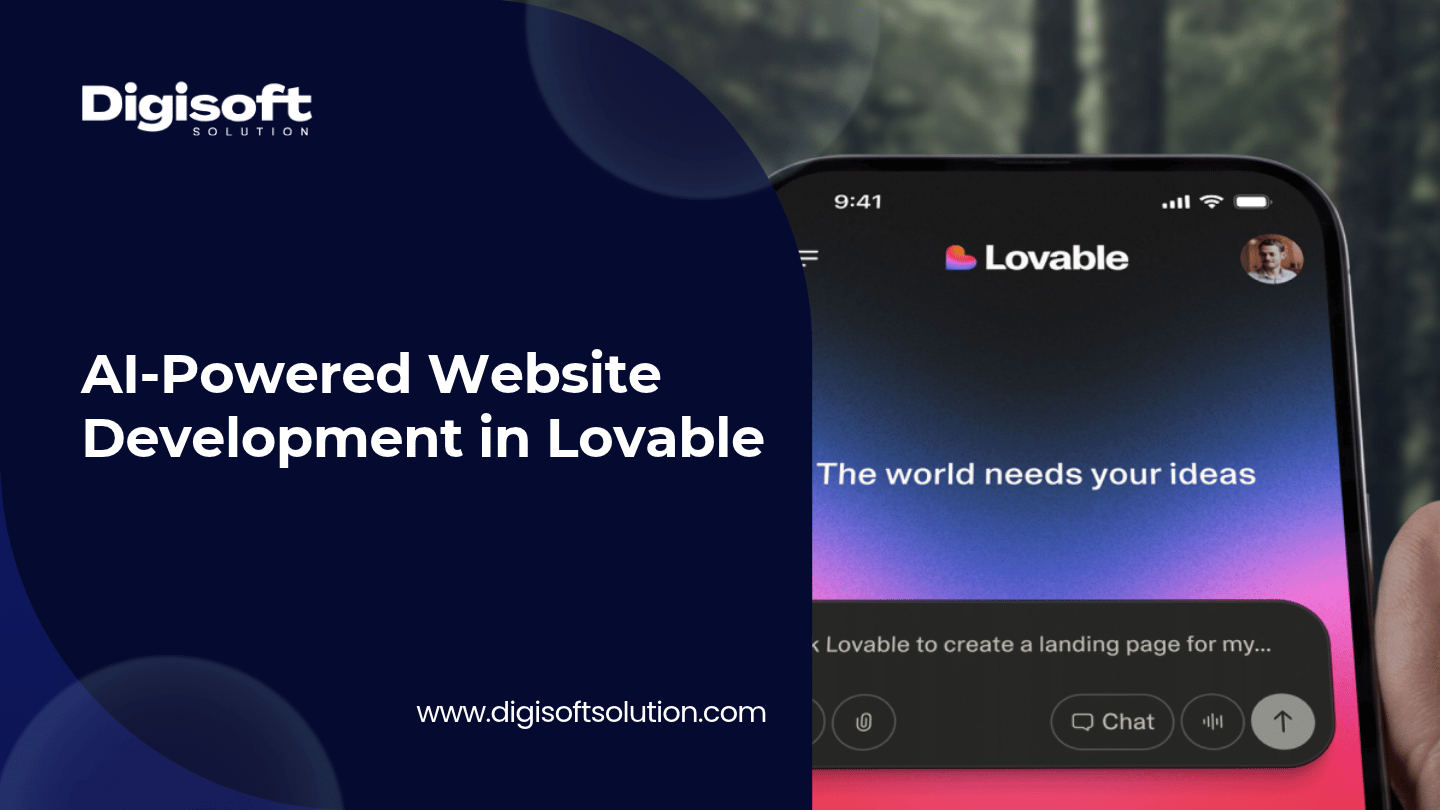
AI-powered website development in Lovable means you describe a website or web app in plain English, and Lovable's AI writes the code, connects a backend, and publishes it for you. For prototypes, MVPs, internal tools and simple marketing sites, it can cut weeks of work down to hours. The catch is that the $25 plan price is not the real cost, and the code still needs human review before real users or real data touch it.
This guide explains how Lovable works, what the 2026 pricing actually means in practice, whether Lovable sites can rank in Google and show up in AI answers, and when you should bring in a development team instead.
What is Lovable?
Lovable is an AI app and website builder. You type what you want, like "a booking site for a yoga studio with a pricing page and a contact form," and it generates a working React application with a database, login, and one-click publishing. Under the hood it routes your prompts to large language models from providers such as OpenAI, Anthropic and Google.
It started as a small open-source project and then grew very fast. By late 2025 it reported close to eight million users, and its founders have talked publicly about more than 70 million projects created on the platform. Numbers like that tell you one thing: lots of non-developers are shipping software now. They don't tell you whether the software is production ready. That's the part this article is really about.
In short, Lovable sits in the category people call vibe coding, where you steer with conversation instead of writing every line yourself. If you want a broader look at where it sits among other tools, our guide to the best AI coding tools compares the main options.
How AI website development in Lovable works
The workflow is simple on the surface. Here is what actually happens, step by step.
Step 1: You write a prompt
You describe the site, the pages, the style and the main user actions. Specific prompts work better than vague ones. "Build a landing page" burns credits on guesses. "Build a 5 section landing page with hero, three feature cards, pricing table, FAQ and contact form, using a dark blue and white palette" gets you much closer on the first try.
Step 2: Lovable plans and generates the code
The AI creates the page structure, components, styling and routing. For apps that need data, it sets up tables and login using a Supabase-compatible backend. You get a live preview almost right away.
Step 3: You iterate in chat
You ask for changes: "make the header sticky," "add a testimonials section," "connect the form to email." Each message can cost credits, and that's where budgets start to wobble. More on that in the pricing section.
Step 4: You publish
You can publish to a lovable.app address on any plan. Custom domains need a paid plan.
Step 5: You sync to GitHub (optional but smart)
Lovable can sync your project to GitHub, so a developer can review, test and extend the code outside the builder. Treat this as your safety net, not an afterthought.
What is under the hood: the tech stack
Knowing the stack helps you judge what Lovable is good at, and what it isn't. Based on how Lovable projects are generally described, this is the picture:
|
Layer |
What Lovable typically uses |
Why it matters |
|
Frontend |
React with TypeScript, Tailwind CSS, shadcn/ui components |
Standard, popular tools, so any React developer can read the code |
|
Build and rendering |
Older projects use Vite as a client-side app. Projects created on or after April 20, 2026 use TanStack Start with server-side rendering options |
This difference matters a lot for SEO (see the SEO section) |
|
Backend |
Supabase-compatible: Postgres database, authentication, storage, edge functions |
Fast to set up, but security rules must be reviewed by a human |
|
Hosting |
Lovable hosting, with Lovable Cloud as the managed backend |
Convenient, but usage can bill from your credit pool after launch |
|
Code access |
GitHub sync and export |
Your exit route if you outgrow the platform |
One more thing worth saying plainly. Because the output is standard React, you are not locked into a proprietary format. That is a real advantage over many no-code tools. If you ever need a team to take over, React.js development services or hired React developers can usually pick the project up without a full rebuild. If you want to compare React with other frameworks before committing, see our breakdown of the best frontend frameworks for web development.
What you can (and can't) build with Lovable
Where Lovable works well
- Landing pages and small business marketing sites
- Internal tools, admin panels and dashboards
- MVPs and proof-of-concept apps for investor or customer demos
- Simple SaaS prototypes with login and a database
- Portals and directories with straightforward data models
If you are a founder testing an idea, Lovable is a great way to get something in front of users fast. Our guide on how much a basic web application MVP costs shows what the traditional route looks like, so you can see exactly how much time and money a tool like this can save at the validation stage.
Where Lovable struggles
- Complex business logic, like multi-step pricing rules or compliance-heavy workflows
- Apps that need a custom backend in Node.js, .NET, Python or Laravel rather than a Supabase-style one
- Regulated industries (healthcare, finance) where audits and compliance matter
- Heavy e-commerce with subscriptions, custom checkout and inventory sync
- Large content sites that need a proper CMS
For that last group, a custom or platform-based build is usually the better path. For example, our MaxMode Shopify case study shows how subscription and one-time purchases needed custom Shopify architecture, selling plans and checkout logic. That kind of work goes well past what a prompt-built site should be trusted with.
Lovable pricing in 2026, verified
Before writing this section I cross-checked Lovable's pricing across several independent 2026 sources (CloudZero, Softr, and others) which themselves reference Lovable's pricing page and documentation. Lovable has changed its plans more than once, so confirm the live numbers on lovable.dev/pricing before you buy.
Lovable plans at a glance
|
Plan |
Monthly price |
Billed annually |
What you get |
|
Free |
$0 |
Not applicable |
5 daily build credits, capped at 30 per month, plus small monthly Cloud and AI grants. No top-ups |
|
Pro |
$25 |
About $21 per month |
100 monthly credits as the starting tier, private projects, custom domains, no Lovable badge, credit tiers that scale up |
|
Business |
$50 |
About $42 per month |
Everything in Pro plus SSO, governance and admin controls |
|
Enterprise |
Custom |
Custom |
Dedicated support, integrations, SCIM, audit logs, negotiated terms |
A few structural facts that change how you read that table:
- Paid plans are priced per workspace, not per seat. Unlimited teammates share one credit pool.
- Pro and Business are not fixed-price plans. They scale in tiers, with the top Pro tier reported at 10,000 credits for $2,250 per month.
- Students can get a discount on Pro through Lovable's student program, reported as 50 percent off for up to 12 months.
- Free, Pro and Business plans include monthly grants of 20 Cloud credits and 4 AI credits, which Lovable labels as temporary and subject to change.
How Lovable credits work
Credits are the real product. One pool covers three things: building (every message that plans or edits your app), running your live app on Lovable Cloud, and AI features inside your deployed app.
Here is how the credit types behave, according to the documentation as summarized by CloudZero, verified in October 2026:
|
Credit type |
Source |
How long it lasts |
|
Daily build grants |
Free with every plan |
Reset daily at midnight UTC, no rollover |
|
Cloud and AI grants |
Free with every plan |
Reset monthly, no rollover |
|
Monthly plan credits |
Your paid plan |
Carry forward for a limited time, then expire |
|
Top-ups |
Bought separately, paid plans only |
Valid for 12 months |
The burn order is grants first, then monthly plan credits, then top-ups. Sources disagree a little on exactly how long unused monthly credits survive, so check Lovable's own documentation before you plan around rollover.
What one credit buys
At the entry Pro tier, $25 for 100 credits works out to $0.25 per credit at list price. Lovable's own examples put a single prompt between about 0.5 credits (a small tweak like recoloring a button) and about 1.7 credits (building a landing page). Bigger features can burn many more, and rebuild loops after a bad prompt burn credits again.
Here is the simple math at the entry Pro rate, so you can estimate your own project:
|
Credits used |
Cost at $0.25 per credit |
|
25 credits |
$6.25 |
|
100 credits |
$25.00 |
|
250 credits |
$62.50 |
|
500 credits |
$125.00 |
These are not Lovable's figures for any specific website. They are just the plan rate multiplied out. Your credits-per-feature number is something you can only learn by building.
Is Lovable's cost actually good value?
This is the question most pricing articles dodge, so let's think about it technically instead of just repeating the price list.
The case that it is a good price
- Building speed. If a prototype that would take a developer a week takes you an afternoon and a few dozen credits, the build cost is tiny. For comparison, a custom web app MVP in our own cost guide lands in a realistic range of about $36,000 to $91,000 with a professional team, over 8 to 16 weeks. Lovable will not replace that for a complex product, but it can validate the idea before you spend it.
- No per-seat fee. Ten teammates sharing one workspace is genuinely generous compared with per-seat tools.
- The free tier is real. You can build and publish something small without a card.
- Standard code output. You can export to GitHub, so the money you spend is not trapped.
The case that the sticker price misleads
- You pay for attempts, not outcomes. A vague prompt followed by five corrections costs more than one good prompt. The meter can't tell the difference.
- Costs continue after launch. Once real users arrive, database queries, storage and any in-app AI features draw from your credit pool. A prototype's hosting cost rounds to zero, a busy product's does not.
- There is almost no volume discount. Based on the reported top tier (10,000 credits for $2,250), the rate is about $0.225 per credit versus $0.25 at the entry tier. That is roughly 10 percent cheaper for a hundredfold increase in usage. Heavy users should price this against a developer or a different tool.
- Usage visibility is mostly after the fact. You can see what you spent, but not always what a request will cost before you send it.
- The plan fee ignores human review. Someone still has to check security rules, accessibility, SEO setup and testing. That time is the biggest hidden cost.
Our verdict
For prototypes, MVPs, internal tools and small marketing sites, Lovable's pricing is good value, honestly very good. For a launched product with real traffic and real customer data, the subscription is only a small slice of what you will spend. Budget for the app you will run, not just the app you will build.
Its not that Lovable is overpriced. It's variably priced, and variable pricing punishes anyone who budgets from the headline number alone.
The real total cost of a Lovable website
Let's put the whole picture in one table. Where a figure comes from our own cost guides, it is noted. Where the cost depends on your project, we say so instead of making up a number.
|
Cost item |
What to expect |
Source or note |
|
Lovable plan |
Free, $25 or $50 per month at entry tiers, scaling with credits |
Lovable pricing, cross-checked November 2026 |
|
Extra credits and top-ups |
Varies with how many retries and features you need |
Depends on your prompts |
|
Lovable Cloud usage after launch |
Varies with traffic and in-app AI use |
Draws from the same credit pool |
|
Domain name |
About $10 to $15 per year |
Digisoft MVP cost guide |
|
Security scanning and vulnerability testing |
About $100 to $500 one time, then ongoing, for a basic MVP |
Digisoft MVP cost guide, simple scope |
|
Developer review, QA and fixes |
Scoped per project, since it depends on app size and risk |
Ask for a quote, no honest fixed number exists |
|
Post-launch maintenance |
About $500 to $1,500 per month for a growing MVP |
Digisoft MVP cost guide |
If you want a rough idea of what a professional build or review might run for your specific idea, our software development cost calculator gives a quick ballpark, and our article on web app development pricing models explains fixed price, time and materials, and dedicated team options.
SEO, AEO and GEO for Lovable websites
This is where old advice online is out of date, so read carefully.
What changed in 2026
For years the main complaint about Lovable was that sites were client-side rendered React apps. A crawler would get a mostly empty HTML shell, and the content only appeared after JavaScript ran. That hurt indexing and made it hard for AI crawlers to read pages.
Here is what Lovable shipped in 2026, based on reports from several SEO publications:
- On April 20, 2026, new Lovable projects began using TanStack Start, which supports server-side rendering. Lovable announced the wider "Discoverability" update publicly in mid May 2026.
- Older projects built on Vite did not get full server-side rendering. Instead they get pre-rendered HTML snapshots, served to a list of verified crawlers such as Google, Bing, social preview bots and AI engines like ChatGPT, Perplexity, Claude and Gemini.
- The same update added a Semrush connector for keyword research inside the builder, an on-demand SEO review, and AI search features such as structured data and an llms.txt style manifest. One hands-on test reported the Semrush connector costing about 10 credits per call, so keep an eye on that.
- Pre-rendering covers deployed public URLs only. Previews and unpublished projects stay invisible.
So the old line "Lovable sites can't be indexed" is mostly wrong now for new projects. But the honest follow-up is this: crawlable HTML is the entry ticket, not the win. Lovable's own documentation reportedly says visibility in AI search is still your job.
What is still on you
Even with server-side rendering, you still need to do the real SEO work. A Lovable site does not rank because it renders. It ranks because of what is on it.
Page level checklist
Titles and descriptions
Every route needs its own title tag and meta description. Do not let the AI reuse one title across the whole site. Aim for roughly 50 to 60 characters for titles and 150 to 160 for descriptions.
Canonical tags and duplicates
Set a canonical URL for each page, and check that old pre-rendered and new server-rendered versions don't create duplicates after a migration.
Site level checklist
- Use a custom domain (it needs a paid plan), not a lovable.app address, if you want brand authority.
- Create and submit an XML sitemap and a clean robots.txt.
- Use real headings (one H1 per page, logical H2 to H6 order) and descriptive internal links, not buttons that do nothing for crawlers.
- Add schema markup, such as Organization, FAQPage, Article and Product, in valid JSON-LD.
- Check Core Web Vitals. AI-generated pages sometimes ship heavy images and unused components.
- Write real content. Thin, generic AI copy won't earn rankings or citations.
AEO and GEO checklist (answer engines and generative engines)
- Put a short, direct answer near the top of key pages, 40 to 60 words, then expand below it.
- Use question-style H2 and H3 headings that match how people actually ask.
- Add an FAQ block with clear, standalone answers.
- Use tables for comparisons and costs. AI systems and featured snippets lift them easily.
- Show who wrote the page, when it was updated, and where facts came from. That is the EEAT side of things, and AI engines lean on trusted sources.
- Keep entity names consistent (brand, product, location) across pages so models connect the dots.
If you want to see what a disciplined SEO program does for a young site, look at our Launch 360 SEO case study. That site started with fewer than 10 monthly organic sessions and grew to over 2,000, with 12 to 18 keywords reaching Google's top three and 20 to 40 organic leads a month, through intent-led content, technical SEO, internal linking and measurement. For the basics before you build, our guide to search engine basics for new websites, software and mobile apps is a good starting point, and our SEO services and digital marketing services teams can handle the setup for you.
Security and code quality risks
AI generated apps move fast, and security is where speed hurts the most. Two things are worth knowing.
First, there is a documented history here. A vulnerability tracked as CVE-2025-48757, tied to missing or weak row-level security in Supabase-backed apps, was reported to have exposed data in well over 170 apps. Lovable has since added automatic checks, but those scans reportedly confirm that access controls exist, not that they are correct.
Second, the backend rules Lovable generates are functional, but they are not security reviewed. If your app stores personal data, payments or anything private, a developer needs to check:
- Row-level security policies on every table
- Authentication and role logic
- Secrets, API keys and environment variables
- Edge functions and any code that accepts user input
- File upload and storage permissions
A quick rule: if real customer data is going in, a human reviews it first. Our security testing services and web app testing services are built for exactly this, and our QA checklist before every launch lists the 34 items we check before anything goes live. If a team inherited a prompt-built project and you're wondering how long a proper review takes, see how long it takes to audit someone else's codebase.
Limitations to Know About
- Complex business logic can trigger fix-and-break loops.
- Web focus: it is not a native mobile app builder.
- Backend dependence: moving fully off Lovable Cloud means re-wiring database, auth and storage.
- Runtime cost forecasting is difficult without real traffic data.
- Compliance-heavy projects (healthcare, finance) need proper engineering and audits. See our guides to healthcare app development and fintech software development if that's your space.
- Design uniqueness: AI output can look similar to other AI-built sites unless you steer the style.
Exporting your code and avoiding lock-in
Lovable output is standard React and TypeScript with a Supabase-compatible backend, so leaving is realistic. Still, a few limits catch people mid-migration:
- GitHub sync covers one branch at a time, so feature-branch workflows don't flow back into Lovable the way teams expect.
- You can export code out, but you can't import an existing GitHub repository into Lovable.
- You can export user data from the database, but not user passwords, so a migration usually needs a password reset flow.
- If you later want Next.js, a different database or a custom API layer, you're rebuilding parts of the app, not just moving it.
- The GitHub integration asks for fairly broad repository permissions, which is worth reviewing with your security owner.
Our practical advice: export to GitHub early, set up local development and deployment before you need them, and have a developer confirm the repo builds without Lovable. If you decide to outgrow it, our web application development and website redesign services teams do this kind of handover work regularly.
Lovable vs hiring developers vs WordPress
|
Factor |
Lovable |
Custom development team |
WordPress |
|
Speed to first version |
Hours to days |
Weeks to months |
Days to weeks |
|
Upfront cost |
Low, from $0 to $50 per month at entry tiers |
Highest. A custom MVP can run $36,000 to $91,000 in our guide |
Low to medium |
|
Running cost |
Credits, which vary with usage |
Hosting plus maintenance |
Hosting, plugins, maintenance |
|
SEO control |
Good for new projects, but you must set it all up |
Full control |
Strong, with mature plugins |
|
Security |
Needs human review |
Built and tested by your team |
Depends on plugins and updates |
|
Scalability |
Fine for small to mid apps |
Built to your needs |
Fine for content sites |
|
Best for |
Prototypes, MVPs, internal tools, simple sites |
Complex, regulated or high-scale products |
Content-heavy sites and blogs |
If you're unsure between a platform and a custom build, our post on WordPress vs a custom web app explains when we advise clients not to use WordPress, and our list of the best content management systems helps if content is the heart of your site.
Practical tips to save credits and get better output
- Plan first. Write a one-page brief with pages, features, brand colors and user roles before your first prompt.
- Prompt in small, specific steps. Ask for one section or one feature at a time.
- Describe the result, the data and the edge cases ("what happens if the form is empty?").
- Don't keep asking the AI to fix the same bug in loops. If it fails twice, stop and rethink the prompt, or hand it to a developer.
- Lock your design early. Changing the style later often rewrites many files.
- Connect GitHub from day one.
- Test every form, login and payment flow on mobile before launch.
- Check your credit balance after every big feature, so there are no surprises at the end of the month.
If you are building something with real AI inside it, not just a website made by AI, our guide on how to build an AI app in 2026 goes deeper into architecture and costs.
When to hire experts
Lovable is a great starting point. You should bring in a development team when:
- You are storing customer data, payments or health or financial records
- You need integrations with CRMs, ERPs, payment gateways or legacy systems
- Your app needs custom backend logic or high traffic performance
- You want a proper SEO, schema and content strategy, not just a crawlable page
- The prototype worked and now you need to scale it
- Credit spend is climbing and rebuild loops are eating your time
Many of our clients start with a quick prototype and then bring us in to harden it. Our MVP development services and software development for startups teams can take a validated idea and turn it into something production ready, with design from our UI/UX design team and QA from software testing and QA.
How Digisoft Solution Can Help With Lovable Development
Lovable gets you to a working version fast. Digisoft Solution helps you get that version ready for real users, real traffic and real search visibility. With 13+ years in the industry and 800+ software solutions delivered, our team works as a technical partner on the parts AI builders leave open.
Review and harden your Lovable build
We review the code from your GitHub repository, check database access rules, secrets handling, authentication and form validation, and fix what needs fixing. Our software testing and QA team and security testing services cover manual and automated checks, and web app testing makes sure your core flows hold up.
Turn the prototype into a production product
When your idea outgrows the AI builder, we can extend it or rebuild the weak parts. That can mean custom web application development, React.js development, API development or cloud application development. Not sure whether to patch or rebuild? Read our take on rebuild vs refactor.
MVP and SaaS development
If your Lovable prototype proves demand, our MVP development services and SaaS development teams can build the scalable version. For a sense of what that looks like, see our Vision Care Direct case study, where a unified SaaS platform cut member onboarding from 2 to 3 days to under 30 minutes. Early-stage founders can also explore our software development for startups page.
SEO, AEO and GEO setup
Our SEO services team handles metadata, schema markup, sitemaps, internal linking and content structure so your Lovable site is easy for Google and AI answer engines to understand. The Launch 360 case study shows the approach in action.
Real AI features inside your site
Want a smart assistant, automation or a recommendation engine, not just an AI-built site? Our AI app development, AI agent development, AI chatbot development and AI integration services teams connect models to your data and workflows. If you're curious about the process, start with how to create an AI agent and what AI agents cost to build. Our Veridian Urban Systems case study shows an AI-powered platform going from concept to launch in eight months.
Design, mobile and extra capacity
Our UI/UX design team can give your AI-built site a custom look, and our mobile app development and Flutter development teams can take it to iOS and Android. If you need more hands, you can hire dedicated developers or React.js developers who plug into your workflow.
Get a clear estimate
Use our software development cost calculator for a quick ballpark, or book a free consultation to talk through your Lovable project. You can also browse more case studies to see our work.
FAQ
What is AI-powered website development in Lovable?
It is a way of building websites and web apps by describing them in plain English. Lovable's AI generates the React code, sets up a backend with a database and login, and lets you publish the result. You refine the site by chatting instead of coding.
How much does Lovable cost in 2026?
Lovable has a Free plan at $0, Pro from $25 per month, Business from $50 per month, and custom Enterprise pricing. Paid plans start at 100 credits and scale up in tiers. Annual billing works out to roughly $21 and $42 per month for Pro and Business entry tiers. Prices change, so confirm on lovable.dev/pricing.
Is Lovable really worth the money?
For prototypes, MVPs, internal tools and small marketing sites, yes. The build cost is low compared with traditional development. For launched products, plan for credit usage after launch, plus human review for security, QA and SEO, which are the larger costs.
Can a Lovable website rank on Google?
Yes. Since the 2026 update, new Lovable projects use server-side rendering through TanStack Start, and older projects get pre-rendered pages for verified crawlers. Ranking still depends on content quality, unique titles and descriptions, a custom domain, internal linking, schema and backlinks.
Will Lovable sites show up in AI search like ChatGPT and Perplexity?
They can be crawled, since Lovable serves rendered HTML to major AI crawlers. Being cited is a separate matter. It depends on clear answers, trustworthy content, structured data and authority, which you still need to build.
Is Lovable secure enough for customer data?
Not without review. Lovable generates working security rules for its Supabase-style backend, but they aren't security audited. Have a developer check row-level security, authentication, secrets and file permissions before storing real user data.
What happens to my app if I stop paying Lovable?
Your code can be synced to GitHub and exported, so you keep the project. But if your live app uses Lovable Cloud and your credits run dry, some paid features may stop working. Set up your own deployment early if the app matters to your business.
Can I move my Lovable project to my own hosting?
Yes. The code is standard React and TypeScript, so it can be deployed elsewhere. Moving the backend takes more care, especially around authentication, since user passwords can't be exported and users may need to reset them.
Should I use Lovable or hire a development company?
Use Lovable to validate an idea quickly and cheaply. Hire a development company when you need security, integrations, compliance, custom backend logic or scale. Plenty of teams do both, they prototype in Lovable, then hand it to engineers to harden.
How is Lovable different from an AI agent?
Lovable is a builder that creates software from prompts. An AI agent is software that plans and completes tasks by itself, using tools and data. You can use Lovable to build the interface, but the agent logic usually needs dedicated engineering.
Final thoughts
Lovable is one of the quickest ways to turn an idea into a working website or app in 2026, and for validation it's hard to beat. The $25 entry price is fair, and the per-workspace model is generous. Just don't mistake the entry price for the full bill. Credits, post-launch usage, security review, QA and SEO setup are where real budgets get decided, and a few of those need a human who has done it before.
Start small, export early, review security before launch, and treat SEO and AI search visibility as ongoing work, not a checkbox. And when your prototype turns into a real product, that's the moment to call in an engineering team.
Digital Transform with Us
Please feel free to share your thoughts and we can discuss it over a cup of coffee.