Medizen
AI-Powered Healthcare Platform for Clinical Documentation & Patient Record Management








About the Client
Medizen
- IndustryHealthcare / Digital Health (HealthTech)
- PlatformAI-powered Web & Mobile Healthcare Platform
- ClientMedizen
- Delivery10 Months
Medizen is a healthcare technology company focused on helping healthcare organizations digitize patient care and streamline clinical administration. Our client's vision was to build a scalable platform that could seamlessly support hospitals, clinics, and independent practitioners to improve operational efficiency.
The client required a secure, compliant, and high-performance solution capable of supporting future growth, multi-organization deployment, and intelligent automation without disrupting existing healthcare workflows.
Project Overview
Project Overview
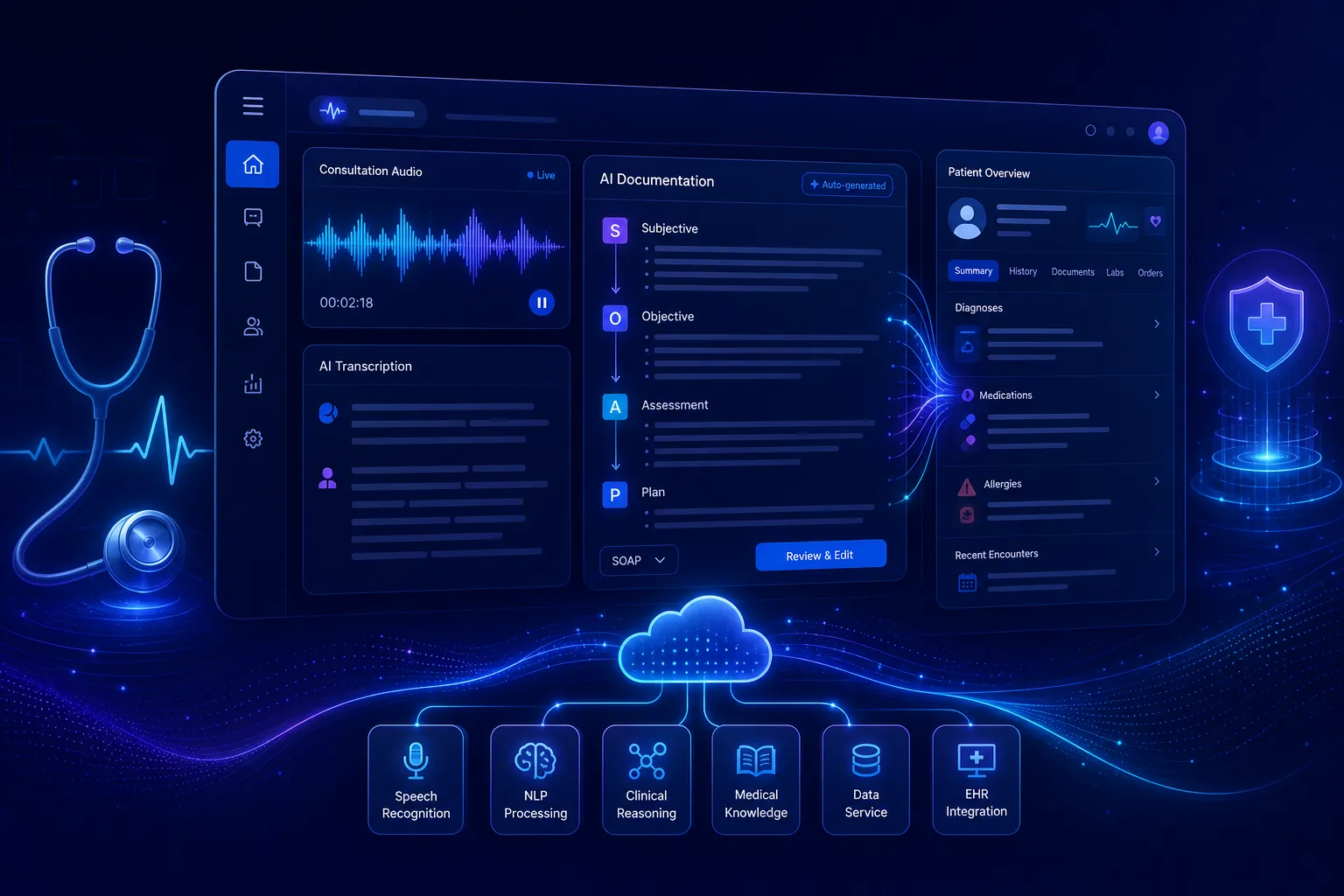
Healthcare providers often struggle with fragmented patient information, time-consuming administrative tasks, and disconnected clinical workflows. This impacts operational efficiency and patient care. Digisoft Solution developed Medizen, an AI-powered healthcare platform that unifies clinical and patient management into a secure digital ecosystem.
By streamlining healthcare operations and reducing manual documentation through intelligent automation, the platform enables healthcare professionals to deliver faster, more accurate, and patient-centric care.
The platform leverages AI-powered speech recognition, Retrieval-Augmented Generation (RAG), and large language models. It automatically generates structured medical documentation while preserving clinical context and improving documentation accuracy.
The Concept
The Concept
Medizen is a cloud-native, microservices-based healthcare platform built for scalability and interoperability. An API Gateway securely routes requests, while event-driven architecture and asynchronous messaging process AI tasks without disrupting clinical workflows.
The AI engine combines speech recognition, LLMs, RAG, and semantic search. Patient records are converted into vector embeddings for accurate context retrieval, enabling reliable AI-generated clinical documentation with secure data access and centralized data management.
Key Challenges Addressed
Key Challenges Addressed
Time-Consuming Clinical Documentation
Doctors spent significant time manually documenting consultations, updating patient records, and preparing clinical notes after each appointment. These repetitive administrative tasks reduced the time available for patient care and slowed overall clinical productivity.
Fragmented Patient Information
Patient histories, diagnoses, prescriptions, laboratory reports, and consultation records were scattered across multiple systems or paper-based files. The lack of a centralized view made it difficult for healthcare professionals to access complete and accurate patient information quickly.
Limited Continuity of Patient Care
Patients often missed medications, follow-up visits, and treatment plans due to limited communication outside clinical appointments. Healthcare providers needed better tools to improve ongoing patient engagement and treatment adherence.
Managing electronic medical records, consultation recordings, and sensitive patient information required a highly secure platform. Robust access controls, data protection, audit logging, and compliance-ready security practices were essential to safeguard healthcare data.
Trustworthy AI-Assisted Documentation
Clinical documentation required reducing AI hallucinations, preserving medical context across consultations, and protecting patient health information (PHI). AI-generated outputs had to remain accurate, context-aware, and grounded in verified medical records for reliable clinical use.
Technical Solutions We Implemented
Technical Solutions We Implemented
We transcribed doctor-patient conversations using OpenAI Whisper and processed them using large language models (LLMs). Structured prompts and AI guardrails generate consistent clinical notes while preserving medical context and reducing AI hallucinations.
Intelligent Appointment & Care Management
Automated workflows manage appointment scheduling, prescriptions, medication reminders, follow-up notifications, and care coordination. This reduces administrative effort while improving patient engagement and clinical efficiency.
Unified Electronic Medical Records (EMR) Platform
A normalized EMR schema organizes patient profiles, medical history, diagnoses, prescriptions, laboratory reports, and consultation records into a unified patient timeline with fully indexed records for fast and reliable access.
Patient records are converted into vector embeddings and indexed in Pinecone for low-latency semantic retrieval. RAG grounds LLM responses with verified clinical history, improving factual accuracy and minimizing hallucinations.
Asynchronous AI Processing Pipeline
We placed audio transcription and AI documentation jobs into AWS SQS queues and processed them asynchronously through background AI workers. This prevents long-running AI tasks from blocking clinician workflows.
Multi-Role Access Management
Role-Based Access Control (RBAC) enforces least-privilege access for doctors, patients, administrators, and clinical staff. This ensures secure handling of sensitive healthcare information.
REST APIs expose transactional healthcare services, while GraphQL enables flexible, client-driven queries for dashboards and reporting interfaces across web and mobile applications.
Containerized microservices are deployed on Amazon EKS (Kubernetes), enabling independent service deployment, horizontal scaling, high availability, and resilient healthcare operations.
Observability & Performance Monitoring
OpenTelemetry provides distributed tracing, while Prometheus and Grafana monitor infrastructure metrics, application performance, and automated alerts for proactive issue resolution.
We enforced security through JWT, OAuth 2.0, RBAC, AES-256 encryption for data at rest, TLS for data in transit, AWS KMS for key management, audit trails, and secure secret management to protect PHI.
System Architecture
System Architecture
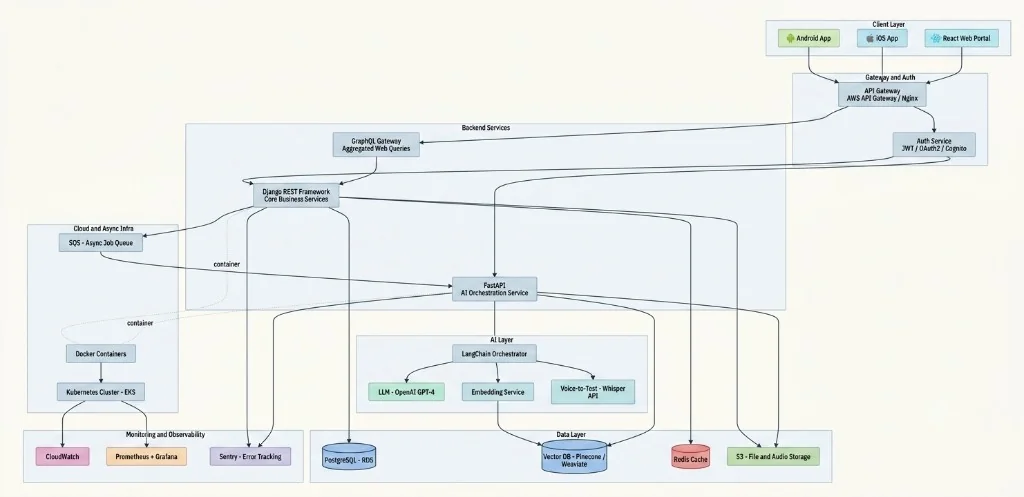
Digisoft Solution built Medizen with a cloud-native microservices architecture that integrates client applications, APIs, AI services, data storage, cloud infrastructure, and monitoring for secure and scalable healthcare operations.
| Component | Responsibility |
|---|---|
| Client Layer | Provides user-facing applications through Android and iOS native mobile apps for doctors and patients, along with a React-based web portal for clinic administrators. All clients authenticate securely and reuse access tokens for REST and GraphQL API communication. |
| API Gateway | Acts as the single entry point for all client requests. It manages request routing, TLS termination, API throttling, authentication validation, and basic request filtering before forwarding traffic to internal services. |
| Authentication & Authorization Service | Handles user authentication using JWT and OAuth 2.0 workflows through AWS Cognito. It issues and validates tokens while enforcing role-based permissions for doctors, patients, administrators, and clinical staff. |
| Backend Services (Django REST Framework + FastAPI) | Django REST Framework (DRF) manages core healthcare business operations, including appointments, prescriptions, EMR workflows, and patient management. FastAPI handles AI orchestration workloads requiring asynchronous processing, external AI integrations, and high-performance API execution. |
| GraphQL Gateway | Provides a flexible query layer for web applications by aggregating data from multiple backend services. It reduces over-fetching and under-fetching compared to multiple REST API calls and improves dashboard performance. |
| AI Processing Layer | Uses LangChain, Large Language Models (LLMs), embeddings, and speech-to-text services to process consultation recordings, generate medical documentation, and retrieve relevant patient context through Retrieval-Augmented Generation (RAG). |
| Voice-to-Text Service | Converts doctor-patient conversations into structured text using speech recognition models such as OpenAI Whisper, enabling automated clinical documentation workflows. |
| LLM & RAG Orchestration Layer | Coordinates prompt execution, retrieves relevant clinical context from vector databases, and generates grounded AI-assisted medical notes while reducing hallucinations through contextual retrieval and validation. |
| Vector Database | Stores embeddings of medical notes, diagnoses, and historical patient records to enable semantic search and context-aware retrieval for RAG-based AI workflows. Technologies include Pinecone / Weaviate. |
| PostgreSQL (Amazon RDS) | Acts as the primary transactional database for structured healthcare information, including patient profiles, appointments, prescriptions, reminders, and clinical records. It provides ACID compliance required for reliable healthcare data management. |
| Redis Cache | Improves application performance by caching frequently accessed information such as doctor schedules, authentication sessions, and rate-limit counters, reducing database load and improving response times. |
| Amazon S3 Storage | Provides secure and durable storage for consultation audio recordings, uploaded medical documents, generated reports, and prescription PDFs. |
| AWS SQS Message Queue | Enables asynchronous processing of long-running AI workloads, including transcription and medical note generation. It prevents AI tasks from blocking clinician workflows and improves system responsiveness. |
| Containerization & Orchestration (Docker + Amazon EKS) | Containerizes application services and manages deployment through Kubernetes. Amazon EKS enables automated scaling, service isolation, self-healing, and rolling deployments for high availability. |
| Monitoring & Observability Stack | Provides end-to-end system visibility using Amazon CloudWatch, Prometheus, Grafana, and Sentry. Infrastructure monitoring, application metrics, distributed tracing, and error tracking enable proactive performance management. |
Architecture Approach
Architecture Approach: Why It Works Better
We follow a secure, event-driven microservices architecture where web and mobile applications securely communicate through an API gateway. This enables scalable healthcare services, intelligent AI workflows, and seamless data exchange across interconnected components.
Architecture Flow
- Client Applications → API Gateway: Web and mobile applications send authenticated requests through an API Gateway, which validates identities, applies security policies, and routes traffic to appropriate healthcare microservices.
- Healthcare Microservices: Dedicated appointment, EMR, prescription, notification, and patient management services operate independently. This ensures modular development, fault isolation, high availability, and seamless feature deployment without affecting other services.
- AI Processing Pipeline: Consultation recordings enter AWS SQS queues, where asynchronous AI workers perform speech transcription, semantic retrieval, and clinical documentation generation without interrupting clinician workflows.
- RAG & Vector Retrieval: Patient records are converted into vector embeddings and indexed in Pinecone, enabling Retrieval-Augmented Generation (RAG) to retrieve verified medical context before LLM inference.
- LLM Documentation Engine: Structured prompts, system guardrails, and retrieved clinical context enable large language models to generate accurate, context-aware medical notes. This reduces hallucinations and maintains documentation consistency.
- Secure Storage & Monitoring: AI-generated clinical notes are securely stored within the EMR platform, while OpenTelemetry, Prometheus, audit trails, encryption, and RBAC continuously monitor and protect healthcare operations.
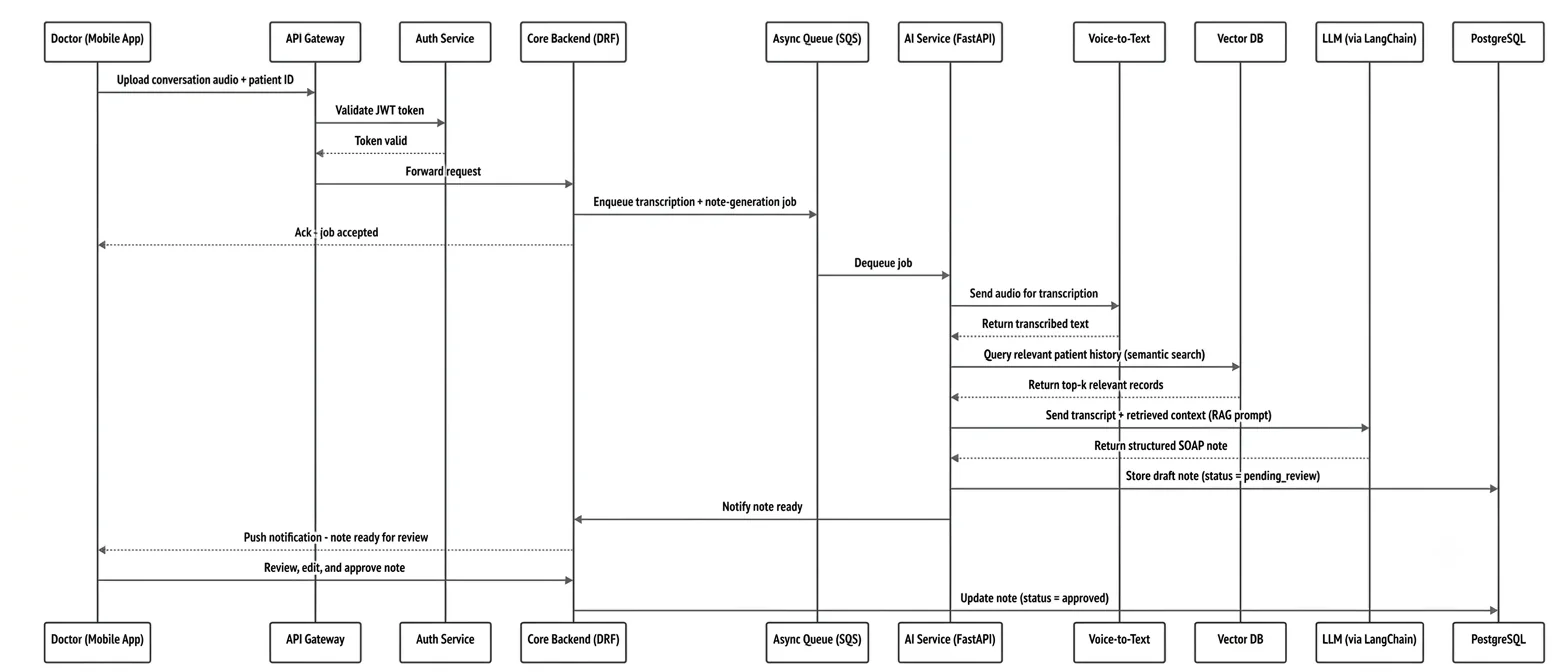
Data Flow
Data Flow
| Step | Process | Description |
|---|---|---|
| Audio Upload | Consultation Recording | The doctor records the patient consultation through the mobile app and securely uploads the audio file. |
| Authentication | Token Validation | API Gateway validates the JWT token through the Auth Service before allowing access to healthcare services. |
| Async Processing | Job Queue Management | The backend places the AI processing request into AWS SQS, allowing the application to remain responsive while background processing continues. |
| Speech Processing | Voice-to-Text Conversion | AI service retrieves the queued job and converts consultation audio into text using the speech recognition engine. |
| Context Retrieval | Patient History Search | The system retrieves authorized clinical information relevant to the consultation context. From the vector database, including medical history, allergies, and previous consultations. |
| AI Note Generation | RAG + LLM Processing | The transcript and retrieved clinical context are processed through the LLM using structured prompts to generate SOAP-format medical notes. |
| Data Persistence | EMR Storage | Generated notes are stored in PostgreSQL with a pending review status until validated by a healthcare professional. |
| Clinical Review | Doctor Approval | Doctors review, edit, and approve AI-generated notes before they become part of the official EMR record. |
Database Design
Database Design
The platform uses a relational database model designed to support secure healthcare workflows, including user management, doctor-patient interactions, AI-powered consultation processing, prescriptions, and medication tracking. The schema follows normalized design principles with optimized relationships, indexing strategies, and caching mechanisms for high-performance access.
| Table | Purpose | Key Relationships |
|---|---|---|
| USERS | Central identity table storing common user information. User roles differentiate between doctors, patients, and administrators. | Parent entity for DOCTORS and PATIENTS. |
| DOCTORS | Stores doctor-specific professional details such as specialization and license information. | One-to-one relationship with USERS through user_id. Creates appointments and issues prescriptions. |
| APPOINTMENTS | Core transactional entity managing scheduled doctor-patient consultations. | Links patients and doctors using patient_id and doctor_id. |
| PATIENT_DIARY | Stores patient-generated health records, observations, and personal medical entries. | Associated with individual patients. |
| CONSULTATION_NOTES | Stores consultation transcripts, AI-generated summaries, and doctor review status. | Linked to appointments. Supports one-to-one or one-to-many consultation records. |
| NOTE_EMBEDDINGS | Stores vector embeddings generated from consultation notes for AI search and retrieval workflows. | Linked with consultation notes for semantic search and RAG-based AI features. |
| PRESCRIPTIONS | Stores medication details prescribed by doctors during consultations. | Connected to both patients and doctors. |
| MEDICATION_REMINDERS | Handles automated medication notifications and schedules. | One prescription can generate multiple reminders based on dosage frequency. |
Database Schema
Database Schema
USERS
| Column | Data Type | Constraint |
|---|---|---|
| iD | UUID | Primary Key |
| name | String | — |
| String | Unique | |
| role | String | Doctor / Patient / Admin |
| created_at | Timestamp | — |
DOCTORS
| Column | Data Type | Constraint |
|---|---|---|
| id | UUID | Primary Key |
| user_id | UUID | Foreign Key → USERS |
| specialization | String | — |
| license_no | String | Unique |
Relationship: USERS (1) → (1) DOCTORS
APPOINTMENTS
| Column | Data Type | Constraint |
|---|---|---|
| id | UUID | Primary Key |
| patient_id | UUID | Foreign Key → USERS |
| doctor_id | UUID | Foreign Key → DOCTORS |
| scheduled_at | Timestamp | — |
| status | String | Scheduled / Completed / Cancelled |
Relationship: PATIENT → APPOINTMENTS ← DOCTOR
PATIENT_DIARY
| Column | Data Type | Constraint |
|---|---|---|
| id | UUID | Primary Key |
| patient_id | UUID | Foreign Key → USERS |
| entry_text | Text | — |
| created_at | Timestamp | — |
CONSULTATION_NOTES
| Column | Data Type | Constraint |
|---|---|---|
| id | UUID | Primary Key |
| appointment_id | UUID | Foreign Key → APPOINTMENTS |
| transcript | Text | Raw consultation transcript |
| ai_summary | Text | AI-generated summary |
| review_status | String | Pending / Approved |
Relationship: APPOINTMENT (1) → (Many) CONSULTATION_NOTES
NOTE_EMBEDDINGS
| Column | Data Type | Constraint |
|---|---|---|
| id | UUID | Primary Key |
| note_id | UUID | Foreign Key → CONSULTATION_NOTES |
| embedding_vector | Vector | AI semantic representation |
PRESCRIPTIONS
| Column | Data Type | Constraint |
|---|---|---|
| id | UUID | Primary Key |
| patient_id | UUID | Foreign Key → USERS |
| doctor_id | UUID | Foreign Key → DOCTORS |
| medication_details | Text | — |
| issued_date | Date | — |
MEDICATION_REMINDERS
| Column | Data Type | Constraint |
|---|---|---|
| id | UUID | Primary Key |
| prescription_id | UUID | Foreign Key → PRESCRIPTIONS |
| reminder_time | Time | — |
| frequency | String | Daily / Weekly / Custom |
Relationship: PRESCRIPTION (1) → (Many) MEDICATION_REMINDERS
Indexing Strategy
Indexing Strategy
The database uses targeted indexes to improve query performance for frequently accessed workflows.
| Index | Purpose |
|---|---|
| Composite Index: (doctor_id, scheduled_at) on APPOINTMENTS | Optimizes doctor schedule retrieval and daily appointment views. |
| Composite Index: (patient_id, status) on PRESCRIPTIONS | Enables fast lookup of active patient prescriptions. |
| Partial Index: review_status = 'pending_review' on CONSULTATION_NOTES | Accelerates doctor review queues by indexing only pending AI-generated notes. |
| Vector Index on NOTE_EMBEDDINGS | Improves semantic similarity search for AI-powered medical knowledge retrieval. |
Data Flow Relationships
Data Flow Relationships
This database architecture provides a scalable foundation for AI-powered healthcare workflows while maintaining data integrity, optimized query performance, and secure handling of sensitive medical information.
USERS
├── DOCTORS
│ ├── APPOINTMENTS
│ │ └── CONSULTATION_NOTES
│ │ └── NOTE_EMBEDDINGS
│ └── PRESCRIPTIONS
│ └── MEDICATION_REMINDERS
│
└── PATIENTS
├── APPOINTMENTS
├── PATIENT_DIARY
└── PRESCRIPTIONS
Core Features & Functionalities
Core Features & Functionalities
The platform automatically converts doctor-patient conversations into structured clinical notes. We use speech recognition, large language models, and contextual patient history in the platform, significantly reducing manual documentation efforts.
Digital Prescription Management
Healthcare providers generate electronic prescriptions directly within the platform, and patients receive organized medication information. This remains accessible throughout their treatment journey.
A centralized EMR system securely stores patient demographics, diagnoses, prescriptions, consultation history, laboratory reports, and treatment records. This provides healthcare professionals with a complete clinical view.
Smart Appointment Management
Doctors and patients can schedule, manage, reschedule, and track appointments through an integrated scheduling system with automated notifications and calendar management.
Medication Reminder System
Automated reminders help patients follow prescribed medication schedules and upcoming appointments. This improves treatment adherence and supports better long-term health outcomes.
AI-Powered Clinical Search
Semantic search retrieves relevant historical patient records based on contextual meaning rather than keyword-based searches. This enables healthcare providers to access critical medical information more efficiently.
Secure Role-Based Access
Doctors, patients, and administrators access dedicated dashboards protected through authentication, authorization, and role-based permissions. This ensures confidential healthcare information remains secure.
Patient Health Diary
Patients can maintain daily health logs, symptoms, wellness updates, and treatment progress. It allows doctors to monitor health trends between clinical visits.
Technologies and Tech Stack We Used
Technologies and Tech Stack We Used
| Category | Technologies |
|---|---|
| Language | Python 3.11 |
| Backend Frameworks | FastAPI, Django REST Framework (DRF) |
| Frontend | React.js (Web Portal), Kotlin (Android), Swift (iOS) |
| API Style | REST APIs, GraphQL |
| Database | PostgreSQL (Amazon RDS) |
| Vector Database | Pinecone |
| Cache | Redis |
| Messaging & Queue | AWS SQS |
| AI & Machine Learning | OpenAI GPT-4, LangChain, Retrieval-Augmented Generation (RAG), OpenAI Whisper, OpenAI Embeddings |
| Cloud & Infrastructure | AWS EC2, AWS EKS (Kubernetes), AWS RDS, AWS S3, AWS Cognito, Amazon CloudWatch |
| Containerization & Orchestration | Docker, Kubernetes (Amazon EKS) |
| DevOps & CI/CD | GitHub Actions, Amazon ECR |
| Monitoring & Observability | Prometheus, Grafana, Sentry, Amazon CloudWatch |
APIs Developed
APIs Developed
The platform was built with secure, role-based APIs to support authentication, appointment management, prescriptions, AI-powered consultation workflows, patient records, and dashboard integrations.
| Method | Endpoint | Purpose | Authentication | Response |
|---|---|---|---|---|
| POST | /api/v1/auth/login | Authenticates users and issues JWT tokens for secure access | Public (Credential-Based) | Access token and refresh token pair |
| POST | /api/v1/appointments | Creates a new patient appointment | JWT (Patient/Admin) | Created appointment object |
| GET | /api/v1/appointments/{doctor_id} | Retrieves a doctor's appointment schedule | JWT (Doctor/Admin) | List of appointment objects |
| POST | /api/v1/prescriptions | Creates a new prescription record | JWT (Doctor) | Created prescription object |
| GET | /api/v1/reminders/{patient_id} | Fetches active medication reminders for a patient | JWT (Patient) | List of reminder objects |
| POST | /api/v1/consultations/audio | Uploads consultation audio for AI-powered clinical note generation | JWT (Doctor) | Job ID with accepted status |
| GET | /api/v1/consultations/{id}/note | Retrieves AI-generated draft consultation notes for review | JWT (Doctor) | Draft SOAP note object |
| PATCH | /api/v1/consultations/{id}/note | Enables doctors to edit and approve AI-generated consultation notes | JWT (Doctor) | Updated note object |
| POST | /api/v1/diary | Allows patients to add personal health diary entries | JWT (Patient) | Created diary entry object |
| GET | /api/v1/emr/{patient_id} | Retrieves a patient's electronic medical records (EMR) summary | JWT (Doctor/Admin) | EMR summary object |
| POST | /graphql | Provides aggregated queries for web portal dashboards and reporting | JWT (Any Role) | GraphQL response payload |
API Security Highlights:
- JWT-based authentication with role-based authorization for patients, doctors, and administrators.
- Secure API access using token-based session management.
- Protected healthcare data exchange through authenticated endpoints.
- GraphQL integration for optimized dashboard data retrieval and reduced API overhead.
Security Implementation
Security Implementation
| Security Control | Implementation |
|---|---|
| JWT Authentication | Implemented short-lived access tokens with longer-lived refresh tokens. Role claims are embedded within tokens to support secure downstream authorization. |
| OAuth 2.0 Authentication | Supported secure social and institutional login workflows through AWS Cognito OAuth 2.0 integration. |
| Encryption | Protected data in transit using TLS 1.2+ encryption and secured data at rest using AES-256 encryption for Amazon RDS databases and Amazon S3 storage. |
| Role-Based Access Control (RBAC) | Enforced authorization at the API layer, providing distinct least-privilege permissions for doctors, patients, administrators, and clinical staff. |
| PII/PHI Protection | Secured sensitive healthcare information, including medical history and patient details, through access controls, audit tracking, and data masking in non-production environments. No PHI data is stored in application logs. |
| Audit Logging | Maintained detailed audit trails for all clinical record operations, including create, update, and delete activities with user identity, timestamps, and before/after state tracking for compliance traceability. |
| API Security | Implemented input validation, ORM-based parameterized queries, CORS restrictions, and secure secret management through AWS Secrets Manager. Sensitive credentials are never hardcoded. |
| Rate Limiting & Abuse Prevention | Applied API Gateway-based rate limiting per user/IP to prevent misuse, protect system resources, and control unexpected LLM processing costs. |
Testing & Quality Assurance
Testing & Quality Assurance
- Validated appointment scheduling, prescription management, medication reminders, and electronic medical record (EMR) workflows to ensure seamless functionality across web and mobile applications.
- Verified speech-to-text processing, Retrieval-Augmented Generation (RAG), semantic search, and AI-generated clinical documentation for accuracy, consistency, contextual relevance, and reliable medical information retrieval.
- Evaluated AI quality through prompt validation, hallucination testing, groundedness evaluation, and response consistency testing to ensure generated clinical notes remained clinically relevant and aligned with verified patient records.
- Tested REST and GraphQL APIs, authentication workflows, role-based access control (RBAC), encryption, audit logging, and healthcare data protection to ensure secure system operations.
- Performed load and latency benchmarking on concurrent appointment bookings, AI processing pipelines, and asynchronous background services to validate scalability, responsiveness, and reliable performance under increasing workloads.
- Executed end-to-end, integration, regression, and cross-platform testing before every production release to maintain platform stability, reliability, and a consistent user experience across web, Android, and iOS applications.
Our Approach & Development Timeline
Our Approach & Development Timeline
Healthcare Requirements Analysis & Solution Planning
Architecture Design & Technology Selection
Backend & AI Development
Web & Mobile Application Development
AI Integration, Validation & Optimization
Cloud Deployment & Continuous Improvement
Measurable Outcomes
Measurable Outcomes
The Medizen platform significantly improved healthcare operations by reducing administrative workload and accelerating clinical documentation. This enhances patient engagement through AI-assisted workflows.
Reduced average clinical documentation time by 8–10 minutes per consultation through AI-generated medical notes and automation.
Improved API response times by 35%, achieving sub-200 ms (P95) latency through query optimization and caching.
Achieved a 95% clinician acceptance rate for AI-generated draft notes using RAG, prompt engineering, AI guardrails, and human validation.
Maintained sub-250 ms semantic search latency through Pinecone vector indexing for rapid contextual patient information retrieval.
- Processed 600+ concurrent AI transcription jobs using AWS SQS without disrupting clinician workflows or platform performance.
- Maintained 99.9% platform availability while supporting 5× concurrent user load through cloud-native microservices and Kubernetes.
Digisoft Solution built Medizen as a cloud-native, AI-powered healthcare platform that unifies clinical workflows, patient management, and intelligent automation. This cross-platform solution is powered by large language models, retrieval-augmented generation (RAG), and scalable cloud infrastructure.
Medizen streamlines healthcare operations, accelerates clinical documentation, and delivers secure, efficient, and patient-centric digital healthcare experiences.