Table of Content
- Key Takeaways
- What Is Google AI Mode?
- AI Mode vs AI Overviews vs Classic Search vs ChatGPT and Perplexity
- What Changed This Week (November 2026)
- How Google AI Mode Works (Query Fan-Out Explained)
- The five steps
- Why ranking #1 is no longer enough
- Citations are unstable (so do not trust one test)
- What Google does not show you
- What Google Says to Do, and What to Skip
- Prompts for AEO: The Complete Library
- Part A: How People Prompt Google AI Mode
- Part B: Prompts to Audit Your Visibility
- Part C: Prompts to Find Gaps and Improve Pages
- Prompts to Stop Using
- How to Measure Google AI Mode Visibility
- What Google gives you
- What you track yourself
- A Practical Google AI Mode Checklist
- AI in a Website Revamp: Get Your Site Ready for AI Mode
- Ads Inside AI Mode: What Advertisers Need to Know
- How Much Does AEO Cost? We Re-Checked the Numbers
- The Short Answer
- What the Market Says
- We Re-Checked What Other Articles Claim
- The Hours Math
- Agency vs In-House vs DIY vs Tools
- Is Your AEO Quote a Good Deal? Quick Test
- What Drives the Price Up or Down
- How Digisoft Solution Helps Your Website Show Up in Google AI Mode
- Questions People Ask About Google AI Mode
- What is Google AI Mode?
- What is query fan-out?
- What does AEO stand for?
- What is GEO, and how is it different from AEO?
- What is the difference between AI Mode and AI Overviews?
- How do I use Google AI Mode?
- How do I get my website into AI Mode answers?
- How do I track my brand in AI Mode?
- How do I write content that AI Mode can cite?
- FAQ
- How long does it take to see results from AEO work?
- Should a small local business care about AI Mode?
- Do I need to rewrite all my old blog posts?
- What content format works best for AI Mode?
- Does page speed matter for AI Mode?
- Can AI-written content show up in AI Mode?
- Should I block AI crawlers?
- What is the best tool to track AI Mode?
- How often should I update my content?
- Can Digisoft Solution build AI features for my site?
- Final Thoughts
Digital Transform with Us
Please feel free to share your thoughts and we can discuss it over a cup of coffee.
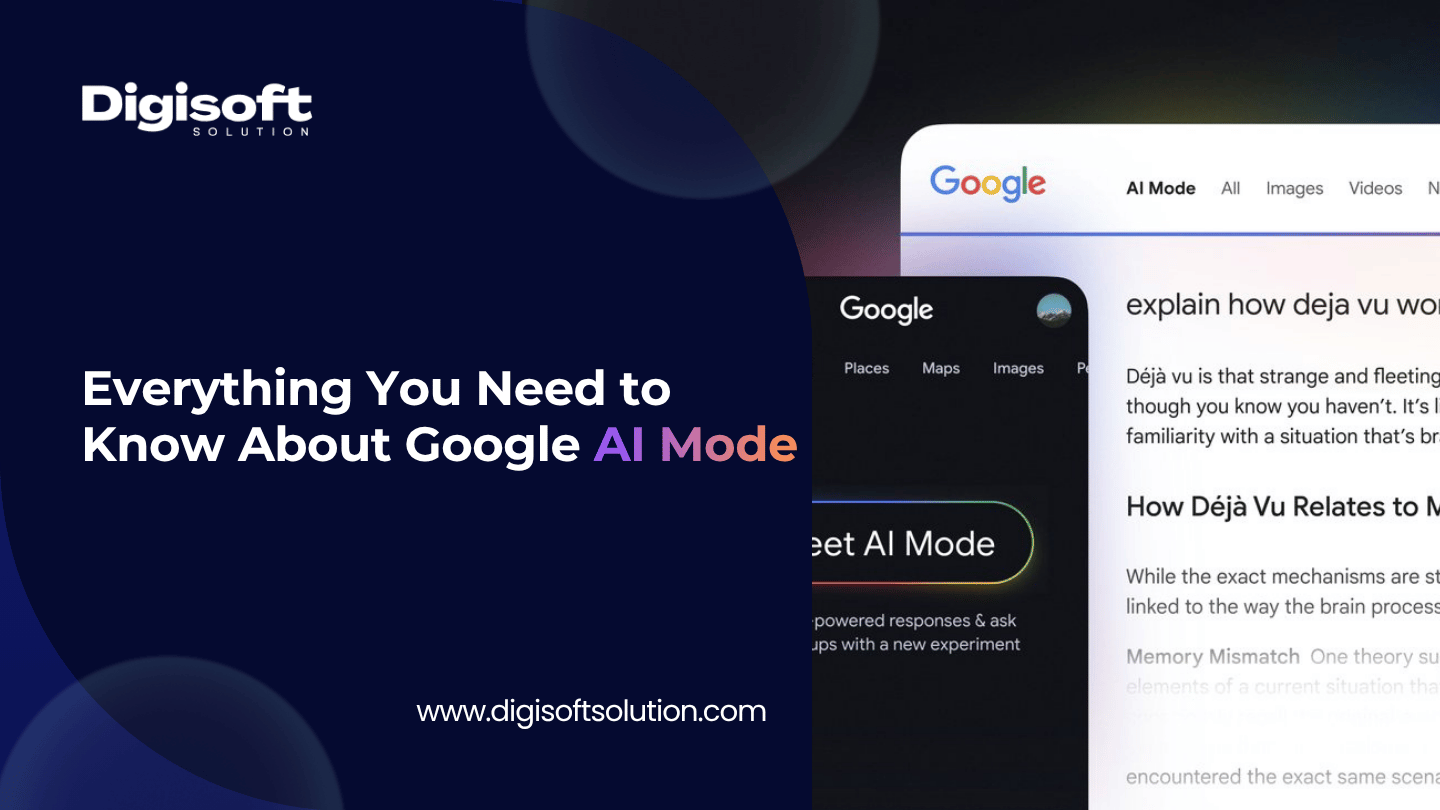
Google AI Mode is a conversational version of Google Search, powered by Gemini. It splits your question into many smaller searches (called query fan-out), reads the results, and writes one answer with links. To appear in it, you need pages that Google can crawl and index, that answer the small sub-questions clearly, and that add something original.
"Prompts for AEO" means two things: the prompts real people type into AI Mode, and the prompts you run to test and improve your own visibility. This guide gives you both, ready to copy.
What does it cost? Most agencies charge $2,000 to $10,000 a month for AEO and GEO work in 2026. After re-checking the numbers, we think $3,000 to $8,000 a month is the fair zone for a single-site business. The full cost check is further down.
Key Takeaways
- Google's own guide (published May 15, 2026) treats AEO and GEO as part of SEO. There is no secret AI file or trick for Google.
- AI Mode runs many sub-searches for one prompt, so your page can win a citation by answering one sub-question really well, even if it does not rank #1 for the main keyword.
- Citations are unstable. In one third-party study, only 9.2% of cited URLs showed up in all three runs of the same prompts on the same day. Test every prompt more than once.
- This week matters: a core update started November 10 and Gemini 4 Hydrogen became the default AI Mode model on November 12. Hold off on judging your results for a while.
- Ads are now showing inside AI Mode answers, so paid and organic need one plan.
- You can do a lot of this yourself with the prompt library below. Pay an agency for execution time, not for dashboards.
What Is Google AI Mode?
Google AI Mode is a Search experience where you ask longer, more detailed questions, get a written answer, and then keep the conversation going with follow-ups. Behind the scenes it uses Gemini models and Google's index. It can take text, images, files, videos and even Chrome tabs as input, according to a November 2026 explainer from NHI Mgmt Group.
A quick timeline, so you know where this came from:
- March 5, 2025: AI Mode starts as an opt-in Labs test.
- May 20, 2025: Google announces a US rollout at I/O, with no Labs sign-up needed.
- 2026: It becomes widely available, gets new models, and starts carrying ads in selected markets.
- November 12, 2026: Gemini 4 Hydrogen becomes the default model (more on this below).
It is free to use inside Google Search. Some newer features start with Google AI Pro and AI Ultra subscribers, so what you see may differ from what a paying user sees.
AI Mode vs AI Overviews vs Classic Search vs ChatGPT and Perplexity
|
Feature |
Classic Google results |
AI Overviews |
AI Mode |
ChatGPT, Perplexity and others |
|
Format |
List of links |
Short summary above the results |
Full conversation with follow-ups |
Chat or answer engine |
|
How it searches |
One main query |
Summary built from search results |
Many sub-queries run in parallel (fan-out) |
Their own retrieval systems |
|
Best at |
Navigation, quick lookups |
Quick factual answers |
Complex, multi-part, comparison questions |
Research and drafting |
|
Citations |
Blue links |
Links inside and beside the summary |
Links in the answer and a sources panel |
Vary a lot by tool |
|
Ads |
Yes |
Yes |
Yes, labeled Sponsored, in selected markets |
Depends on the tool |
|
Google's SEO guidance applies? |
Yes |
Yes |
Yes |
No, Google's guide covers only Google |
A note on "did AI Mode and AI Overviews merge?" Some sites say they merged in May 2026. Others have checked and say that claim does not hold up, and that Google is really testing ways to move people from an Overview into AI Mode. Because sources disagree, we are not claiming a merge. What is certain is that Google keeps linking the two experiences together.
What Changed This Week (November 2026)
A lot happened in the last seven days. If you are checking your traffic right now, read this first.
|
Date |
What happened |
Why it matters to you |
|
Nov 10 |
Google began rolling out the November 2026 core update, a global update that can take up to two weeks |
Classic rankings and AI citations can both move. It runs into Black Friday week. |
|
Nov 10 |
Gemini 4 Carbon arrived in AI Mode for Google AI Ultra subscribers |
Premium users may see different answers than free users. |
|
Nov 12 |
Google made Gemini 4 Hydrogen the default model in AI Mode and began using it for the hardest AI Overview questions |
Google says it handles multi-part questions, typos and very specific requests better. Shallow pages will struggle with detailed prompts. |
|
Nov 4 to 12 |
More ads showed up inside AI Mode: up to four text ads under one answer, multi-turn ads (Google confirmed on Nov 9), and sponsored local retailer packs |
Paid results now sit inside the answer. Brands without a paid plan can lose space. |
|
Nov |
Google began testing a "Source preferences" button in the AI Mode sources panel, and added more inline links higher in answers |
Users can choose trusted sources on the spot. Brand trust becomes a real lever. |
Do not panic-edit your site this week. The Hydrogen rollout started two days into the core update, so you cannot easily tell which one caused a change. Google has also suggested waiting about a week after a core update finishes before judging results. A core update can effect both classic rankings and AI citations, so wait, then compare.
How Google AI Mode Works (Query Fan-Out Explained)
Google's documentation says AI Mode and AI Overviews can use query fan-out. In plain words, the system does not just search your exact words. It writes several related searches, runs them at the same time, and combines what it finds.
The five steps
- It reads the prompt. That includes the intent, earlier turns in the chat, and location.
- It fans out. One prompt becomes many sub-queries. Google does not publish the number. Third-party estimates range from about 5 to 20, often 8 to 16, so treat that as a rough guess.
- It retrieves. Each sub-query pulls from Google's index and other data sources like local and shopping data.
- It writes an answer. Gemini combines the results into one response.
- It cites and links. The answer shows the pages it used. Every follow-up starts the cycle again.
Why ranking #1 is no longer enough
Here is the shift. The old contest was "my page against yours for one keyword." The new one is "which page best answers each sub-question."
- Ahrefs reported that only about 38% of AI Overview citations came from pages ranking in the organic top 10 for the same query, down from 76% in earlier research (as summarized by Parse).
- A third-party study of AI Mode found only 14% exact-URL overlap between AI Mode citations and the top 10 organic results (21.9% at domain level).
- A Surfer study reported that pages ranking for fan-out sub-queries were 161% more likely to be cited than pages ranking only for the head term. That is a vendor study, so read it as direction, not as a promise.
What this means for you: a narrow, specific page that answers one sub-question well can beat a bigger, more famous page. Your H2 and H3 headings act like a menu of the sub-questions you are eligible to win.
Citations are unstable (so do not trust one test)
The same study that measured overlap ran identical prompts three times on one day. Only 9.2% of cited URLs appeared in all three answer sets, and 18.5% appeared in two. Overlap between AI Mode and AI Overview citations was just 13.7%, even though the answers themselves were about 86% similar in meaning.
Takeaway: one screenshot proves nothing. Anyone who sells you "guaranteed citations" is guessing, or worse.
What Google does not show you
Google does not publish the fan-out sub-queries for any prompt, not in Search Console, not in Analytics. Tools that list "your fan-out queries" are using a language model to guess likely ones. They are still useful as a checklist, but they are not Google's real data.
A quirk worth knowing: the May 2026 arXiv study (again via Parse) found AI Overviews appeared on 13.7% of queries on average, but on 64.7% of question-form queries. So writing for real questions is not just a style choice, it matches where AI answers actually show up.
What Google Says to Do, and What to Skip
On May 15, 2026, Google published "Optimizing your website for generative AI features on Google Search". It is the first official playbook for AI Overviews and AI Mode. Google says AI search is still SEO, we mostly agree with that, but only for Google. Other tools like ChatGPT and Perplexity use their own systems, and nobody outside those companies can fully verify what they weigh.
|
Do this (Google says it helps) |
Skip this (Google says it is not needed for its AI features) |
|
Make sure key pages are indexed and eligible to show snippets |
Creating an llms.txt file |
|
Publish original, "non-commodity" content: first-hand experience, real data, a clear point of view |
Chopping content into tiny "AI chunks" |
|
Cover the technical basics: Search Console, crawlable pages, good page experience, semantic HTML |
Rewriting everything in a special "AI style" |
|
Keep local and product details accurate (Google Business Profile, Merchant Center) |
Buying or faking brand mentions |
|
Add useful images and video |
Over-investing in structured data just for AI |
|
Build depth across the whole topic, not one keyword |
Paying extra for any of the above |
Two notes so you do not over-read this:
- Structured data is not banned. It is still useful for rich results where you are eligible, and it does no harm if it matches the visible page. It is just not an AI shortcut.
- Agentic search is early. The guide includes optional guidance for AI agents that browse and act for users. Clean semantic HTML and labeled form fields help both humans and agents, so it is cheap to do. Our website revamp guide covers llms.txt and schema questions in more detail.
Google also announced on June 3, 2026 that it is testing a Search Console control that lets site owners manage how their content appears in generative AI features, plus new reporting. It started with a subset of site owners in the UK, so you may not see it yet.
Prompts for AEO: The Complete Library
Most guides give you three tips and call it "prompts for AEO." Here you get the whole kit, in three parts:
- Part A: how real people prompt AI Mode, and what your pages need to answer.
- Part B: prompts you run to audit your visibility.
- Part C: prompts you give an AI assistant to find gaps and improve pages safely.
Replace anything in [brackets] with your own details.
Part A: How People Prompt Google AI Mode
AI Mode prompts are longer and more specific than old keyword searches. People stack constraints, ask follow-ups, and expect a recommendation. Hydrogen, the new default model, is built to handle exactly this.
|
Prompt pattern |
Example prompt |
What your page needs |
|
Comparison |
"Compare Shopify and WooCommerce for a store with 500 products and a small team" |
A comparison table with clear criteria and honest trade-offs |
|
Stacked constraints |
"Best booking software for a 10-person clinic that needs HIPAA support and costs under $100 a month" |
Constraints stated in plain words: size, compliance, price |
|
How-to with context |
"How do I redesign my site without losing rankings if I am changing CMS?" |
Numbered steps plus edge cases for each situation |
|
Cost |
"How much does a website redesign cost in 2026 and what is included?" |
A price table with ranges, assumptions and what drives the number |
|
Local and urgent |
"Pediatrician near me open Saturday that accepts Aetna" |
Accurate hours, insurance list, address, tap-to-call |
|
Follow-up |
"Which of those is cheapest to maintain?" |
Maintenance and running costs, not just launch costs |
|
Trust check |
"Is [brand] legit? What do customers say?" |
Reviews, credentials, an About page, third-party mentions |
Writing rule: put the direct answer in the first two sentences under each heading, then add detail. AI systems can lift that block, and readers love it too.
Part B: Prompts to Audit Your Visibility
Run these in Google AI Mode first, then in ChatGPT, Perplexity and Gemini. Log what happens.
Prompt 1: The category test
What are the best [service or product] providers for [type of customer] in [city or country]? Explain how you chose them and list your sources.
Prompt 2: The problem-first test
I run a [type of business] and I have this problem: [problem]. What should I do first, what will it cost, and how long will it take?
Prompt 3: The comparison test
Compare [your brand] and [competitor] for [use case]. Use a table covering price, strengths, weaknesses and who each one suits.
Prompt 4: The brand fact-check
What does [your brand] do, where is it based, who are its customers, and what does it charge? List the sources you used.
Prompt 5: The reputation test
What do customers say about [your brand]? Summarize the good and the bad.
Prompt 6: The price probe
How much does [your service] cost in 2026, what drives the price, and what is a fair price?
Prompt 7: The three-turn follow-up chain
Send these one after another in the same chat, because follow-ups trigger a fresh fan-out each time.
Turn 1: I need [service]. What should I look for?
Turn 2: Which of those options is cheapest to maintain over three years?
Turn 3: Shortlist three providers and explain why.
Prompt 8: The local test
Best [specialty] near [neighborhood] that is open on weekends and accepts [insurance or payment method].
Prompt 9: The downside test
What are the downsides of [service category], and who should avoid it?
Prompt 10: The source probe
Which websites would you trust for information about [topic], and why?
This one only hints at which sources the model likes. It is not Google's ranking list, so do not treat it as one.
How to run the audit properly
- Run each prompt three times in separate sessions. Because citations shift so much, one run is an anecdote.
- Use the same device and location every time, and note whether you were signed in.
- Count a win only when you show up in at least 2 of 3 runs.
- Test AI Mode, AI Overviews (search the question normally), ChatGPT, Perplexity and Gemini separately.
- Re-test every four weeks, and after any big update.
Copy this log into a spreadsheet:
|
Date |
Platform |
Prompt # |
Run (1, 2, 3) |
Brand mentioned? |
URL cited |
Competitors named |
Facts correct? |
Action to take |
If the answer gets a fact wrong (old address, wrong price, wrong service), fix the source pages, listings and profiles it is likely pulling from. Our online reputation management services team helps with the review and listing side of this.
Part C: Prompts to Find Gaps and Improve Pages
These go to an AI assistant. They are for finding problems and drafting options, not for publishing without review.
Prompt 11: Fan-out gap finder
Act as a search analyst. For the question "[question]", list 12 sub-questions a search engine might run in parallel to answer it fully. Group them by intent: definition, cost, comparison, risks, steps, local, proof. Then compare them with the page text below and mark which ones the page does NOT answer.

[paste page text]
Remember, this produces educated guesses, not Google's real sub-queries. Use it as a checklist.
Prompt 12: Heading match
Here are the H2 and H3 headings of my page: [paste headings]. Which likely sub-questions have no matching heading? Suggest heading wording that sounds like a real question.
Prompt 13: Answer-first rewrite
Rewrite only the first two sentences under this heading so they directly answer "[question]" in 40 to 60 words. Keep every fact. Add no new claims, numbers or sources.

[paste section]
Prompt 14: Evidence check
List every claim in this section that needs a source, a number or first-hand proof. Do not invent any sources. Tell me what evidence a reader would want.

[paste section]
Prompt 15: Question mining from real customers
Here are 50 anonymized customer emails, support tickets and sales call notes. Extract the 15 most common questions in the customers' own words, and group them by topic.
This is the best prompt on the list. Real customer questions are original data, which is exactly the "non-commodity" content Google asks for. Remove names and private details before you paste anything.
Prompt 16: Consistency check
Compare these five pages and flag any contradictions in pricing, hours, services, locations or claims: [paste text or URLs].
Prompt 17: Semantic HTML review
Review this HTML for structure: heading order, lists, tables, form labels and landmarks. List problems by severity and say how to fix each.

[paste HTML]
Prompt 18: Matching structured data
Write JSON-LD for [Organization, LocalBusiness or FAQPage] that matches ONLY what is visible on this page. Do not add any fact that is not in the text.

[paste page text]
Prompt 19: Crawler access check
Review this robots.txt and list which major search and AI crawlers it blocks. Quote the exact user-agent and disallow lines. Do not guess.

[paste robots.txt]
Guardrails for Part C
- A human must review everything before it goes live. A May 2026 arXiv study found about 11% of claims in AI Overviews were not supported by the cited pages, which shows how easily AI summaries drift from the facts.
- Never paste confidential, patient or customer data into a public AI tool.
- Make your claims explicit and quotable: numbers, dates, named sources. Vague writing gets summarized wrongly.
- Do not publish AI drafts that add nothing new. Volume is not a strategy.
Prompts to Stop Using
|
Prompt or tactic |
Why to skip it (for Google) |
|
"Rewrite my page in 100-word chunks for AI" |
Google says chunking is not needed |
|
"Generate an llms.txt file for my site" |
Not needed for Google's AI features |
|
"Write 500 near-identical location pages" |
Thin, repeated content is a quality risk |
|
"Write fake reviews or mentions of my brand" |
Google says inauthentic mentions do not help, and it can hurt trust |
|
"Give me the exact keywords AI Mode uses" |
Google does not publish fan-out queries |
How to Measure Google AI Mode Visibility
You cannot measure this perfectly yet. You can measure it well enough to make decisions.
What Google gives you
Google's AI features documentation says that sites appearing in AI Overviews and AI Mode are included in the overall search traffic in Search Console. So your clicks and impressions are in there, but mixed with everything else. Google has also started testing extra AI reporting for a subset of site owners, so check your own account for new reports.
What you track yourself
The AI visibility scorecard
|
Metric |
How to calculate it |
Why it matters |
|
Mention rate |
Prompts where your brand is named, divided by prompts tested |
Shows if you are in the conversation at all |
|
Citation rate |
Prompts where your URL is linked, divided by prompts tested |
Shows if the answer sends people to you |
|
Share of voice |
Your mentions divided by mentions of you plus named competitors |
Shows who is winning the category |
|
Accuracy rate |
Answers with correct facts about you, divided by answers that mention you |
Wrong facts cost you trust and leads |
|
Referral clicks |
Visits from Google and AI tools in GA4 |
Shows the traffic result |
|
Branded search trend |
Searches for your name in Search Console |
Often rises when you are recommended |
|
Conversions |
Leads or sales from those visits |
The number that pays the bills |
Weekly checks
- Search Console: clicks, impressions and top pages for the question-style queries you care about.
- A quick look at the log: any new competitor names or wrong facts?
- Reviews and listings: new reviews answered, details still correct?
One caution on tools
A lot of teams forgets to ask how an "AI rank tracker" actually samples answers. Ask any tool vendor how many times it runs each prompt, from which locations, and whether it uses the real AI Mode or a lookalike. If they cannot answer, the dashboard is decoration. And remember, AI visibility tools are cheap now (more on cost below), so do not pay agency prices for a login.
A Practical Google AI Mode Checklist
This list follows Google's own guidance. None of it is exotic, and that is the point.
- Confirm indexing. Verify your site in Search Console and check that key pages are indexed and not blocked from snippets.
- Fix the basics. Speed, mobile layout and clean HTML still decide who gets surfaced. Our mobile SEO guide and search engine basics cover this.
- Map your sub-questions. For each money page, list the definition, cost, comparison, risk, steps and proof questions. Use Prompt 11.
- Give every sub-question a heading and a direct answer. Two to three sentences first, then depth.
- Add original proof. Your own numbers, screenshots, case studies and named experts. Generic tips are "commodity" content.
- Show real expertise. Author bios, credentials, review dates and sources.
- Keep facts consistent everywhere. Same name, address, phone, prices and hours across your site, Google Business Profile and directories.
- Earn real mentions and reviews. Do not buy them. Our SEO services and digital marketing services cover outreach and review building.
- Use images and video that explain something. Not decoration.
- Match structured data to visible content. Optional, harmless, and useful for rich results.
- Check crawler access. Do not block search bots by accident in robots.txt or your CDN. Use Prompt 19.
- Plan content, not one-off posts. A content roadmap keeps you from publishing less pages than your topic needs.
Proof that foundations work: in our Launch 360 case study, an intent-led plan built on keyword clusters, internal linking, technical indexing and content architecture took a site from fewer than 10 monthly organic sessions to 2,000+, with 20 to 40 organic leads a month. Those are results reported in that case study, and yours will depend on where you start. For online stores, see our MaxMode Shopify case study and ecommerce SEO services.
AI in a Website Revamp: Get Your Site Ready for AI Mode
If your site is slow, built on messy templates, or full of thin pages, a revamp is often the biggest AEO move you can make. AI can speed that project up a lot. It can also fill your new site with generic text that nobody cites. Our full guide to revamping a website effectively covers steps, costs and AI in depth. Here is the AI Mode angle.
|
Revamp task |
How AI helps |
The AI Mode angle |
Human check |
|
Content audit |
Clusters pages by topic, finds duplicates and thin pages |
Spot topics with missing sub-question coverage (Prompt 11) |
You decide what to keep, merge or remove |
|
URL and redirect mapping |
Suggests old-to-new matches at scale |
Protects the pages AI Mode may already cite |
Review every low-confidence match |
|
Wireframes and prototypes |
Fast first drafts, see our guide to AI-powered website development in Lovable |
Build answer-first page templates from day one |
Designer fixes UX and brand |
|
Copy and metadata |
Drafts headings, summaries, alt text |
A direct answer under every heading |
Add proof and check every fact |
|
Accessibility and semantic HTML |
Flags structure and label problems |
Clean HTML helps people and AI agents |
Manual keyboard and screen reader tests |
|
Testing |
Generates test cases |
Catches broken redirects and leftover noindex tags |
QA owns the plan, see our QA checklist before every launch |
|
On-site AI |
A chatbot answers visitor questions and qualifies leads |
Turns a cited click into a conversation |
Guardrails and a human handoff |
Timing tip: do not push a major migration while the core update is still settling, and think twice about launching in Black Friday week (November 27) or Cyber Monday (November 30). Save your baseline numbers first, launch after the dust settles, and then monitor for 90 days.
Need help? Our website redesign services and UI/UX design team rebuild the structure, and our AI development services add AI features where they pay for themselves, like an AI chatbot or an AI agent. If you are not sure an AI feature is worth it, our AI consulting team can check the business case first.
Ads Inside AI Mode: What Advertisers Need to Know
AI Mode now carries ads labeled "Sponsored" in selected markets. In early November, people spotted up to four text ads under a single answer, multi-turn ads that appear as a conversation continues (Google confirmed these on November 9), and sponsored local retailer packs. Google's help pages also list local inventory ads and vehicle ads as experiments, and some product panels now show "Add to cart" and "Buy now" buttons, as reported by PPC Land.
What to do about it:
- Treat paid search and AEO as one plan. Ads buy presence today. AEO earns trust and citations over time.
- Keep Search campaigns tight, with negatives and weekly search-term reviews, because automated features can widen your reach.
- Make sure your landing pages answer the long, specific questions people now ask.
- According to our Google Ads for doctors guide, ads in AI surfaces run through the same auction, and you cannot target or opt out of them separately from Search.
Our PPC advertising services team builds and audits these campaigns.
How Much Does AEO Cost? We Re-Checked the Numbers
Cost is where most AEO articles either get vague or quietly sell you something. So we read ten popular pricing guides, compared them against each other, and ran simple hours math to see which numbers actually make sense. Many of those guides are written by companies that sell AEO, so keep that bias in mind. We flag it below.
The Short Answer
|
Question |
Answer |
|
What do most agencies charge for AEO and GEO in 2026? |
About $2,000 to $10,000 a month for focused work |
|
What is the full market spread? |
About $1,500 to $50,000+ a month |
|
What do we think is fair for a single-site business? |
$3,000 to $8,000 a month, if the quote shows hours and deliverables |
|
What does a one-time audit cost? |
Roughly $1,500 to $10,000 depending on site size |
|
What do AI visibility tracking tools cost? |
About $50 to $1,000+ a month |
What the Market Says
|
Source |
Reported range |
Who wrote it |
Date |
|
MarketerHire |
$2,500 to $25,000 a month. Fractional specialist $2,500 to $8,000, boutique agency $6,000 to $15,000, full service $15,000 to $25,000+. One-time audit $3,000 to $10,000 |
A talent marketplace that sells fractional specialists |
Oct 2026 |
|
The Remarkable Agency |
$3,000 to $15,000 a month. Audit $1,500 to $5,000 |
An agency |
Jun 2026 |
|
OutreachBloom |
Most B2B pay $2,000 to $10,000. Small business from about $1,500. Enterprise $25,000 to $50,000+ |
An agency that lists its own plan at $4,900 a month |
Nov 2026 |
|
310 Creative |
Most $3,000 to $15,000. Entry $1,000 to $3,500. Mid-tier $4,000 to $12,000 |
An agency |
Aug 2026 |
|
Digital Strategy Force |
$2,000 to $50,000 for similar scope. Tracking dashboards now cost from $50 a month |
An agency |
Jun 2026 |
|
Organik PI |
AEO-native specialists $6,000 to $20,000. Hybrid agencies $10,000 to $25,000 |
An agency |
Aug 2026 |
|
Stackmatix |
$1,500 to $15,000+. DIY $200 to $800 |
An agency |
Mar 2026 (oldest, treat as dated) |
We Re-Checked What Other Articles Claim
Here is what held up and what did not.
|
Claim you will see online |
What we found |
Verdict |
|
"AEO costs $1,500 to $50,000+ a month" |
True as a spread, useless as a budget. One guide calls its own $2K to $50K range "14x wide," but $50,000 divided by $2,000 is 25x. A small slip, but it shows why you should do the math yourself |
Accurate range, not a budget |
|
"Anything under $1,500 is rebranded SEO" |
At $100 to $150 an hour, $1,500 buys only 10 to 15 hours, so the claim is fair for US agencies. Offshore teams at $25 to $75 an hour can deliver 20 to 60 hours for the same money |
Fair for US agencies, too strict for offshore |
|
"A $4,000 AEO retainer compounds, while Google Ads stops the moment you pause" |
Partly true. Site improvements stay. Citations do not stay: only 9.2% of cited URLs repeated across three same-day runs. The value compounds in content quality, not in a guaranteed mention |
Half true, overstated |
|
"AI visibility dashboards cost $15,000 to $25,000 a month" |
Tracking software now starts around $50 a month. You pay an agency for the work, not the login |
Outdated |
|
"An in-house AEO specialist costs $80,000 to 130,000"(olderguide)vs"130,000 to $180,000" (newer guide) |
Different seniority levels. At $130,000 to $180,000 base, that is $10,833 to $15,000 a month before benefits. Add $1,500 to $3,000 a month in tools and it is about $12,300 to $18,000 a month |
Both can be true, pick by seniority |
|
"You need llms.txt, chunking or special AI schema" |
Google's May 2026 guide says none of these are needed for its AI features |
Do not pay a premium for these (for Google) |
|
"AEO is a separate discipline and costs 2 to 3 times more than SEO" |
One guide puts traditional SEO at $1,500 to $8,000 and AEO at $2,500 to $25,000. But Google treats AEO as part of SEO. A premium is fair only for extra deliverables like citation outreach or multi-platform tracking |
Pay for scope, not for the label |
The Hours Math
Cost is hours multiplied by rate. We used the hourly bands from our website revamp cost guide ($25 to $75 for offshore teams, $100 to $150 for small US agencies, $150 to $225 for mid-size US agencies) as a planning assumption. Marketing rates can differ, so swap in your own.
|
Monthly retainer |
Hours at $25 to $75 |
Hours at $100 to $150 |
Hours at $150 to $225 |
What that realistically buys |
|
$1,500 |
20 to 60 |
10 to 15 |
7 to 10 |
Audit, basic schema, a few page fixes |
|
$3,000 |
40 to 120 |
20 to 30 |
13 to 20 |
Monthly prompt testing plus 2 to 3 page rewrites |
|
$5,000 |
67 to 200 |
33 to 50 |
22 to 33 |
Testing, 3 to 5 page rewrites, listings and review work |
|
$8,000 |
107 to 320 |
53 to 80 |
36 to 53 |
All of the above plus new content and light outreach |
|
$15,000 |
200 to 600 |
100 to 150 |
67 to 100 |
Multi-location or multi-product program with outreach |
Here is a simple monthly plan that fits in about 35 hours (our own planning estimate, not an industry standard):
- 6 to 8 hours running and logging the audit prompts
- 10 to 14 hours rewriting three to five key pages
- 6 hours on technical checks
- 6 hours on listings, reviews and entity cleanup
- 4 hours on reporting
Ask any agency for an hours or phase breakdown. If a quote implies far fewer hours than this, something is missing.
Agency vs In-House vs DIY vs Tools
|
Path |
Monthly cost |
Best for |
Watch out for |
|
DIY with the prompts in this guide |
Your time, plus $0 to $50 if you use basic tools |
Small sites with a content person who has spare hours |
Slow results if nobody owns it |
|
AI visibility software only |
About $50 to $1,000+ |
Tracking, not fixing |
Tools that sample answers only once |
|
Fractional specialist |
$2,500 to $8,000 |
Growing businesses that want a senior brain part-time |
Limited hours |
|
Boutique or mid-size agency |
$3,000 to $15,000 |
Most SMBs and B2B companies |
Vague scope and no hours listed |
|
Full-service or enterprise agency |
$15,000 to $50,000+ |
Multi-region brands with PR and citation work |
Paying enterprise rates for a small site |
|
In-house senior hire |
About $12,300 to $18,000 before benefits |
Large teams with steady workload |
Tool costs and the hiring risk |
Its worth noting a tool-only plan is cheaper then an agency, but it does not fix a single page. Tracking tells you what is wrong. Someone still has to write the fix.
Is Your AEO Quote a Good Deal? Quick Test
Green flags
- The quote lists deliverables and hours or phases
- It starts with a baseline audit before any retainer
- It explains how prompts are sampled (multiple runs, fixed locations)
- It ties work to Google's official guidance
- Reporting covers mentions, citations, accuracy and conversions
- Tool costs are listed separately
Red flags
- "Guaranteed" citations or rankings
- llms.txt or "AI chunking" as the headline service
- Paid or seeded brand mentions
- A long contract with no exit and no baseline
- A price far below $1,500 from a US agency
- A dashboard login presented as the main deliverable
What Drives the Price Up or Down
- Site size: more pages and templates mean more audit and rewrite hours.
- Competition: crowded categories need more content and proof.
- Number of platforms: covering Google only costs less than also covering ChatGPT, Perplexity and Gemini.
- Regulated industries: healthcare and finance need more review time.
- Locations or languages: each one multiplies the work.
- Content production: writing from scratch costs more than fixing what you have.
We do not publish a fixed AEO price, because it depends on your site and goals. Use the tables above to sanity-check any quote, ours included.
How Digisoft Solution Helps Your Website Show Up in Google AI Mode
Google says AI Mode is still SEO, so there is no secret trick we can sell you. What we do is the careful, ordinary work that Google’s own guide points to, done in the right order. Here is how that looks in practice.
What we do
- Baseline audit first. We run the audit prompts from this guide (Prompts 1 to 10) three times each, across AI Mode, AI Overviews, ChatGPT, Perplexity and Gemini. This shows where your brand is mentioned, where it is cited, and where an answer gets your facts wrong.
- Sub-question mapping. For each money page, we list the definition, cost, comparison, risk, steps and proof questions that fan-out is likely to ask. Then we check which ones your page does not answer yet.
- Answer-first rewrites. We add a clear, direct answer under each heading, then back it with your own numbers, case studies and named experts. This is the original content Google asks for.
- Technical and indexing checks. We confirm key pages are crawlable, indexed and eligible for snippets, and that robots.txt or your CDN is not blocking search bots by mistake. Our SEO services team handles this.
- Facts that match everywhere. We keep your name, address, prices, hours and services consistent across your site, Google Business Profile and directories. Our online reputation management services team helps with reviews and listings.
- Site structure and templates. If your pages are thin or your templates are messy, our website redesign services team builds answer-first layouts with clean, semantic HTML.
- Paid and organic as one plan. Since ads now sit inside AI Mode answers, our PPC advertising services team keeps your campaigns and landing pages in line with your AEO work.
Proof that the foundations work
In our Launch 360 case study, keyword clusters, internal linking, technical indexing and content architecture took a site from fewer than 10 monthly organic sessions to 2,000+, with 20 to 40 organic leads a month. Those are the results reported in that case study, and yours will depend on where you start.
What we will not do
We do not guarantee citations or rankings, because AI Mode citations change from run to run. We also do not sell llms.txt files, “AI chunking” or fake brand mentions as a service, since Google says none of these are needed or helpful for its AI features.
How to start
We begin with the baseline audit, then send you a scoped plan that lists deliverables and hours, so you can judge the quote using the checks in the cost section above. Contact Digisoft Solution for a free consultation and a first look at how your site appears in AI Mode.
Questions People Ask About Google AI Mode
These are the kinds of questions people type into search and AI tools. Each answer is short on purpose.
What is Google AI Mode?
A conversational Google Search experience powered by Gemini. It answers complex questions, accepts follow-ups, and links to the pages it used.
What is query fan-out?
It is how AI Mode breaks one prompt into several related searches, runs them together, and combines the results into one answer.
What does AEO stand for?
Answer engine optimization. It means making your content easy to find, understand and quote in direct answers from search features and AI tools.
What is GEO, and how is it different from AEO?
Generative engine optimization focuses on tools like ChatGPT, Gemini and Perplexity. In practice, AEO and GEO overlap heavily, and for Google, its own guide says the work is still SEO.
What is the difference between AI Mode and AI Overviews?
AI Overviews are a summary at the top of regular results. AI Mode is a full conversation with follow-up questions.
How do I use Google AI Mode?
Look for the AI Mode option near the search box on Google. The exact spot depends on your device and country. Then ask a detailed question and follow up in the same chat.
How do I get my website into AI Mode answers?
Make sure your pages are indexed, answer specific sub-questions clearly, add original proof, and keep your business details consistent everywhere. See the checklist above.
How do I track my brand in AI Mode?
Run the audit prompts three times each, log the results, and watch Search Console. Do not rely on a single screenshot.
How do I write content that AI Mode can cite?
Put the direct answer first, use clear headings that sound like real questions, and back claims with numbers, dates and named sources.
Can I opt out of AI Mode?
Google said on June 3, 2026 that it is testing a Search Console control for managing how your content appears in generative AI features, starting with a subset of UK site owners. Check Google's AI features documentation for the controls available to you today, and think carefully before limiting your visibility.
Does AI Mode show ads?
Yes, labeled "Sponsored," in selected markets. Ads have been expanding in November 2026.
Is Google AI Mode free?
It is free inside Google Search. Some newer features start with Google AI Pro and AI Ultra subscribers.
Does llms.txt help me show up in AI Mode?
Not according to Google's May 2026 guide.
Is AEO the same as SEO?
For Google, mostly yes. The labels describe different goals (ranking, being answered, being cited) but the foundations overlap.
Will AI Mode kill my website traffic?
The evidence is mixed, and numbers swing wildly. Zero-click estimates range from about 68% in one 2026 report headline to over 90% in a small usability study, because methods differ. Informational queries are hit hardest. Transactional and local searches hold up better. Build pages that answer the question and also give a reason to click, like a calculator, original data or a clear next step.
How much does AEO cost?
About $2,000 to $10,000 a month at most agencies. We think $3,000 to $8,000 is fair for a single-site business, if hours are shown.
How much do Google Ads cost for doctors?
Plan around $4.76 to $5.00 per click and $40 to $57 per lead for physicians, then divide by your show rate to get cost per patient. Elective specialties cost much more.
How much does AI visibility software cost?
Roughly $50 to $1,000+ a month, depending on features.
FAQ
How long does it take to see results from AEO work?
Plan on 8 to 12 weeks before you judge, since pages need to be re-crawled and answers re-tested. That is our planning estimate, and it can be quicker for small fixes.
Should a small local business care about AI Mode?
Yes. Local and product details show up directly in AI answers. Keep your Google Business Profile, hours, services and reviews accurate and consistent.
Do I need to rewrite all my old blog posts?
No. Start with pages tied to revenue. Use Prompts 11 to 14 to find the gaps, fix the top ten, and measure.
What content format works best for AI Mode?
Answer-first sections, clear headings, tables for comparisons and costs, and short lists for steps. These are easy for people and for machines to extract.
Does page speed matter for AI Mode?
Yes, because AI features rely on the same crawl, index and quality systems as normal Search. Speed and clean HTML still decide who gets surfaced.
Can AI-written content show up in AI Mode?
Google says AI-assisted content is fine if it meets its quality standards and spam policies. Content that adds nothing new is the real problem.
Should I block AI crawlers?
It depends on the crawler and your business goals. Blocking Googlebot removes you from Google Search entirely. Decide per bot, and check your robots.txt and CDN settings so you do not block search bots by accident.
What is the best tool to track AI Mode?
Start with a manual log and Search Console. If you buy a tool, ask how often it samples each prompt, from where, and whether it uses the real AI Mode.
How often should I update my content?
Whenever facts change. Pricing, hours and service pages deserve a regular review, and a visible "last reviewed" date helps readers trust them.
Can Digisoft Solution build AI features for my site?
Yes. We build AI chatbots, AI agents, AI integrations and AI automation, and you can also hire AI developers directly.
Final Thoughts
Google AI Mode changes how people ask questions, but not what earns trust. Infact, the sites that win are usually the ones that do the basics better than everyone else: pages that load fast, answers that come first, proof that is original, and facts that stay consistent. Test your prompts, log the results, fix the gaps, and be wary of anyone selling a shortcut.
If you want help turning this guide into a plan, talk to Digisoft Solution. We will tell you honestly what is worth doing first.
Digital Transform with Us
Please feel free to share your thoughts and we can discuss it over a cup of coffee.