Table of Content
- Key takeaways
- How we researched this article
- What are the biggest food delivery app social media trends in 2026?
- Trend 1: Social media is the new front door for food discovery
- Trend 2: TikTok is turning food videos into a restaurant guide
- Trend 3: Delivery apps are copying social media
- Trend 4: Creator marketing is becoming a managed program
- Trend 5: Ad platforms are connecting delivery data to social ads
- Trend 6: AI is shaping what people order and how brands get found
- Trend 7: Social commerce claims that need a reality check
- Which social platform matters most for a food delivery app?
- How to turn social attention into orders: what your app needs
- Deep links and shareable pages
- Attribution, creator codes and server-side events
- Surge handling after a viral post
- In-app video and user-generated content
- How much does a food delivery app cost in 2026?
- What competitor articles say
- Technical sanity check: hours times rates
- Costs people forget
- What the social media side costs
- Is it worth building your own app instead of using marketplaces?
- A 90-day plan to turn social views into delivery orders
- Days 1 to 30: Foundation
- Days 31 to 60: Creators and offers
- Days 61 to 90: Measure and scale
- Common mistakes to avoid
- Answering the public: questions people ask about food delivery app social media trends
- Why do people order food they see on TikTok or Instagram?
- Which social media platform is best for promoting a food delivery app?
- Can a restaurant pay to be featured in TikTok Must Eat?
- Do food delivery apps pay influencers?
- How much does it cost to run social media for a food delivery business?
- How do you track orders that come from a social media post?
- What content works best for food delivery brands?
- Is it worth building a food delivery app in 2026?
- How long does it take to build a food delivery app?
- Frequently asked questions (FAQ)
- What are the top food delivery app social media trends in 2026?
- How much does it cost to build a food delivery app in 2026?
- How much does social media management cost for a food delivery brand?
- What features help a food delivery app convert social media traffic?
- How do I measure ROI from social media for a food delivery app?
- What is the annual maintenance cost of a food delivery app?
- Should I build a custom food delivery app or use a white label app?
- Does TikTok let you order food delivery inside the app?
- How Digisoft Solution helps with food delivery app development and social media marketing
- Food delivery app development
- Social-ready engineering
- Social media marketing, SEO and content
- Proof from our case studies
- Ready to plan your food delivery app and social launch?
Digital Transform with Us
Please feel free to share your thoughts and we can discuss it over a cup of coffee.
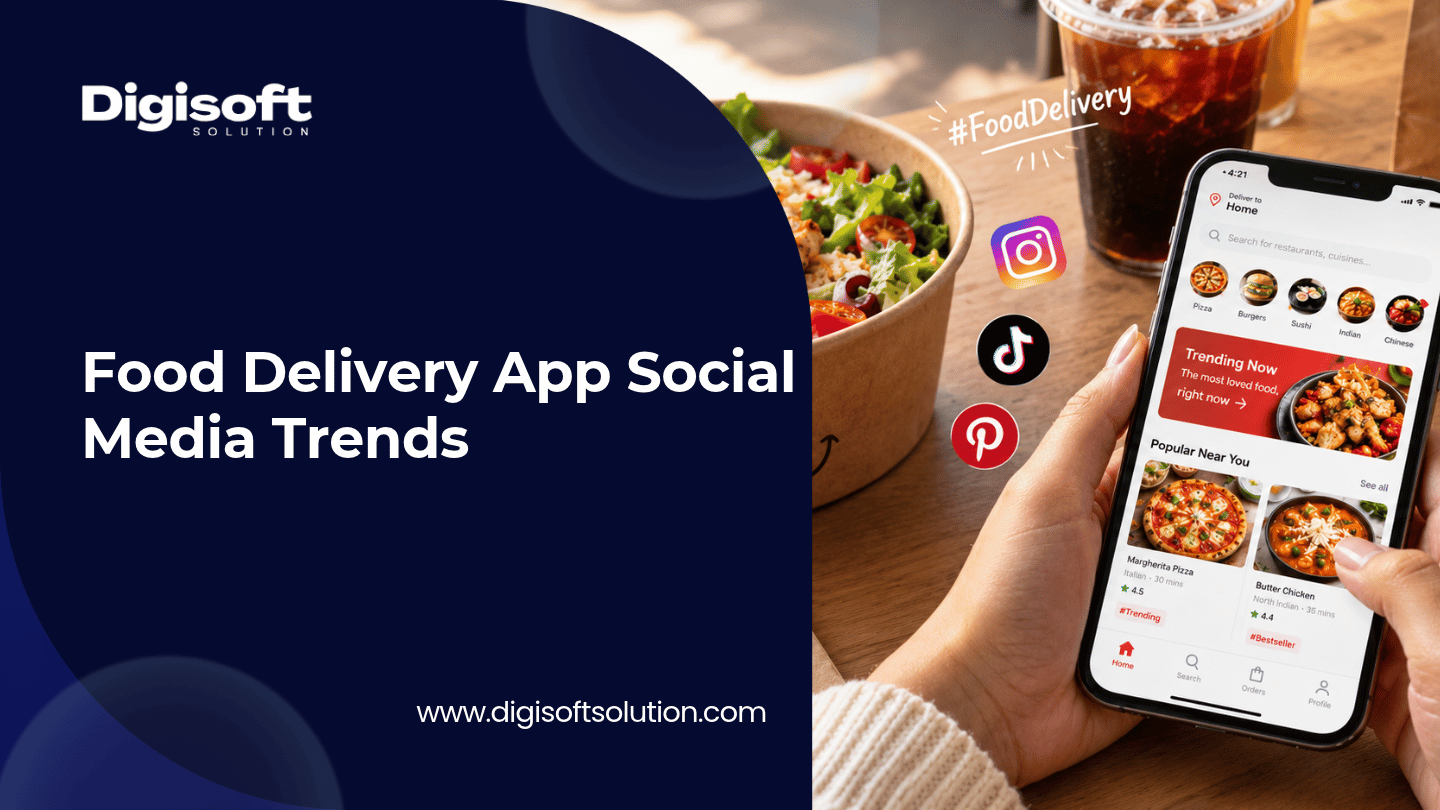
Food delivery app social media trends in 2026 come down to five shifts. People discover food on Instagram, Facebook, TikTok and YouTube before they ever open a delivery app. TikTok has just launched its own restaurant guide. Delivery apps are copying social media with in-app video feeds. Creator marketing is turning into a managed, trackable program. And the apps that win are the ones that can turn a viral view into a paid order in under a minute.
Key takeaways
- Social media is now a top-of-funnel channel for food orders, not just a branding job. In DoorDash's 2025 US survey, 74% of Gen Z and 69% of millennials said they had ordered a restaurant item after seeing it go viral.
- TikTok launched "Must Eat" on October 28, 2026, a restaurant guide built from more than 40 million posts, reviews and comments. It supports reservations, not delivery, so it is a discovery signal and not an ordering channel.
- Uber Eats already runs a short-video feed inside its app, and its UK team now gives restaurants creator-marketing tools. Video-first browsing is becoming a normal expectation.
- A real food delivery app with customer, restaurant, driver and admin panels costs roughly $45,000 to $140,000 when built offshore (our estimate from hours and rates). Quotes under $10,000 buy a template, not a platform.
- Social traffic only turns into revenue if the app has deep links, creator codes, server-side tracking and surge protection. Those are engineering jobs, not marketing jobs.
How we researched this article
We started with first-party data wherever we could find it: DoorDash's published 2025 Delivery Trends Report and merchant pricing page, TikTok's Must Eat launch coverage from October 28, 2026, and Uber Eats announcements. We then compared cost claims from several popular competitor articles against 2026 hourly rate data for mobile developers, and rebuilt the estimates from hours instead of trusting a headline number.
One rule we followed: if a claim came from a vendor blog that sells a related product and we could not confirm it with the company itself, we say so in the text. A full source list sits near the end of the article.
What are the biggest food delivery app social media trends in 2026?
Trend 1: Social media is the new front door for food discovery
DoorDash's 2025 Delivery Trends Report surveyed 1,504 US consumers in late February and early March 2025. It is the newest US edition we could verify, so treat the exact percentages as a 2025 snapshot. The top social channels people use to find new restaurants were Instagram (22%), Facebook (19%), TikTok (18%) and YouTube (16%). Gen Z leaned toward TikTok, millennials toward Instagram, and Gen X and baby boomers toward Facebook.
Two other numbers from the same research matter for any delivery brand. Seventy-four percent of Gen Z and 69% of millennials had ordered a restaurant item after seeing it go viral. And DoorDash's merchant guidance reports that 67% of Gen Z and 63% of millennials trust restaurant reviews from social media influencers, against 45% of Gen X and 28% of baby boomers.
Numbers shift by country. In DoorDash's Canadian data, Instagram led at 17%, followed by Facebook (13%), YouTube (12%) and TikTok (9%). If your app serves more than one market, do not copy a US channel mix into Toronto or Sydney.
What this means in practice: your social channels sit at the top of the order funnel. A good social media marketing plan for a delivery brand is built backward from the order screen, not forward from the content calendar.
Trend 2: TikTok is turning food videos into a restaurant guide
On October 28, 2026, TikTok's US business launched Must Eat in New York, Los Angeles and the San Francisco Bay Area. It sorts restaurants into "Everyday Eats" and "Elevated Dining," lets users filter by cuisine, price, rating and distance, and supports saving places to a list. Select restaurants can be booked through an OpenTable partnership. TikTok says the guide draws on more than 40 million posts, reviews and comments, and says no restaurant can pay to be featured.
TikTok also shared company data that 27 million Americans visited an independent restaurant, cafe or shop for the first time last year after finding it on the app, spending an estimated $4.7 billion. That is TikTok's own figure and we have not seen it independently audited. Coverage also noted that the announcement does not explain how paid creator partnerships affect rankings.
Here is the honest read for delivery brands. Must Eat is about reservations and local discovery, not delivery. It does not replace your app. But it confirms the direction: short video is becoming a search engine for food. If your restaurants or your own kitchen brand have strong video, strong reviews and clean listings, you are more likely to be found. If a viewer then searches your name, your app store page, website and Google profile need to match what the video promised.
Trend 3: Delivery apps are copying social media
Uber Eats launched a TikTok-style short-form video feed inside its app in April 2024, placed in carousels including the home screen. TechCrunch reported that the videos were not ads and merchants were not charged for placement. The logic is simple. If people already pick dinner from video, why make them leave your app to watch it?
Smaller players are building on the same idea. BiteSight, a New York app founded by Lucious McDaniel IV, climbed to number two in the Food and Beverage category of the Apple App Store in 2025 after a founder video on TikTok took off, according to Ebony. Its pitch is a feed of food videos where you can order what you see.
The product lesson is that browse-by-video is a feature users now expect to find. The engineering cost is real, though: adaptive video streaming, a CDN, moderation tools and licensed audio. If you plan an in-app feed, talk about it at the architecture stage. Adding it after launch usually costs more. Our social media app development team builds these feed patterns for other industries, and the same patterns carry over to food.
Trend 4: Creator marketing is becoming a managed program
Uber Eats UK partnered with a creator platform called Invyted so restaurant partners can find creators, manage collaborations and track results in one place. Invyted says it connects nearly 8,000 creators and has run more than 36,000 brand collaborations. Uber Eats' UK general manager said discovery increasingly happens on social media, which is why the tools were added.
Results from a single agency case study, run by Nonsensical for Uber Eats in Merseyside, show what a local TikTok push can look like: 11 videos from 4 creators, about 1.75 million views, 18,000 clicks to the app and 400 code redemptions. This is the agency's own case study, so read it as a data point and not a promise.
The math is the useful part. 18,000 clicks from 1.75 million views is about 1% of viewers clicking. 400 redemptions from 18,000 clicks is about 2.2%. Reach is cheap, orders are not. That is why tracking each creator with their own code matters more than the follower count.
Trend 5: Ad platforms are connecting delivery data to social ads
DoorDash's ad products include offsite extensions that reach Meta, Google, YouTube and TikTok, and the company bought ad-tech firm Symbiosys for $175 million in June 2025, according to a 2026 industry write-up that cites DoorDash's press release. Uber Eats sells in-app formats such as Journey Ads.
The implication for smaller apps: big marketplaces can target with years of order history. You cannot match that, so you need to start collecting your own first-party data early, with proper consent. That means a clean event schema in your app and server-side events sent to ad platforms, which we cover in the engineering section below.
Trend 6: AI is shaping what people order and how brands get found
DoorDash's 2025 reporting found that diners are open to AI restaurant recommendations but more cautious about AI in the kitchen itself. That fits what we see in practice: recommendation features are easy to accept, while "AI made my food" is a harder sell.
Discovery is also shifting toward AI assistants and AI search summaries. We could not find a reliable, independently verified number for how many people use them to pick restaurants, so we will not invent one. What we can say is that AI systems lean on consistent, structured information: the same business name, address, hours, menu and reviews everywhere they look. For app owners, that means schema markup on restaurant and dish pages, accurate listings and fresh reviews. Our guide to AI chatbot development for customer support and engagement shows how a support bot can sit inside an ordering flow, and our AI development services page covers recommendation engines.
Trend 7: Social commerce claims that need a reality check
Several vendor blogs claim TikTok Shop now lets US restaurants take food orders inside TikTok, with DoorDash handling delivery and lower commissions than delivery marketplaces. We searched for confirmation from TikTok or DoorDash and did not find it. The claims come from a company that sells order-integration software, so they may be forward-looking or simply wrong. Until TikTok publishes seller documentation for food, treat in-app TikTok food ordering as unverified. The confirmed food move from TikTok this week is Must Eat.
Which social platform matters most for a food delivery app?
Each of these platforms have a different job. Use the table as a starting point, then check your own analytics.
|
Platform |
DoorDash 2025 US discovery share |
Strongest audience |
Best use for a delivery brand |
|
|
22% |
Millennials |
Reels with a direct ordering link, Stories with limited-time offers, local geo-targeted ads |
|
|
19% |
Gen X and baby boomers |
Local community groups, event posts, radius-targeted ads around your delivery zone |
|
TikTok |
18% |
Gen Z |
Creator videos, trend response, local discovery, Must Eat visibility |
|
YouTube |
16% |
Broad, longer sessions |
Shorts for dish clips, longer behind-the-kitchen stories |
Do not try to be everywhere. A small team does better with two platforms done well than five done badly. If your buyers are under 28, start with TikTok and Instagram. If they are over 40, put Facebook first.
How to turn social attention into orders: what your app needs
A viral video is wasted if the viewer lands on a slow page, gets asked to create an account before seeing the menu, or finds the dish sold out. These are the technical pieces that decide the outcome.
Deep links and shareable pages
Use universal links on iOS and app links on Android so a link in a Reel opens the exact restaurant or dish inside the app. Add deferred deep linking so people who do not have the app yet are sent to the store and then land on the right dish after install. Every restaurant and dish should also have a public, indexable web page with Restaurant and Menu schema, so search engines and AI assistants can read it. A progressive web app is a solid fallback for people who will not install anything from a single video.
Do not forget the store listings. Our guides on how to optimize your app for the App Store and the Play Store cover the listing basics that decide whether a curious viewer installs.
Attribution, creator codes and server-side events
Give every creator a unique code and a tagged link with UTM parameters. Then send purchase events from your server to ad platforms, using Meta's Conversions API and TikTok's Events API, because browser and device tracking keeps getting weaker. Deduplicate events so one order is not counted twice. Your developers will need clean, well-documented endpoints, which is where API integration services come in.
Referral and creator code engine
Build limits in from day one: one use per new customer, expiry dates, a minimum order value, and a margin guardrail so a code can never push an order below cost. Codes without guardrails get leaked to coupon sites within a week.
Surge handling after a viral post
A creator post can send ten times your normal traffic in an hour. Without protection you get late orders, cancelled orders and angry reviews. Plan for autoscaling on a cloud application development setup, queue limits on checkout, and a "busy" mode that automatically stretches delivery estimates. Our article on scalable checkout, inventory sync and fulfillment orchestration explains the patterns in more detail.
Real-time inventory and kitchen capacity
Viral dishes sell out. The app should hide or snooze unavailable items instantly and, where possible, suggest a close alternative. We built similar real-time stock handling in our McGrocer case study, where fallback sourcing and live stock checks cut out-of-stock order failures by 40%, as reported on that page.
Order throttling rules worth setting
- Cap new orders per restaurant per 10-minute window
- Auto-snooze items when stock or prep capacity runs low
- Extend the promised delivery time automatically during spikes
- Alert the restaurant before the queue gets out of hand, not after
In-app video and user-generated content
If you add a video feed, use adaptive streaming and a CDN so clips start fast on weak mobile networks. Add report buttons, automated screening and a human review queue. Use licensed audio only, because music rights are a real legal risk for food videos.
Moderation checklist
Report button on every clip, automated screening for unsafe content, a human review queue, and a clear takedown process for restaurants.
How much does a food delivery app cost in 2026?
Many articles quote a big range and stop there. We re-checked the figures from several popular competitors and compared them with our own hours-based estimate. The question is not only "what is the price," it is "is that price actually good for what you get?"
What competitor articles say
|
Source |
Claimed cost |
Claimed timeline |
Our read |
|
SoftTeco (2026 guide) |
$20,000 to $300,000+ |
Not stated in the snippet we checked |
Lower end is plausible. The upper end is so wide that you cannot budget with it. |
|
aPurple (updated December 2, 2025) |
$15,000 to $150,000+ |
Not stated |
Plausible for offshore-built apps. |
|
DevTechnoSys |
$30,000 to $150,000. Basic $30,000 to $60,000. Multi-vendor $60,000 to $120,000. |
MVP in 3 to 5 months |
Realistic for a full multi-vendor build, a bit high for a lean MVP. |
|
PerfectionGeeks |
$20,000 to $150,000 |
5 to 7 months |
Reasonable. |
|
Damco |
$3,000 to $10,000 for a basic app in low-cost centers, up to about $20,000 |
Not stated |
Looks dated. That money buys a restaurant finder or a template, not a three-sided delivery platform. |
|
Digisoft Solution food delivery page |
$17,000 to $180,000+ |
3 to 10 months |
Credible. The "+" matters, because advanced platforms can go past it. |
Technical sanity check: hours times rates
Price is just hours multiplied by an hourly rate, so we tested the claims that way. First, the 2026 agency rates we found for mobile and Flutter development:
|
Region |
Typical agency rate per hour |
|
United States |
$120 to $220 |
|
UK and Western Europe |
$95 to $180 |
|
Eastern Europe |
$50 to $100 |
|
Latin America |
$45 to $95 |
|
India |
$25 to $70 (many offshore guides quote $25 to $50) |
|
Philippines and Southeast Asia |
$25 to $60 |
Next, our working assumptions for hours. These are our estimates for planning, not a quote, and real projects vary:
|
Scope |
Hours (our assumption) |
India-based team at $25 to $50 per hour |
US agency at $120 to $220 per hour |
|
Single-restaurant ordering app with admin panel |
700 to 1,100 |
$17,500 to $55,000 |
$84,000 to $242,000 |
|
Multi-restaurant MVP (customer app, restaurant panel, driver app, admin panel) |
1,800 to 2,800 |
$45,000 to $140,000 |
$216,000 to $616,000 |
|
Advanced marketplace (AI recommendations, loyalty, video feed, analytics) |
3,500 to 5,500 |
$87,500 to $275,000 |
$420,000 to $1,210,000 |
Our verdict on the cost
- A $17,000 to $55,000 single-restaurant app is fair value if it includes ordering, payments, push notifications and an admin panel.
- For a real multi-restaurant platform, $45,000 to $140,000 offshore is the honest band. Anything under $10,000 will not include the driver app, the restaurant panel and the admin tools.
- The same scope built by a US agency can easily pass $200,000. Location is the biggest swing factor. One 2026 Flutter pricing guide notes the same scope can vary 3 to 5 times between the US or UK and India, Latin America or Eastern Europe.
- The "$20,000 to $300,000+" style headline is true but useless. Ask for a feature-by-feature estimate with hours.
For a wider look at how scope drives price, see our guide on how much it costs to develop an app in 2026, our breakdown of outsourcing to India, and the native vs cross-platform comparison, since cross-platform tools like Flutter often reduce build hours for apps like this.
Costs people forget
- Annual maintenance: Most 2026 guides put this at 15% to 20% of the original build cost per year, and a few say up to 25%. On a $60,000 app, that is $9,000 to $12,000 a year. Our own guide on the cost to maintain a mobile app goes deeper.
- Store fees: Apple and Google charge developer account fees, which are small but never zero.
- Usage-based services: maps, SMS, push notifications and payment processing grow with your order volume, so budget them as a percentage of revenue and not a flat fee.
- Security and compliance: payment handling and personal data bring PCI DSS and privacy rules into scope, and testing time is not free.
What the social media side costs
|
Item |
Typical 2026 range |
Our read |
|
DIY scheduling tools |
$0 to $50 per month |
Fine for one person posting daily. |
|
Freelance social media manager |
$300 to $1,500 per month |
Good for a small brand with a clear brief. |
|
Agency management for a small business |
$1,000 to $3,000 per month (wider market $500 to $5,000) |
Worth it if strategy, creative and reporting are included. |
|
Paid social ads |
Billed on top. One 2026 guide suggests $1,500 to $2,500 per network per month. |
Start smaller and prove one channel before adding another. |
|
Micro-creator video (10K to 100K followers) |
Sources disagree widely. Typical TikTok quotes run about $200 to $800, and Instagram about $150 to $500. Some guides list up to $2,500. |
For local food creators plan $150 to $800 a video. Pay more only after you see code redemptions. |
Management fees do not include ad spend, and creator fees are separate again. A small delivery brand running two platforms, one agency retainer and a handful of creators can land between $2,000 and $5,000 a month before ads. That is our estimate from the ranges above, so check it against your own quotes.
Is it worth building your own app instead of using marketplaces?
DoorDash's published delivery commissions are 15% on Basic, 25% on Plus and 30% on Premier, with pickup at 6%. On a $50 order that is $7.50, $12.50 or $15 before your food, labor and packaging costs.
Here is an illustration. It is our math, with assumptions, not a quote. A restaurant gets 1,000 delivery orders a month at an average of $35. Social media and creator codes move 300 of those orders to its own app, where it avoids a 25% commission.
- Commission avoided: 300 x $35 x 25% = $2,625 per month
- Payment processing at roughly 3% (assumption): about $315 per month
- Net saving: about $2,310 per month, or roughly $27,700 per year
Against a $17,500 to $55,000 build, payback lands somewhere between 8 and 24 months, before maintenance, marketing and your own delivery costs. So the answer is yes for brands with a loyal customer base and a real social audience, and probably not for a restaurant with neither. If you are unsure, test with an MVP first and use the software development cost calculator to size the scope.
A 90-day plan to turn social views into delivery orders
Days 1 to 30: Foundation
- Pick two platforms based on your customers' ages, not your own habits.
- Set up deep links, a public web page for each restaurant and dish, and Restaurant and Menu schema.
- Install server-side tracking and define your events: view menu, add to cart, checkout started, order placed.
- Build a simple content map. Our guide to a content roadmap can help.
Days 31 to 60: Creators and offers
- Test 5 to 10 local creators with unique codes and a small fixed fee.
- Post short videos of real kitchens, real packaging and real delivery moments.
- Respond to trending dishes within 48 hours if your menu can support them.
- Ask every happy customer for a review and a tagged photo.
Days 61 to 90: Measure and scale
- Keep the creators whose codes produce repeat orders, not just first orders.
- Cut channels with a high cost per order.
- Add retargeting using your first-party events.
- Review the app: slowest screens, drop-off points, sold-out items.
Metrics to track
- Cost per order by channel and by creator
- View to click, click to install, install to first order
- Code redemption rate
- Repeat order rate at 30 and 60 days
- Share of orders placed directly vs through marketplaces
- Average delivery time during spikes
Common mistakes to avoid
- Buying followers or views instead of tracking orders.
- Sending every click to a generic home screen. Send people to the dish they saw.
- Forcing sign-up before showing the menu.
- Giving out discount codes with no limits, which trains customers to wait for deals.
- Running a viral campaign without kitchen capacity, so you get less orders completed on time than you got placed.
- Copying a competitor's content style when your customers are a different age group.
Answering the public: questions people ask about food delivery app social media trends
Why do people order food they see on TikTok or Instagram?
Short videos show taste, texture and portion size better than a menu photo, and a recommendation from a creator feels like advice from a friend. DoorDash's survey found 74% of Gen Z and 69% of millennials had ordered a viral item. The gap between seeing and ordering is also small when the app link is one tap away.
Which social media platform is best for promoting a food delivery app?
It depends on your audience. In DoorDash's 2025 US data, Instagram led restaurant discovery at 22%, followed by Facebook at 19%, TikTok at 18% and YouTube at 16%. Gen Z preferred TikTok, millennials Instagram, and older groups Facebook. Pick two platforms and test.
Can a restaurant pay to be featured in TikTok Must Eat?
TikTok says no. The company states that restaurants cannot pay to appear in Must Eat, and that each listing is checked to confirm the business is open and in good standing. The guide is built from posts, reviews and comments. The practical move is to earn attention with real videos and reviews.
Do food delivery apps pay influencers?
Yes. Uber Eats has worked with creators in several markets and, in the UK, gives restaurant partners tools to find and manage creators. Many programs combine a fixed fee with a unique discount code so results can be tracked.
How much does it cost to run social media for a food delivery business?
Most small businesses pay between $1,000 and $3,000 a month for agency management, while freelancers often charge $300 to $1,500. Ad spend and creator fees are extra. Micro-creator rates vary a lot, so negotiate and track codes.
How do you track orders that come from a social media post?
Use unique links with UTM parameters, a code for each creator and server-side purchase events sent to the ad platform. Together these show which post, creator or ad led to an order, even when device tracking is limited.
What content works best for food delivery brands?
Short videos of real kitchens, packing, delivery arrival and the first bite usually beat polished ads. Pair them with a direct ordering link and respond quickly to comments. Test one format for two weeks before changing it.
Is it worth building a food delivery app in 2026?
It can be, if you have repeat customers and a social audience to move off marketplaces. Marketplace commissions of 15% to 30% add up fast, and our illustration above shows a payback of roughly 8 to 24 months. Start with a lean MVP and expand after you see real orders.
How long does it take to build a food delivery app?
Published estimates range from about 3 to 7 months for an MVP, and Digisoft Solution's food delivery page quotes 3 to 10 months depending on features, integrations and testing. A single-restaurant app is faster than a multi-restaurant marketplace.
Frequently asked questions (FAQ)
What are the top food delivery app social media trends in 2026?
The top trends are social-first food discovery, TikTok's new Must Eat restaurant guide, in-app short-video feeds in delivery apps, managed creator marketing with unique codes, ad platforms that use delivery data, and AI-driven recommendations and search. Claims about ordering food directly inside TikTok are still unverified.
How much does it cost to build a food delivery app in 2026?
Published ranges run from about $15,000 to $300,000+. Our hours-based check puts a single-restaurant app near $17,500 to $55,000 and a multi-restaurant MVP near $45,000 to $140,000 when built by an offshore team. US agency rates can multiply those figures by three to five. Digisoft Solution quotes $17,000 to $180,000+ on its food delivery page.
How much does social media management cost for a food delivery brand?
Expect about $300 to $1,500 a month for a freelancer and $1,000 to $3,000 for a small-business agency package. Paid ads and creator fees are billed separately. Costs rise with the number of platforms, the amount of video and the reporting you need.
What features help a food delivery app convert social media traffic?
The most useful features are deep links to specific dishes, guest checkout, creator and referral codes, real-time stock and kitchen capacity, live order tracking, fast video loading and server-side event tracking. Each one removes a reason for a viewer to drop off.
How do I measure ROI from social media for a food delivery app?
Track cost per order by channel and creator, code redemption rate, view-to-order conversion and repeat orders at 30 and 60 days. Compare the commission you avoid on direct orders against marketing and delivery costs.
What is the annual maintenance cost of a food delivery app?
A common benchmark is 15% to 20% of the original development cost each year, with some sources going up to 25%. On a $60,000 app that is roughly $9,000 to $12,000 a year, plus usage-based costs like maps, messaging and payments.
Should I build a custom food delivery app or use a white label app?
White label is faster and cheaper to start, but you give up some control over features, data and design. Custom suits brands with a clear differentiator, such as a cloud kitchen with multiple brands or a loyalty model. A white label app can be a smart first test before a larger custom build.
Does TikTok let you order food delivery inside the app?
Not that we could verify. TikTok's confirmed food product is Must Eat, which supports discovery and reservations. Some vendor blogs claim in-app food ordering through TikTok Shop, but we found no confirmation from TikTok or DoorDash.
How Digisoft Solution helps with food delivery app development and social media marketing
Digisoft Solution is an IT consulting and software development company founded in 2013, with offices in Punjab, India and Gilbert, Arizona. We build the app and we help you market it, which matters because a food delivery app that nobody finds is just an expensive demo.
Food delivery app development
Our food delivery app development team builds multi-restaurant marketplaces, single-brand apps, cloud kitchen platforms, aggregator apps, white label apps and AI-powered ordering apps. A typical build includes four connected parts: a customer app, a restaurant panel, a delivery partner app and an admin dashboard. Features include live order tracking, multiple payment options, push notifications, route optimization for drivers, ratings and reviews, and analytics.
Our food delivery page lists 800+ apps delivered, 60+ food delivery app developers and clients in 25+ countries. We build on Flutter, React Native, Swift, Kotlin, .NET, Node.js and major cloud platforms, and we follow standards such as GDPR and PCI DSS for data and payments. Many of our food apps use cross-platform tools, so see our Flutter development services and mobile app development pages. If you need an on-demand model beyond food, our on-demand app development team can help. For first-time founders, our software development for startups service starts with a lean scope.
Our published range is $17,000 to $180,000+ with a typical timeline of 3 to 10 months, depending on platform choice, UI/UX complexity, integrations and custom features. We offer fixed cost, time and materials, dedicated team and staff augmentation models, and you can hire dedicated developers if you want an extension of your own team.
Social-ready engineering
The trends in this article all need engineering support. We can build deep linking, creator and referral code engines, server-side event tracking, real-time inventory, surge-ready cloud infrastructure and in-app video. Our UI/UX design team designs the order flow so a viewer can go from a video to a paid order in as few taps as possible, and our AI chatbot development service adds support and recommendation features.
Social media marketing, SEO and content
Our social media marketing services and wider digital marketing services cover platform strategy, content planning, paid social, creator outreach and reporting. For search visibility, our SEO services and ecommerce SEO services help restaurant and dish pages get found on Google and in AI answers. You can also hire digital marketing experts on a dedicated basis.
Proof from our case studies
We want to be careful here, because not every case study is a food app. Our case studies page lists our public projects. These are relevant to the problems in this article:
- Launch 360 (SEO and digital growth): our Launch 360 case study reports organic sessions growing from fewer than 10 a month to more than 2,000, 12 to 18 keywords reaching Google's top three, and 20 to 40 monthly organic leads. It is an SEO project, and it shows the intent-led approach we apply to discovery content.
- McGrocer (multi-retailer ordering): our McGrocer case study covers real-time stock, fallback sourcing and shipment updates, with a reported 40% drop in out-of-stock order failures and a 30% drop in support queries.
- MaxMode (repeat orders): our MaxMode case study reports subscription-driven repeat orders rising from 12% to 27%.
Ready to plan your food delivery app and social launch?
Tell us your market, your target customers and your budget, and we will send a feature-by-feature estimate. Book a free consultation or start with the software development cost calculator.
Digital Transform with Us
Please feel free to share your thoughts and we can discuss it over a cup of coffee.