Table of Content
- Why Health Insurance Is Changing So Fast Right Now
- Top Health Insurance Technology Trends in 2026
- 1. AI-Driven Underwriting That Actually Moves Fast
- 2. FHIR-Based Interoperability Is No Longer a "Nice to Have"
- 3. Real-Time Prior Authorization
- 4. Embedded Insurance and API-First Distribution
- 5. IoT, Wearables, and Telematics Feeding Risk Models
- 6. Machine Learning Fraud Detection
- 7. Explainable AI and Regulatory Guardrails
- The Tech Stack Behind Modern Health Insurance Platforms in 2026
- Backend and data layer
- Interoperability layer
- AI and ML layer
- Member experience layer
- Security and compliance layer
- What's Actually Changing for Insurers, Employers, and Patients
- How Much Does It Actually Cost to Build This Kind of Platform (And Is That Price Fair)?
- How Digisoft Solution Helps You Build Future-Ready Health Insurance Software
- Frequently Asked Questions
- Is AI actually replacing human underwriters in health insurance in 2026?
- Do small insurers and TPAs need to comply with CMS-0057-F?
- What's the difference between FHIR and HL7 in this context?
- How long does it take to become FHIR compliant if we're starting from a legacy system?
- Is embedded insurance actually profitable, or is it just a trend?
Digital Transform with Us
Please feel free to share your thoughts and we can discuss it over a cup of coffee.
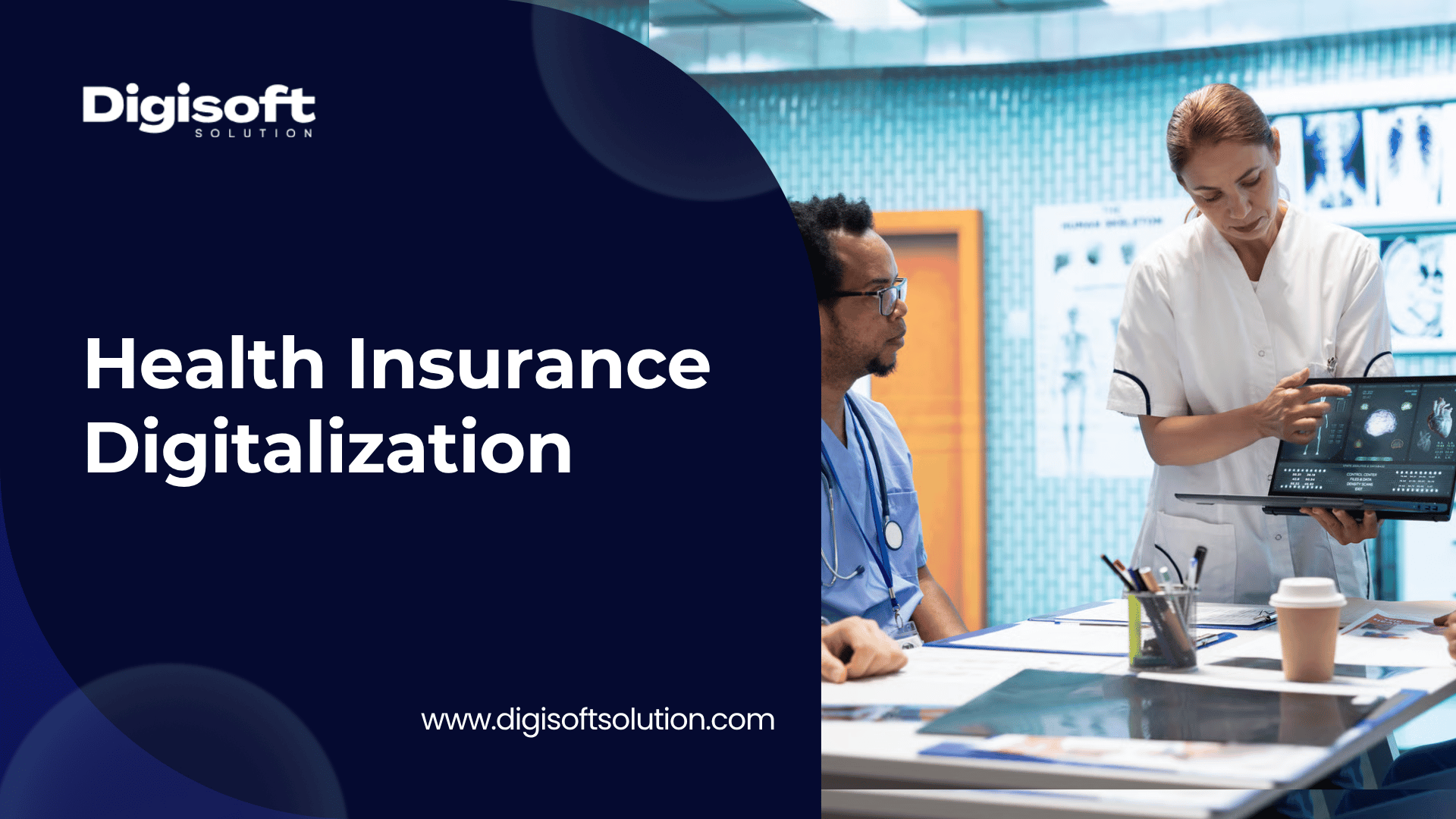
If you work anywhere near the health insurance industry, you've probably noticed something: the pace of change this year feels different than it did in 2023 or 2024. Back then, AI in insurance was mostly pilots and press releases. In 2026, it's actually running the show, quietly deciding underwriting outcomes, flagging fraud, and processing claims while most policyholders don't even realize it's happening.
This article breaks down what's really changing in health insurance technology in 2026, the tech stack powering it, and what it actually costs to build (and whether that cost is worth paying).
Why Health Insurance Is Changing So Fast Right Now
Three things are colliding at the same time this year, and that's why 2026 feels like a turning point instead of just another incremental year.
- Regulation is forcing the issue. CMS finalized rules (CMS-0057-F) that require payers, including Medicare Advantage organizations, Medicaid managed care entities, and Qualified Health Plans, to expose Patient Access, Provider Access, and Payer-to-Payer APIs. Several of these requirements kicked in during 2026, with the Prior Authorization API mandate landing January 1, 2027. CMS has also proposed extending prior authorization rules to prescription drugs under CMS-0062-P.
- AI adoption jumped from experiment to default. Industry data shows the share of insurers with full-scale AI healthcare deployment went from around 8% in 2024 to roughly 34% in 2025, and 2026 is the year most of the remaining holdouts are catching up.
- Political and funding uncertainty is pushing insurers toward efficiency. Reduced Medicaid and rural healthcare funding tied to recent federal budget changes is forcing insurers to do more with less, which is exactly the kind of pressure that accelerates automation.
Put those together and you get an industry that's rebuilding its tech stack under a deadline, not by choice.
Top Health Insurance Technology Trends in 2026
1. AI-Driven Underwriting That Actually Moves Fast
This is the trend everyone's talking about, and for good reason. Underwriting timelines that used to take 3 days are now getting resolved in around 3 minutes for straightforward cases. Straight-through processing rates (meaning no human ever touches the file) have climbed from around 10 to 15% a couple years back to somewhere between 70 and 90% today for standard policies.
Machine learning models now pull in medical history, lifestyle data, and even satellite or drone imagery (mostly for property lines, but increasingly relevant for group health risk pooling too) to generate real time risk scores instead of waiting on a human underwriter to manually review a file.
The catch, and it's a real one: automated claims denial systems have already drawn scrutiny and regulatory attention because an algorithm doesn't always catch the obvious medical necessity a human adjuster would spot in two seconds. This is why explainable AI isn't optional anymore, its a requirement if you want to stay out of trouble with regulators.
2. FHIR-Based Interoperability Is No Longer a "Nice to Have"
For years, FHIR (Fast Healthcare Interoperability Resources) was something insurers talked about in roadmaps and rarely shipped. That's over. Under ONC's HTI-1 rule, USCDI v3 data classes became mandatory for certified health IT starting January 2026. USCDI v3 specifically added health insurance information (coverage details, plan identifiers, payer data) as a required data class, which matters a lot for eligibility and revenue cycle workflows.
If you're building anything in this space, you need to actually support:
- SMART Backend Services for system to system authorization
- PKCE (Proof Key for Code Exchange) for public client apps
- Bulk Data Access for population level exports (NDJSON, async polling)
- Da Vinci PAS for electronic prior authorization submissions
3. Real-Time Prior Authorization
Prior authorization has been the single biggest pain point in US healthcare for both patients and providers for over a decade. CMS-0057-F is finally forcing payers to build FHIR-based Prior Authorization APIs, and the proposed CMS-0062-P rule extends similar requirements to prescription drugs. The goal is to replace fax machines and portals with structured, machine-readable authorization requests that return decisions in a defined, shorter timeframe.
4. Embedded Insurance and API-First Distribution
Insurance is increasingly showing up inside other products, not as a separate purchase. Think of a gym membership app that offers accident coverage at checkout, or a gig platform bundling a basic health plan. This only works because insurers are exposing their underwriting and quoting engines as APIs that partners can call directly, instead of forcing customers through a traditional agent workflow.
5. IoT, Wearables, and Telematics Feeding Risk Models
Wearable data, remote monitoring devices, and telematics are increasingly used to build dynamic risk profiles instead of static, once a year assessments. This is more mature on the property and auto side, but health insurers are borrowing the same playbook for wellness-linked premiums and chronic disease management programs.
6. Machine Learning Fraud Detection
Fraud detection powered by ML has reportedly improved accuracy by over 30% compared to older rules based systems. These models are now catching pattern based fraud (like billing anomalies across a network of providers) that a rules engine would simply miss because it doesn't fit a predefined pattern.
7. Explainable AI and Regulatory Guardrails
As AI decisions carry more weight, regulators are demanding insurers show their work. Expect more requirements around algorithmic transparency, audit trails for every automated decision, and documented reasoning for denials, especially in claims and underwriting where a wrong automated call has a direct impact on someone's healthcare access.
The Tech Stack Behind Modern Health Insurance Platforms in 2026
Here's roughly what a competitive health insurance platform is actually built on this year.
Backend and data layer
- Cloud-native microservices (AWS, Azure, or GCP), usually containerized with Kubernetes
- Event-driven architecture for real-time claims and policy updates
- Data lakes/warehouses (Snowflake, BigQuery, or similar) for the analytics and ML training pipelines
Interoperability layer
- FHIR R4 APIs, built to Da Vinci Implementation Guides (PDex, CRD, PAS)
- HL7 v2/v3 support for legacy system compatibility
- EDI/X12 for claims and eligibility transactions where FHIR hasn't fully replaced older standards yet
AI and ML layer
- Predictive models for underwriting risk scoring
- NLP models for processing unstructured clinical notes and claims documentation
- Computer vision, mostly borrowed from property/auto, now finding use in document and ID verification workflows
Member experience layer
- Patient/member portals built on React or similar frontend frameworks
- Mobile apps for claims submission, ID cards, and provider search
- Chat and voice interfaces for routine service inquiries
Security and compliance layer
- End-to-end encryption for PHI at rest and in transit
- Role-based access control with detailed audit logging
- SOC 2 and HIPAA-aligned infrastructure, with BAAs in place for every vendor touching PHI
What's Actually Changing for Insurers, Employers, and Patients
For insurers, the biggest shift is that AI is no longer a side project, its baked into the core underwriting and claims pipeline, and the ones who delay risk falling behind on cost per policy processed.
For employers offering group health plans, expect faster renewal quoting, more granular risk-based pricing, and pressure to adopt data feeds (wellness program participation, etc.) that plug into the insurer's underwriting models.
For patients, the CMS interoperability rules mean you should, in theory, be able to pull your own claims and coverage data into a third-party app of your choice. Whether that actually feels seamless in practice by end of 2026 depends heavily on how well individual payers implement it, some will do the bare minimum to stay compliant.
How Much Does It Actually Cost to Build This Kind of Platform (And Is That Price Fair)?
This is the part most articles gloss over, they'll throw out a number and move on. Let's actually look at what the market is charging in 2026 and whether it holds up.
|
Platform Tier |
What's Included |
Typical Cost Range (2026) |
Timeline |
|
MVP / Basic Platform |
Core policy and claims workflow, basic member portal, single integration |
$40,000 to $100,000 |
3 to 5 months |
|
Mid-Complexity Platform |
AI-assisted underwriting, FHIR API layer, payment and eligibility integrations |
$100,000 to $250,000 |
6 to 10 months |
|
Enterprise Platform |
Full AI/ML pipeline, multi-EHR and payer integrations, fraud detection, multi-role access |
$250,000 to $500,000+ |
12 to 20 months |
|
Ongoing Maintenance |
Security patching, compliance updates, model retraining |
15 to 25% of build cost, annually |
Ongoing |
So, is this pricing actually reasonable, or is it just what agencies feel like charging? Looking at it technically, it holds up for a few reasons:
- HIPAA and compliance work alone typically adds 15 to 25% to a base build, this isn't padding, its real engineering work: encryption architecture, audit logging, BAA management, and third party security testing.
- McKinsey has estimated generative AI could add somewhere around $1.1 trillion in annual value across the global insurance industry. Against that backdrop, a $150,000 to $300,000 mid-tier platform investment is a rounding error if it's actually driving the underwriting speed gains (3 days down to 3 minutes) that are being reported industry wide.
- The real financial risk isn't the sticker price, it's scoping mistakes. Multiple industry sources point to the same pattern: a startup budgets $80,000 for an "AI powered" platform and the final invoice lands closer to $300,000, not because anyone was dishonest, but because HIPAA architecture and integration work were never priced into the original scope.
Our honest take: if a vendor quotes you a number without separately breaking out compliance cost, integration cost, and AI/ML cost, that quote is incomplete, not competitive. A properly scoped mid-complexity platform in the $100,000 to $250,000 range is fair value in 2026 given what's actually required to ship something compliant and interoperable. Anything drastically below that range for a genuinely FHIR-compliant, AI-integrated platform should raise questions about what's actually being cut.
If you're weighing this decision for your own organization, our guide on custom healthcare software development walks through the full scoping process in more detail.
How Digisoft Solution Helps You Build Future-Ready Health Insurance Software
At Digisoft Solution, we work directly with insurers, TPAs, brokers, and health tech startups who need to move fast on exactly the trends covered above, without cutting corners on compliance.
Here's where we typically plug in:
- FHIR and interoperability builds: We design and implement FHIR R4 APIs aligned with Da Vinci Implementation Guides, so your platform is ready for CMS-0057-F requirements instead of scrambling before a deadline.
- AI-assisted underwriting and claims: Our team builds risk scoring and claims automation models with explainability baked in from day one, not bolted on after a regulator asks questions.
- Compliance-first architecture: Every insurance platform we build is architected around HIPAA, SOC 2, and audit trail requirements from the very first sprint, because retrofitting compliance later almost always costs more than building it in from the start.
- Custom insurance platforms: From MVP to full enterprise builds, our insurance software development services cover policy administration, underwriting, claims, and digital distribution end to end.
We've spent 13+ years building software across healthcare, fintech, and insurance, so we understand what actually breaks when these systems go live, not just what looks good in a proposal. If you want a transparent, technically grounded project scope and cost estimate, you can explore our full range of software development services or reach out for a free consultation.
Frequently Asked Questions
Is AI actually replacing human underwriters in health insurance in 2026?
Not fully. AI is handling straight-through processing for standard, low-risk cases, but complex or borderline cases still get routed to human underwriters. Insurers that use AI purely to replace people, rather than support them, are the ones running into regulatory and trust problems.
Do small insurers and TPAs need to comply with CMS-0057-F?
CMS-0057-F applies mainly to Medicare Advantage organizations, Medicaid and CHIP managed care entities, state Medicaid agencies, and Qualified Health Plans. Smaller commercial insurers and TPAs outside those categories aren't directly regulated by this rule, but many are adopting FHIR anyway since it's becoming the industry standard for data exchange.
What's the difference between FHIR and HL7 in this context?
HL7 v2/v3 is the older messaging standard still widely used for legacy claims and eligibility transactions. FHIR is the newer, API-based standard built for modern web and mobile integration, and it's what CMS interoperability rules are built around going forward.
How long does it take to become FHIR compliant if we're starting from a legacy system?
It depends heavily on how tangled your existing data model is, but most mid-sized organizations should budget 6 to 12 months for a proper FHIR layer, including sandbox testing against CMS and EHR environments before going live.
Is embedded insurance actually profitable, or is it just a trend?
Early data suggests it's working, particularly for simple, add-on coverage types (accident, device protection, travel) where the purchase decision is low-friction. It's less proven yet for comprehensive major medical coverage, where regulatory and underwriting complexity is much higher.
Digital Transform with Us
Please feel free to share your thoughts and we can discuss it over a cup of coffee.