Table of Content
- What Is an Entertainment and Music App?
- Core Features Every Music App Needs
- Must-have features for an MVP
- Advanced features that improve retention
- Recommended Tech Stack for a Music Streaming App
- Native or cross-platform?
- Why HLS is the default for music streaming
- Music Licensing and Legal Requirements
- The rights you usually need
- Ways to start with a smaller legal risk
- How Music Apps Make Money
- Music App Development Process, Step by Step
- Realistic timelines
- How Much Does Music App Development Cost?
- Why some cost claims do not add up
- Realistic cost ranges (development only, estimated)
- Costs that are not in the development budget
- What pushes the cost up or down
- Common Technical Challenges and How to Solve Them
- How to Choose a Music App Development Partner
- How Digisoft Solution Helps With Entertainment and Music App Development
- What we build
- How we build it
- Why teams pick Digisoft Solution
- People Also Ask
- How do I make a music app?
- Is it legal to build a music app like Spotify?
- How does a music streaming app work technically?
- Which programming language is best for a music app?
- How do music apps get songs?
- How do free music apps make money?
- What is the best platform for a music app, iOS or Android?
- FAQs
- How long does it take to build a music streaming app?
- How much does it cost to build a music app in 2026?
- Should I build an MVP first?
- Can I build a music app without licensing music?
- Do I need DRM?
- How much does it cost to maintain a music app?
- Which is better for a startup, native or cross-platform?
- Can Digisoft Solution build a white-label music app?
- Final Thoughts
Digital Transform with Us
Please feel free to share your thoughts and we can discuss it over a cup of coffee.
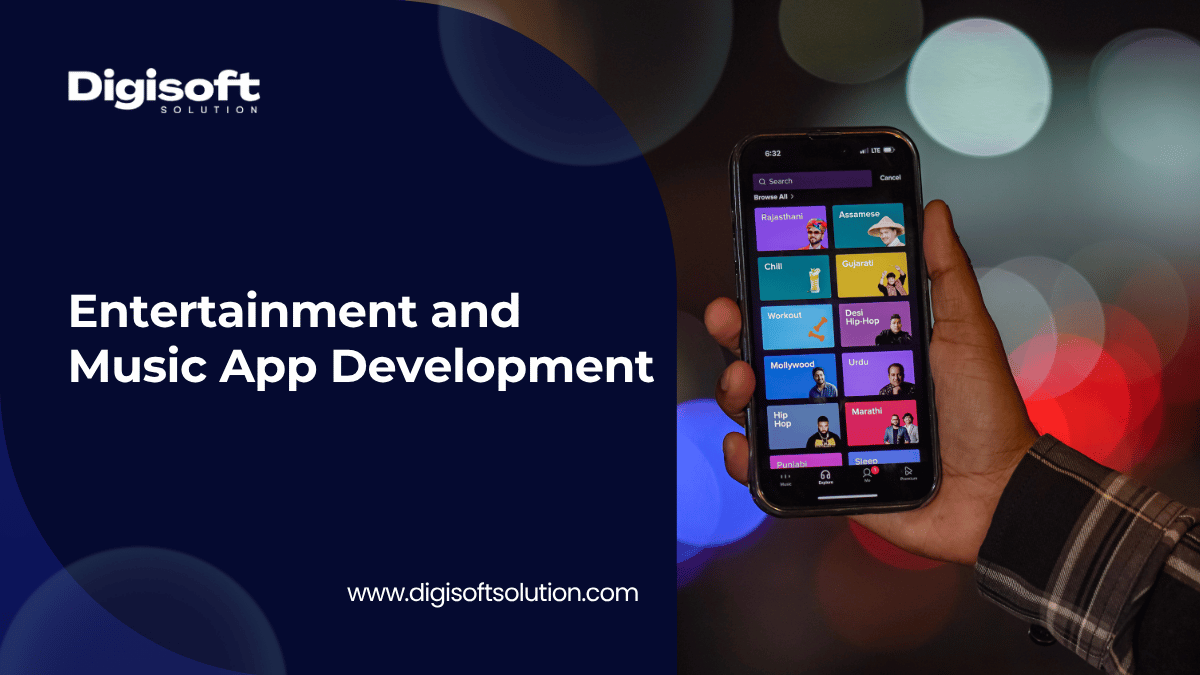
A music or entertainment app needs five things: a mobile app (iOS, Android or both), a streaming backend with a CDN, a content catalog with legal rights, a payment and subscription layer, and an admin panel. A lean MVP usually takes 4 to 8 months. A full Spotify-style product takes 10 to 16 months or more. The biggest cost surprise is not code. It is licensing and royalties. Cross-platform frameworks like Flutter and React Native are fine for most music apps, but heavy audio features may need native modules.
What Is an Entertainment and Music App?
An entertainment and music app delivers audio or video content to users, usually with playlists, search, personalization and a paid tier. The category is wider than "a Spotify clone". Pick your type first, because it changes the architecture.
|
App type |
Example use |
Main technical challenge |
|
On-demand music streaming |
Spotify-style catalog |
Licensing, CDN, recommendations |
|
Podcast and audiobook apps |
Episodes, chapters, resume playback |
Sync of playback position, offline downloads |
|
Live audio and radio |
Talk rooms, live DJ sets |
Low latency, scaling concurrent listeners |
Core Features Every Music App Needs
Must-have features for an MVP
- User signup and login (email, phone, Apple, Google)
- Search with filters for song, artist, album and genre
- Player with background playback, lock-screen controls and queue
- Playlists, likes and library
- Subscription and in-app purchase flow
- Push notifications
- Admin panel for uploading and managing content
Advanced features that improve retention
- Personalized recommendations and daily mixes
- Offline downloads with encrypted storage
- Gapless playback and crossfade
- Lyrics sync
- Social sharing and collaborative playlists
- Smart speaker, car and TV casting support
- Podcasts and live audio rooms
- AI-generated playlists and mood-based discovery
What most teams forget
Analytics events, crash reporting, content moderation and a takedown workflow. These are boring, but they save you alot of pain later.
Recommended Tech Stack for a Music Streaming App
|
Layer |
Common choices |
Why it matters |
|
Mobile (native) |
Swift for iOS, Kotlin with Jetpack Compose for Android |
Best background audio behavior and battery use |
|
Mobile (cross-platform) |
Flutter, React Native |
Faster and cheaper to ship on both platforms |
|
Audio playback |
AVFoundation, Media3 (ExoPlayer) |
Handles adaptive streaming, buffering and caching |
|
Streaming protocol |
HLS or MPEG-DASH |
Adapts audio quality to network speed |
|
Audio formats |
AAC, Opus, FLAC for lossless |
Balance of quality and data usage |
|
Backend |
Node.js, Python, Go or Java |
Handles APIs, auth, catalog and billing |
|
Database |
PostgreSQL plus Redis cache |
Metadata, playlists, sessions |
|
Search |
Elasticsearch or OpenSearch |
Fast fuzzy search across large catalogs |
|
Storage and delivery |
AWS S3, CloudFront or another CDN |
Global low-latency delivery |
|
DRM |
Widevine, FairPlay |
Needed when labels require protected content |
|
Payments |
Apple IAP, Google Play Billing, Stripe for web |
Store rules decide which one you must use |
|
DevOps |
Docker, Kubernetes, CI/CD |
Safe releases and scaling |
Native or cross-platform?
For most startups, cross-platform is the sensible start. Choose native if your app has a custom audio engine, heavy offline DRM, or needs very deep OS integration such as CarPlay and Android Auto from day one.
Why HLS is the default for music streaming
HLS splits audio into small chunks and serves multiple bitrates. If the user's network drops, the player switches to a lower bitrate instead of stopping. This is the main reason buffering can be reduced without users even noticing.
Music Licensing and Legal Requirements
This is the part that decides whether your business can exist. You cannot legally stream songs just because you can build a player.
The rights you usually need
- Master rights: the recording itself, usually from labels or distributors
- Publishing or composition rights: the song, covered by performance and mechanical licenses
- Sync rights: needed if music is paired with video
In the US, mechanical rights for interactive streaming go through a blanket license managed by the MLC, but that does not cover the master recording. Rules differ by country, so get a music lawyer involved early.
Ways to start with a smaller legal risk
- Independent artist catalogs through distributors
- Royalty-free and Creative Commons libraries
- Direct deals with local labels for a niche or regional market
- Artist-upload platforms with a proper DMCA takedown process
How Music Apps Make Money
- Freemium: free with ads, paid tier removes ads and adds offline mode
- Subscription: monthly or yearly plans, family and student tiers
- Ads: audio ads, banners, sponsored playlists
- Pay-per-download or pay-per-track
- Artist tools: promotion, tipping and merch
- B2B licensing: white-label for gyms, cafes, hotels and brands
Keep in mind that Apple and Google typically take 15% to 30% of in-app subscription revenue, so factor that into your margins.
Music App Development Process, Step by Step
- Discovery and market research: define audience, niche and content source
- Business model and licensing plan
- Product scope and MVP feature list
- UI/UX design and prototype
- Architecture and tech stack decision
- Development in sprints (app, backend, admin)
- Testing across devices, networks and battery states
- Store submission and compliance
- Launch, monitoring and iteration
Realistic timelines
|
Stage |
Typical duration |
|
Discovery and design |
3 to 6 weeks |
|
Lean MVP build |
3 to 6 months |
|
Mid-level product |
6 to 10 months |
|
Full-featured platform |
10 to 16 months or more |
How Much Does Music App Development Cost?
Honest answer: it depends, but not randomly. Cost comes from hours, team location, and non-engineering items like licensing. If you read online guides you will see numbers from $10,000 all the way to $1 million for the same "music app", and that gap looks confusing. Here is how we read it technically.
Why some cost claims do not add up
A real streaming MVP on iOS and Android needs a backend, a CDN setup, an admin panel, subscription billing, search and QA. That is easily 2,000 hours or more. At even a modest blended rate, a total of $10,000 to $17,000 covers only a few hundred hours. That is enough for a basic audio player or prototype, not a launch-ready streaming product. On the other side, quotes near $300,000 for an MVP usually include US-rate teams and licensing budgets, so they are not wrong, just not comparable.
Realistic cost ranges (development only, estimated)
|
Product level |
What you get |
Estimated range (USD) |
Typical timeline |
|
Prototype or simple player |
Basic player, limited catalog, one platform |
$15,000 to $40,000 |
2 to 3 months |
|
Lean MVP |
Cross-platform app, backend, search, playlists, subscriptions, admin |
$40,000 to $100,000 |
4 to 8 months |
|
Mid-level product |
Offline mode, recommendations, social features, analytics |
$100,000 to $200,000 |
6 to 10 months |
|
Full platform |
Advanced personalization, DRM, podcasts, live audio, multi-device |
$200,000 to $400,000+ |
10 to 16 months |
These are planning ranges based on an offshore or blended team. US-only teams can be 2 to 3 times higher. Treat them as a starting point, not a quote.
Costs that are not in the development budget
|
Item |
Why it matters |
|
Music licensing and royalties |
Can match or exceed build cost over time |
|
CDN and cloud hosting |
Grows with listening hours, not just users |
|
App store fees |
15% to 30% of in-app revenue |
|
Legal and compliance |
Contracts, DMCA process, privacy policy |
|
Maintenance |
OS updates, bug fixes, new devices, usually a yearly percentage of build cost |
|
Marketing |
User acquisition is a big share of the budget in a crowded market |
What pushes the cost up or down
- Number of platforms
- Offline mode with DRM
- Recommendation engine (third-party or custom)
- Live audio and real-time features
- Catalog size and ingestion pipeline
- Team location and seniority
- Design complexity
Common Technical Challenges and How to Solve Them
- Buffering on weak networks: adaptive bitrate, prefetching and local caching
- Gapless playback: proper player config and encoded audio that supports it
- Battery drain: efficient background services and limited wake-ups
- Slow search: dedicated search engine instead of database queries
- Piracy: encrypted offline storage and token-based URLs
- Scaling on release days: autoscaling backend and CDN caching
- Store rejections: follow payment, content and privacy rules from the start
How to Choose a Music App Development Partner
- Ask for streaming or media experience, not only general apps
- Ask how they handle HLS, DRM and offline playback
- Check if they understand licensing, or at least plan for it
- Look for sprint-based delivery with automated testing
- Confirm post-launch support in writing
How Digisoft Solution Helps With Entertainment and Music App Development
Digisoft Solution is a software development company with over a decade of experience and 700+ software products delivered. For entertainment and music projects, our team covers the full build, from architecture to store launch and support.
What we build
- On-demand music and podcast streaming apps
- Live audio, live broadcasting and content distribution apps
- Artist and fan engagement platforms
- Admin dashboards and content management systems
- Subscription, payments and analytics layers
How we build it
- Mobile: iOS with Swift, Android with Kotlin, and cross-platform with Flutter and React Native. See our Mobile App Development and Android App Development services.
- Web and offline access: installable, offline-ready web experiences through our Progressive Web App Development service.
- Backend: scalable APIs with Node.js, Python, Java and Go, with real-time communication through WebSockets and event streaming for high-traffic moments. Learn more on our Software Product Development page.
- Delivery: two-week sprints, automated testing and CI/CD pipelines. See How We Work.
- Team: need extra hands? You can hire Android developers or set up a dedicated team.
Explore all our Software Development Services, read more on our Blog, and see relevant work in our Case Studies.
Why teams pick Digisoft Solution
- Senior engineers who plan architecture before writing code
- Clear scope and estimate after a discovery call
- A consultant replies within 24 hours
People Also Ask
How do I make a music app?
Define your niche, secure content rights, design the MVP, build the app and streaming backend, add subscriptions, test on real devices, and launch on the stores.
Is it legal to build a music app like Spotify?
Yes, if you license the content. Building the player is legal. Streaming songs without master and publishing rights is not.
How does a music streaming app work technically?
The app requests a track from your API. The server returns a secure link to audio chunks stored on a CDN. The player downloads chunks and plays them, adjusting quality based on network speed.
Which programming language is best for a music app?
Swift for iOS, Kotlin for Android, Dart with Flutter or JavaScript with React Native for cross-platform, and Node.js, Python or Go for the backend.
How do music apps get songs?
Through label deals, distributors, aggregators, royalty-free libraries, or direct artist uploads.
How do free music apps make money?
Mostly ads and premium upgrades, plus sponsorships and B2B licensing.
What is the best platform for a music app, iOS or Android?
It depends on your audience. Android dominates in many markets like India, while iOS users often spend more per user. Many teams launch on both using cross-platform.
FAQs
How long does it take to build a music streaming app?
A lean MVP takes 4 to 8 months. A full-featured platform can take a year or more.
How much does it cost to build a music app in 2026?
Roughly $15,000 to $40,000 for a simple player, $40,000 to $100,000 for a lean MVP, and $200,000 or more for a full platform, excluding licensing. Exact cost depends on scope and team location.
Should I build an MVP first?
Yes. Launch the core listening experience, then add offline mode, social features and recommendations based on real user data.
Can I build a music app without licensing music?
Yes, with royalty-free content, independent artists who agree to your terms, or a platform where artists upload their own work with a clear rights process.
Do I need DRM?
Only if your content partners require it, which is common with major labels and video content. Indie catalogs often start without it.
How much does it cost to maintain a music app?
Plan for ongoing hosting, CDN, updates and support. A common rule is 15% to 20% of the build cost per year, and streaming costs grow with usage.
Which is better for a startup, native or cross-platform?
Cross-platform for speed and budget. Native when you need a custom audio engine or deep OS features.
Can Digisoft Solution build a white-label music app?
Yes, we can build white-label or fully custom platforms depending on your goals. Share your requirements for a scoped estimate.
Final Thoughts
Building a music or entertainment app is doable, but the winners are rarely the ones with the most features. They pick a clear niche, sort out licensing early, and ship a stable listening experience first. If you want help scoping it, talk to the Digisoft Solution team and get a clear plan before you commit budget.
Digital Transform with Us
Please feel free to share your thoughts and we can discuss it over a cup of coffee.