Enterprise PII Detection & Compliance Platform
AI-Powered Data Protection for Enterprise Privacy & Compliance









About the Client
Confidential Enterprise Client
- IndustryData Privacy, Regulatory Compliance, Healthcare, Financial Services
- RegionConfidential
- PlatformEnterprise SaaS Data Protection & Compliance Platform
- Delivery8 Months
The client is a technology-driven enterprise organization managing large volumes of sensitive business information across multiple systems. With increasing volumes of digital information across multiple business systems, the organization needed better visibility into sensitive data management processes.
Existing workflows relied on manual evaluations and fragmented tools, making privacy oversight more complex. The client aimed to establish a centralized approach for improving information governance and streamlining compliance activities. This supported long-term data protection objectives across enterprise environments.
Project Overview
Project Overview
Most enterprises face growing challenges in managing sensitive information distributed across documents, databases, applications, and cloud environments. Manual PII and PHI identification creates accuracy issues, increases compliance risks, and becomes difficult to scale with evolving privacy requirements.
Digisoft Solution developed an AI-powered data privacy platform that automates sensitive data discovery, classification, monitoring, and compliance management. The platform enables accurate PII detection, audit visibility, stronger privacy controls, and structured data governance practices.
The platform combines Microsoft Presidio, custom NLP recognizers, Named Entity Recognition (NER), and distributed processing pipelines to automate enterprise-wide PII and PHI detection.
The Concept
The Concept
The main idea was to create a proactive privacy management framework that provides continuous awareness of sensitive information across complex enterprise ecosystems. Traditional compliance methods often depend on periodic assessments and manual validation, limiting efficiency at scale.
The approach focuses on intelligent data analysis, automated recognition, and consistent monitoring to support faster privacy operations. The platform enables organizations to transition from reactive compliance practices toward a continuous and scalable data protection model. The framework achieves this by combining contextual NLP models, rule-based recognizers, and Named Entity Recognition (NER).

Key Challenges Addressed
Key Challenges Addressed
Multi-Source Data Detection
Enterprises struggled to identify PII and PHI across documents, databases, emails, and applications. Achieving accurate detection across structured and unstructured data remained a key challenge.
Detection Accuracy Improvement
Existing systems relied primarily on regex, dictionary matching, and keyword rules, resulting in high false positives and poor contextual understanding. The objective was implementing intelligent recognition capabilities to understand context and improve sensitive data identification accuracy.
Real-Time & Batch Processing
Organizations needed privacy monitoring for real-time workflows and large-scale batch operations. The main difficulty was creating a shared detection pipeline capable of handling different workloads efficiently.
Enterprise Data Scalability
Growing enterprise data volumes created scalability challenges for continuous analysis. The platform required efficient processing capabilities to handle high-volume workloads while maintaining performance and optimizing resources.
Organizations needed detailed tracking of sensitive data activities to support HIPAA, GDPR, and CCPA requirements. The problem was providing centralized monitoring, reporting, and audit visibility.
Secure & Scalable Performance
Enterprise privacy systems needed strong protection without affecting speed or productivity. The solution was delivering secure, reliable, and scalable data processing across complex business environments.
Technical Solutions We Implemented
Technical Solutions We Implemented
Built a Microsoft Presidio-based detection engine extended with custom recognizers, contextual NLP models, and confidence scoring. The solution scanned structured and unstructured enterprise data while delivering accurate and consistent privacy detection.
Custom NLP Recognizers
Extended Microsoft Presidio using custom EntityRecognizer implementations and PatternRecognizer components. This enabled the platform to detect organization-specific identifiers, proprietary business information, domain-specific terminology, and other contextual entities beyond the capabilities of the default Presidio recognizers.
Integrated spaCy's en_core_web_lg Named Entity Recognition (NER) model to analyze contextual relationships, accurately distinguish sensitive entities, and reduce false positives and false negatives. This improved recognition of people, locations, organizations, and healthcare-related information.
Designed a FastAPI-based microservices architecture with modular services for data ingestion, PII analysis, compliance reporting, audit management, and workflow orchestration. This simplifies maintenance and enterprise system integration.
Event-Driven Processing
Leveraged Apache Kafka for asynchronous event-driven processing, enabling reliable message streaming, workload distribution, and fault-tolerant processing. This enabled efficient high-volume document analysis across distributed services.
Enabled both real-time REST API scanning and asynchronous batch processing through a unified detection engine. This supports live data monitoring, document uploads, historical repository scanning, and compliance assessments.
Enterprise Data Search
Integrated Elasticsearch to index detection records, document metadata, and extracted text and metadata. This enables high-speed search, advanced filtering, and rapid investigation of sensitive data across enterprise repositories.
Audit & Compliance Logging
Implemented PostgreSQL to securely store immutable audit records, detection history, confidence scores, compliance events, document references, timestamps, and redaction activities. This ensures complete traceability, supports regulatory reporting, and maintains an auditable history of compliance operations.
High-Performance Caching
Integrated Redis as an in-memory caching layer to accelerate repeated detection requests, optimize API response times, and manage application sessions. This improves processing efficiency for large-scale privacy operations.
Deployed the platform on AWS using stateless Docker containers behind load balancers. This enabled horizontal scaling, high availability, secure cloud hosting, automated deployments, and reliable enterprise-grade performance.
System Architecture
System Architecture
The following table summarizes the primary components of the platform architecture and their responsibilities in supporting secure, scalable, and AI-powered PII/PHI detection and compliance operations.
| Component | Responsibility |
|---|---|
| Client Layer | Serves as the entry point for enterprise applications, document repositories, email gateways, compliance dashboards, and scheduled batch uploads that submit data for privacy analysis. |
| API Gateway / Load Balancer | Routes incoming requests to backend services, distributes traffic efficiently, applies rate limiting, and secures communications through TLS termination. |
| Authentication Service | Validates OAuth 2-issued JWT bearer tokens and enforces role-based access control (RBAC) |
| FastAPI Real-Time Scan Service | Provides low-latency REST APIs for immediate scanning of documents, text, and application data requiring instant compliance validation. |
| Batch Ingestion Service | Receives bulk document uploads, stores files securely in AWS S3, and publishes processing events to Apache Kafka for asynchronous analysis. |
| Detection Orchestrator | The FastAPI-based orchestration service integrates Microsoft Presidio, custom recognizers, spaCy NER, and Kafka to consolidate detection results. |
| Apache Kafka | Enables asynchronous event-driven processing, distributes workloads across services, supports high-volume document scanning, and improves system scalability. |
| Microsoft Presidio Engine | Detects built-in sensitive entities such as names, email addresses, phone numbers, SSNs, and financial identifiers using configurable recognition models. |
| Custom NLP Recognizers | Detect organization-specific identifiers, proprietary business information, healthcare records, and industry-specific data patterns beyond standard recognition models. |
| spaCy NLP / NER Models | Identifies contextual entities embedded within unstructured text, improving detection accuracy and reducing false positives. |
| Confidence Scoring Engine | Combines rule-based, NLP, and contextual validation scores to assign reliable entity confidence classifications. |
| PostgreSQL | Stores audit logs, scan history, compliance records, confidence scores, timestamps, and processing metadata for reporting and regulatory traceability. |
| Elasticsearch | Indexes scanned content and metadata to provide high-speed search, advanced filtering, and rapid compliance investigations. |
| AWS S3 | Securely stores original documents, processed files, and redacted outputs for long-term retention and retrieval. |
| Redis | Improves application performance by caching frequently accessed data, recognizer configurations, duplicate scan information, and session data. |
| AWS ECS | Runs containerized microservices with automatic scaling to support changing workloads while maintaining reliable application performance. |
| Amazon CloudWatch & Centralized Logging | Continuously monitors application health, performance metrics, system logs, and operational events while supporting alerting and troubleshooting. |
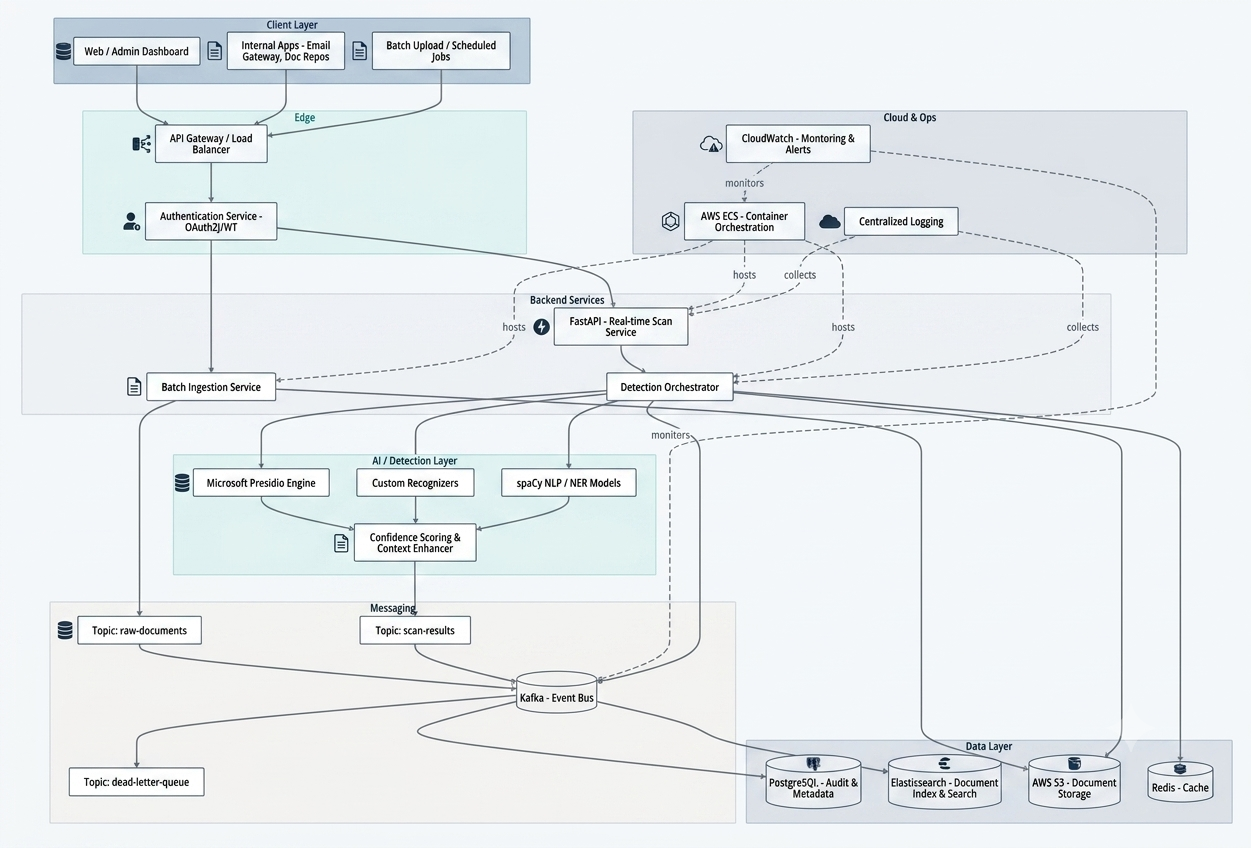
Architecture Approach
Architecture Approach: Why It Works Better
We designed a layered, cloud-native microservices architecture that combines AI-powered detection, distributed processing, and scalable cloud infrastructure. The platform separates ingestion, analysis, processing, storage, and deployment into dedicated layers. This enables accurate detection, independent scalability, high availability, and enterprise-grade compliance across large volumes of sensitive data.
- The architecture separates data ingestion, AI detection, processing, storage, and infrastructure into independent layers, improving scalability, maintainability, flexibility, and future system enhancements.
- Built a hybrid detection pipeline combining Microsoft Presidio, custom EntityRecognizer implementations, and spaCy NER for accurate contextual entity detection.
- Leveraged Apache Kafka and FastAPI microservices for asynchronous processing, parallel execution, fault tolerance, and scalable high-volume document analysis.
- Used a shared detection engine for real-time APIs and batch scanning, ensuring consistent entity classification and compliance across all workloads.
- Utilized PostgreSQL, Elasticsearch, and Redis for immutable audit logging, fast search, intelligent caching, and complete compliance traceability.
- Deployed stateless Docker containers on Amazon ECS behind an Application Load Balancer, enabling scalable, highly available, and secure cloud operations.
Data Flow
Data Flow
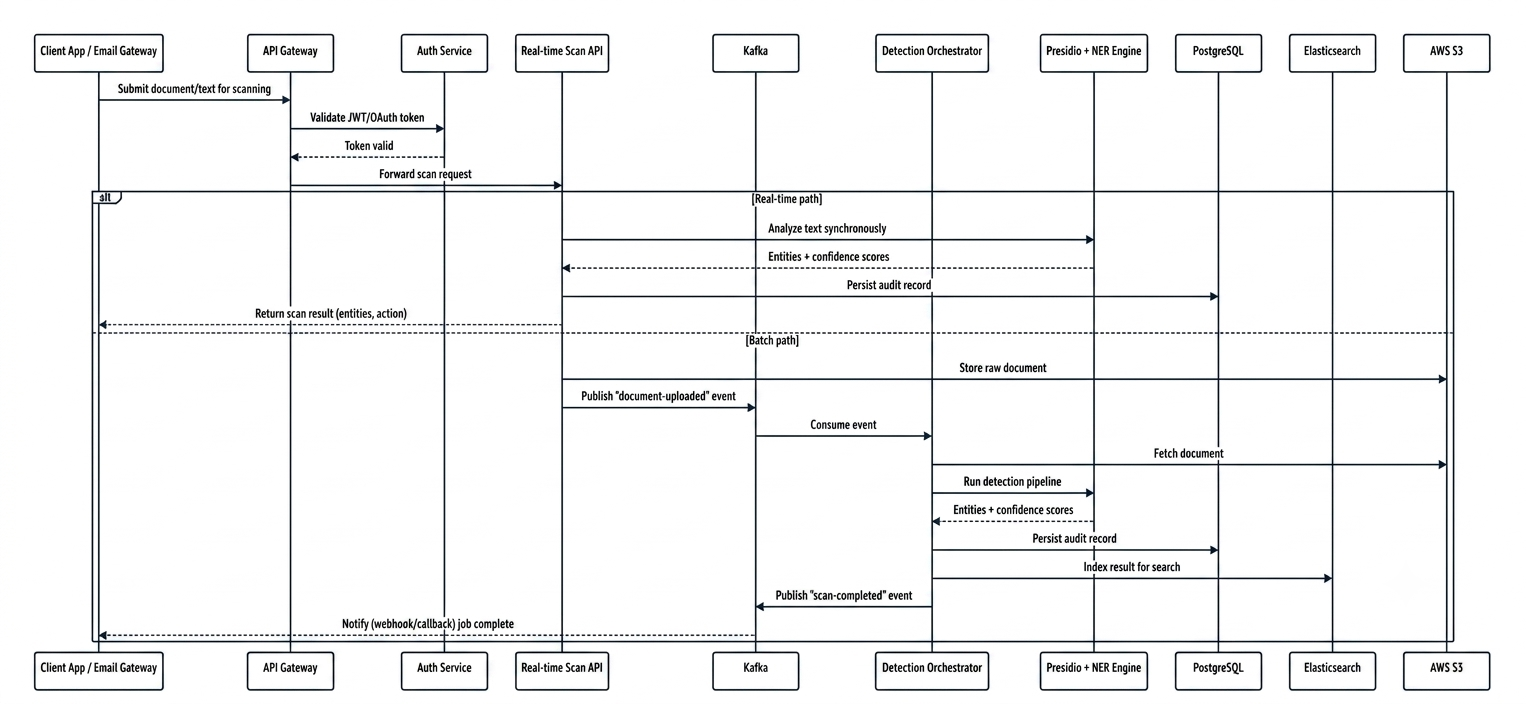
The following workflow illustrates how large-scale data moves through the platform, from secure data ingestion and AI-powered PII detection to event-driven processing, audit logging, search indexing, and compliance reporting. This ensures accurate, scalable, and traceable privacy operations.
Core Features & Functionalities
Core Features & Functionalities
Automatically scans structured and unstructured organizational data to identify PII, PHI, financial, healthcare, and organization-specific sensitive information, significantly reducing manual compliance efforts.
Intelligent Data Classification
Classifies detected information based on entity type, sensitivity level, and contextual analysis. This helps organizations prioritize remediation, risk assessment, and regulatory compliance activities.
Custom Detection Rule Management
Supports configurable custom recognizers that detect organization-specific identifiers, proprietary business information, healthcare records, and industry-specific data beyond standard privacy models.
Real-Time Compliance Monitoring
Continuously analyzes incoming documents and application data through real-time scanning. This enables immediate detection of sensitive information and faster compliance decision-making.
Comprehensive Audit Reporting
Maintains detailed audit records, confidence scores, processing history, timestamps, and compliance events. This provides complete traceability for governance, regulatory reporting, and internal audits.
Enterprise-Scale Document Processing
Processes individual documents and high-volume repositories through unified real-time and batch workflows. It supports scalable enterprise-wide privacy assessments and compliance operations.
Searchable Compliance Intelligence
Enables high-speed search, advanced filtering, and rapid investigation of detected sensitive information using indexed records. This helps compliance teams resolve privacy incidents efficiently.
Secure and Scalable Deployment
Runs on AWS using Docker-based microservices with load balancing, horizontal scaling, and secure cloud infrastructure. This delivers reliable enterprise-grade availability and performance.
Technologies and Tech Stack We Used
Technologies and Tech Stack We Used
| Category | Technologies |
|---|---|
| Programming Language | Python 3.11 |
| Frontend | React (Internal Admin Dashboard) |
| Backend Framework | FastAPI |
| AI / NLP Framework | Microsoft Presidio, spaCy (en_core_web_lg), Custom EntityRecognizer Implementations |
| Machine Learning | Contextual Entity Classification, Confidence Scoring Models |
| API Architecture | REST APIs, Microservices Architecture |
| Event Processing | Apache Kafka |
| Database | PostgreSQL (AWS RDS) |
| Search & Analytics | Elasticsearch |
| Cache Layer | Redis |
| Containerization | Docker |
| Cloud Infrastructure | AWS (Amazon ECS, Application Load Balancer (ALB), S3, RDS, CloudWatch, Secrets Manager) |
| Data Processing | Real-Time Processing, Batch Document Processing |
| Security & Compliance | OAuth2, JWT, RBAC, HIPAA, GDPR, and CCPA Compliance Alignment |
| Monitoring & Logging | Amazon CloudWatch, Centralized Logging |
| DevOps | Docker Build and GitHub Actions CI/CD Pipeline |
| Development Approach | Cloud-Native, API-First Microservices Architecture |
APIs Developed
APIs Developed
The Enterprise PII Detection & Compliance Platform exposes secure REST APIs to support real-time scanning, batch processing, custom recognizer management, compliance policy control, and audit tracking.
| Method | Endpoint | Purpose | Authentication | Response |
|---|---|---|---|---|
| POST | /v1/scan/realtime | Performs synchronous scanning of a single document or text input to detect PII/PHI entities. | OAuth 2.0 / JWT | 200 OK — Detected entities, confidence scores, and recommended actions |
| POST | /v1/scan/batch | Submits multiple documents for asynchronous PII/PHI scanning and processing. | OAuth 2.0 / JWT | 202 Accepted — Returns job ID for tracking processing status |
| GET | /v1/scan/batch/{job_id} | Retrieves processing status and summary results for a batch scanning job. | OAuth 2.0 / JWT | 200 OK — Job status and result summary |
| GET | /v1/results/{job_id} | Fetches detailed entity-level detection results for a completed scanning job. | OAuth 2.0 / JWT | 200 OK — List of detected entities, offsets, and confidence scores |
| POST | /v1/recognizers | Registers or updates custom PII/PHI recognizers for enterprise-specific detection requirements. | OAuth 2.0 / JWT (Admin Role) | 201 Created / 200 OK — Recognizer configuration status |
| GET | /v1/policies | Retrieves active compliance policies and configured detection rules. | OAuth 2.0 / JWT | 200 OK — List of active policies |
| PUT | /v1/policies/{policy_id} | Updates compliance policy thresholds, rules, and automated response actions. | OAuth 2.0 / JWT (Admin Role) | 200 OK — Updated policy details |
| GET | /v1/audit/{job_id} | Retrieves an immutable audit trail associated with a scanning job for compliance reporting. | OAuth 2.0 / JWT (Compliance Role) | 200 OK — Audit log entries |
| GET | /v1/health | Provides service health monitoring and availability checks. | Internal Access (No Authentication) | 200 OK — Service health status |
API Design Highlights:
- REST-based architecture for seamless enterprise integration.
- OAuth 2.0 and JWT-based authentication for secure API access.
- Role-based authorization for administrative and compliance operations.
- Support for both real-time and asynchronous document processing workflows.
- Detailed entity-level responses with confidence scoring for explainable PII/PHI detection.
Security Implementation
Security Implementation
The Enterprise PII Detection & Compliance Platform was designed with enterprise-grade security controls to protect sensitive information throughout the detection, processing, and reporting lifecycle.
| Security Area | Implementation |
|---|---|
| JWT Authentication | Implemented JWT-based authentication for user and dashboard sessions using short-lived access tokens with refresh token rotation workflows to maintain secure and controlled user access. |
| OAuth 2.0 Authorization | Applied OAuth 2.0 client credentials flow for secure service-to-service communication, such as integrations between enterprise systems (e.g., email gateway and PII scanning APIs). |
| Data Encryption | Secured all API communication using TLS 1.2+ encryption for data in transit. Stored documents and database records were protected using AES-256 encryption at rest with AWS S3 Server-Side Encryption (SSE) and AWS KMS-managed keys. |
| Role-Based Access Control (RBAC) | Implemented granular role-based permissions to control platform access: Admin users can manage recognizers and compliance policies, compliance officers can access audit trails and dashboards, and service roles can submit scanning requests only. |
| PII Data Protection | Prevented exposure of sensitive information by avoiding plaintext storage of detected PII/PHI data in application logs. Detection results stored entity types, data offsets, and confidence scores instead of raw sensitive values wherever compliance policies allowed. Redacted and anonymized copies were used for downstream analytics. |
| Immutable Audit Logging | Maintained a secure audit trail through a protected audit_log database table with restricted modification access capturing scan activities, policy decisions, user actions, and administrative changes, including recognizer and policy updates with timestamps and user identity tracking. |
| API Security Controls | Strengthened API protection using schema-based input validation with Pydantic, strict request payload size restrictions, and API Gateway security controls to mitigate injection attacks and unauthorized usage patterns. |
| Rate Limiting & Abuse Prevention | Implemented client-level rate limiting through API Gateway controls backed by Redis counters to prevent excessive requests, protect system resources, and ensure fair usage across integrated enterprise applications. |
Testing & Quality Assurance
Testing & Quality Assurance
- Conducted comprehensive functional testing to validate PII/PHI detection, custom recognizers, real-time and batch document scanning, REST APIs, and compliance reporting across enterprise privacy scenarios.
- Evaluated detection accuracy using precision, recall, F1-score, false-positive and false-negative analysis while validating contextual NLP performance and custom entity recognition.
- Performed high-volume performance and load testing by validating concurrent API requests, Kafka event streaming, large-scale document processing, system throughput, and response latency.
- Optimized PostgreSQL, Elasticsearch, and Redis through query tuning, indexing strategies, search optimization, and intelligent caching for enterprise-scale compliance workloads.
- Executed end-to-end security testing, including OWASP API Security Top 10 validation, OAuth2 with JWT bearer authentication, RBAC, secure data handling, and cloud infrastructure security.
- Verified platform stability through integration, end-to-end workflow, and deployment testing, ensuring reliable microservices communication, fault tolerance, and consistent enterprise-scale processing.
Our Approach & Development Timeline
Our Approach & Development Timeline
Business Discovery & Compliance Planning
Platform Architecture & Technology Design
AI-Powered Detection Engine Development
Microservices, Data Processing & System Integration
Validation, AWS Deployment & Performance Optimization
Continuous Monitoring, Enhancement & Support
Measurable Outcomes
Measurable Outcomes
The Enterprise PII Detection & Compliance Platform delivered significant improvements in data privacy, operational efficiency, and compliance readiness. Intelligent automation improved detection accuracy, reduced manual effort, and enabled scalable enterprise-wide privacy operations.
Reduced average API response time for standard document scanning workflows to approximately 1.8 seconds per document.
Processed high-volume enterprise document repositories through scalable batch processing, enabling efficient large-scale privacy assessments.
Significantly reduced false positives using a hybrid detection pipeline combining Microsoft Presidio, custom EntityRecognizer implementations, spaCy NER, and contextual confidence scoring.
Improved PII and PHI detection through layered AI models, strengthening contextual entity recognition and enterprise compliance coverage.
- Automated large-scale privacy scanning, reducing manual review efforts and enabling compliance teams to prioritize complex, low-confidence cases.
- Delivered a scalable AWS-based platform with complete audit history, horizontal auto-scaling, and cost-efficient cloud infrastructure supporting enterprise compliance and regulatory audits.
Digisoft Solution developed an AI-powered enterprise PII detection & compliance platform that automates sensitive data discovery and regulatory compliance. By combining intelligent detection with cloud-native architecture, the platform simplifies privacy operations and strengthens enterprise data governance.