Advanced Mission Planning Platform: For a U.S. Defense Organization








About The Client
U.S. Defense Organization
- IndustryDefense & Military Operations Management
- RegionUnited States
- PlatformWeb-Based Mission Planning Platform
- Delivery1 Year
The client operates in the defense sector, where mission planning, personnel readiness, and resource management require strict operational control and structured processes. Their operational environment involved managing sensitive mission-related information across multiple departments, operational units, and authorized personnel roles.
The organization required a system capable of supporting secure operational coordination with restricted access to mission records, deployments, operational coordination requests, assets, and workflows. Security, operational visibility, and hierarchical access management were critical requirements due to the nature of defense-related operations and controlled mission activities.
Client identity is confidential per U.S. Department of Defense engagement requirements.
Project Overview
Centralized Mission Planning For Secure Defense Operations
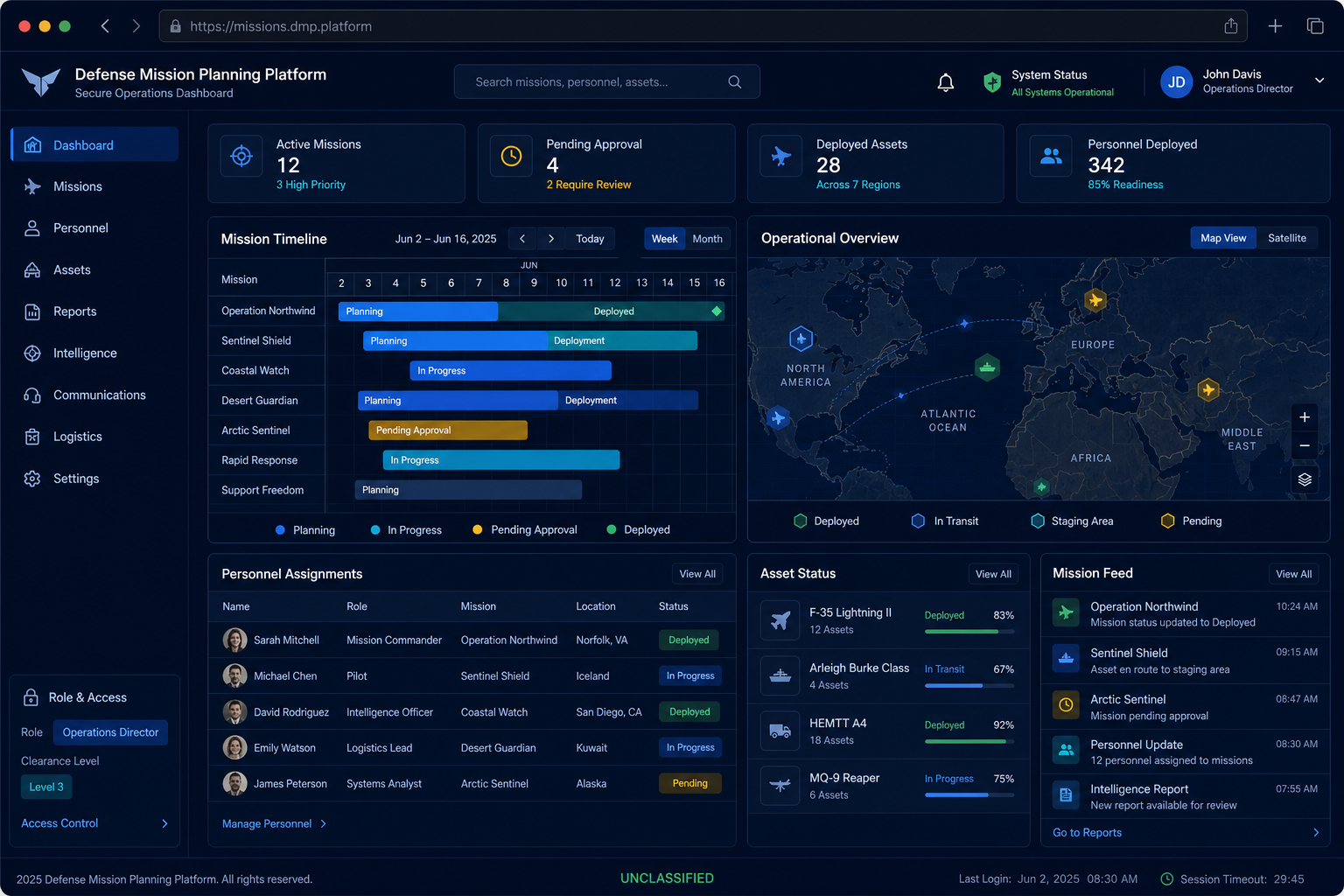
Mission planning, personnel deployment, intelligence coordination, and operational resource management were handled across multiple defense units. This created administrative and access-control challenges for the organization. The client approached Digisoft Solution to develop a web-based platform to centralize operational workflows.
The system was developed to support mission assignment, deployment scheduling, execution monitoring, and secure coordination across personnel, equipment, and operational units. The platform provided centralized administrative control for managing mission activities. This enforced restricted access to operational information based on user authorization and military hierarchy. All API communication was protected using TLS 1.2+, while authentication and role-based access controls safeguarded mission operations and sensitive operational data.
The Concept
Unified Mission Coordination Across Operational Units
The platform serves as a mission coordination system to support defense operations and planning activities. It enabled structured management of mission data, personnel roles, and operational resources within a unified framework.
The platform unified mission coordination, personnel assignments, operational resources, and intelligence workflows into a centralized defense management system. It supported the managed execution of defense operations by maintaining structured coordination across mission activities and operational dependencies.
The overall concept focuses on improving coordination, traceability, and discipline in mission execution across multiple operational units.
Key Challenges Addressed
Defense Operations Required Control Over Coordination, Access & Assets
Fragmented Mission Coordination
Mission planning activities, such as assignments, deployment planning, operational coordination requests, and equipment tracking, were handled across separate processes. This made it difficult to maintain a unified operational view and a consistent execution flow.
Uncontrolled Access to Sensitive Data
Operational information needed to be restricted based on rank and responsibility. Inconsistent access control increased the risk of unauthorized access to mission and deployment data.
Lack of Unified Equipment Tracking
Equipment, personnel, and deployment resource data were managed in silos, making tracking and readiness assessment difficult. This created difficulties in monitoring availability, allocation, and readiness across missions.
Limited Operational Monitoring
There was no centralized mechanism to monitor system usage, operational actions, and resource handling. This made it difficult to detect misuse or ensure consistent adherence to operational rules.
Technical Solutions We Implemented
Modular Architecture For Governed Mission Execution
A modular monolithic platform with separated operational domains, secure RESTful APIs, and role-based access control—centralizing mission coordination, personnel deployment, and resource administration.
Centralized Mission Coordination Framework
We implemented a modular monolithic architecture to manage mission creation, scheduling, assignment, and tracking. Each mission domain was separated into dedicated service layers to improve maintainability and scalability.
Controlled Access Management
Role-based authorization was implemented using managed access policies enforced across operational workflows. Role-based authorization was implemented through centralized access policies aligned with operational responsibilities.
Administrative Control Services Layer
A dedicated backend service layer was developed to handle administrative operations, including user management, mission configuration, and resource governance. This layer managed user administration, mission configuration, operational permissions, and governance controls.
Operational Asset Tracking Engine
A structured data engine was implemented to maintain records of operational assets, including equipment, personnel allocations, and deployment resources. This ensured accurate tracking and consistent status for operational assets.
Structured Mission Execution Workflows
A mission workflow management layer was introduced to manage mission workflow stages, including creation, review, assignment, and execution. It ensured consistent, rule-based progression across the mission lifecycle.
Operational Security Controls
Centralized security controls were implemented to enforce validated and authorized operational requests across system workflows. This ensured controlled, validated execution of mission-related operations.
Why It Works Better
Modular Monolith With Secure RBAC
The platform was built using a modular monolithic architecture with separated operational domains for mission coordination, personnel management, and resource administration. Secure RESTful APIs enabled authenticated communication across system modules.
- Modular system organization improved maintainability and operational stability across core workflows.
- Secure API services enabled authenticated communication between operational modules.
- Role-based access control (RBAC) restricted access according to authorization levels and operational responsibilities.
- Standardized data handling improved consistency across mission records and workflows.
- Azure hosting provided stable infrastructure and scalable deployment support.
Core Features & Functionalities
Designed For Secure Defense Operations
- Mission Planning and Tracking: The system enabled users to create, assign, and monitor missions throughout their lifecycle. It provided visibility into mission progress, status updates, and operational timelines to support organized execution and coordination across defense activities.
- Personnel Deployment Management: The system enabled users to allocate personnel to missions based on operational requirements. The feature maintained records of assignments, deployment status, and role distribution. This ensured clarity in workforce utilization across different mission environments and operational scenarios.
- Intelligence Request Handling: This feature enabled the submission and tracking of mission support requests. Requests followed defined processing steps for review, routing, and response handling, ensuring proper coordination between mission units and intelligence operations.
- Operational Resource Management: The system provided governed access to mission-related resources, including equipment, platforms, personnel, and support assets. It helped users monitor availability and allocation status to support efficient planning and operational readiness.
- Mission Workflow Stages: Each mission progressed through defined operational stages: planning, assignment, operational review, deployment coordination, and execution tracking. This ensured consistent handling of mission activities and improved clarity in progression across different operational units.
- Role-Based Access and Administration: System access was governed by user roles, ensuring restricted interaction with sensitive mission data. Administrators managed users, permissions, and mission configurations while maintaining centralized operational oversight and accountability across the platform.
Technologies and Tech Stack We Used
Tools Chosen For Security & Operational Scale
C# · ASP.NET Core · Web API
Modular monolithic services with secure RESTful APIs for mission coordination workflows.
SQL Server 2016 · Entity Framework · LINQ
Structured operational records with consistent data handling across mission domains.
Microsoft Azure · Git · SonarQube
Scalable Azure hosting with quality gates and version-controlled delivery pipelines.
SSIS · Swagger UI · JSON
Cross-system data transfer, API validation, and documented service contracts.
Testing & Quality Assurance
Validated For Security, Access & Workflow Integrity
- ASP.NET Core services were validated for mission workflows, authorization handling, and data consistency.
- API behavior was tested through Swagger UI request and response validation.
- SQL Server operations and Entity Framework data handling were reviewed for operational record integrity.
- Role-based permissions were verified across administrative and operational access levels.
- Integration testing confirmed communication between API, business logic, and database layers.
- Security validation was conducted to prevent unauthorized operational access.
- SSIS workflows were reviewed to ensure accurate cross-system data transfer.
- End-to-end workflow testing validated planning, assignment, deployment, and mission tracking processes.
Our Approach & Development Timeline
Phased Delivery Across 1 Year
From discovery and security planning through architecture, backend development, module implementation, hardening, and Azure deployment with performance optimization.
Discovery, Requirement Analysis & Security Planning
Operational workflow definition and security architecture specification.
System Architecture & Database Design
Modular monolith design and relational schema for mission domains.
Core Backend & API Development
Secure RESTful APIs and foundational service layers.
Mission, Personnel & Asset Module Implementation
Workflow engines, RBAC, and operational asset tracking.
Security Hardening, Integration & Workflow Validation
SSIS integration, security controls, and end-to-end workflow validation.
Testing, Azure Deployment & Performance Optimization
QA, production deployment, and operational performance tuning.
Measurable Outcomes
Operational Gains From Centralized Mission Delivery
Metrics were measured using operational monitoring systems, SQL Server audit logs, and workflow timestamp comparisons between legacy manual processes and system-generated execution records. Previously, mission activities were managed manually or across disconnected systems, causing delays and inconsistencies. After deployment, operations were centralized with real-time tracking, structured workflows, and accurate reporting.
Administrative mission coordination & approval (down from 48–72 hours)
Equipment tracking accuracy (up from 70%)
Data mismatches (down from 20–25%)
The system was delivered using a structured engineering approach focused on governed data handling, role-based access, and consistent workflow execution across all mission operations. The architecture unified mission planning, personnel deployment, support workflows, and resource tracking in a single, secure, centralized environment. The implementation improved operational consistency, reduced manual dependencies, and enhanced oversight across mission activities.