Miller Tanner Associates: Transforming Life Sciences Events into Seamless Global Experiences








About The Client
Miller Tanner Associates
- IndustryEvents Services / Corporate Event Management (Life Sciences Focus)
- RegionUnited States
- PlatformVirtual · Hybrid · In-Person Events
- Delivery4 years
Miller Tanner Associates (MTA) is a US-based organization founded in 1997 that provides meeting support services to enterprises. It operates in regulated industries such as pharmaceuticals and biotechnology.
The company delivers support for structured business gatherings, including training sessions, leadership meetings, advisory boards, and investigator meetings. It operates across major global regions, including the Americas, Europe, the Middle East, Africa, and Asia-Pacific.
MTA is organized into dedicated internal teams responsible for specific functional areas, including coordination, scheduling, participant management, and event documentation. This structure enables consistent internal allocation of responsibilities across projects without relying on a single centralized workflow.
Project Overview
A Unified Execution Layer For Global Life Sciences Events
Miller Tanner Associates manages large-scale, multi-region life sciences events across registration, scheduling, and engagement workflows. Fragmented systems across distributed teams caused inconsistencies, delays, and unreliable data.
A unified execution layer was introduced to centralize operations, enabling automation and real-time coordination. This reduces manual effort and improves global consistency, speed, and reliability.
The Concept
From Fragmented Tools To A Unified Orchestration Model
Previously, event operations relied on fragmented tools and manual coordination across registration, scheduling, and engagement workflows. This fragmentation led to inconsistent execution across global events.
To address this, we restructured the system into a single event execution layer that centralizes scheduling, participant management, and engagement processes. This reduced dependency on manual coordination and unified operational control.
The new model standardizes execution across all event formats through unified workflows, shifting operations from fragmented, ad hoc processes to a unified orchestration model. It ensures consistency, reliability, and scalability across global events.

Key Challenges Addressed
Scaling Required Control Over Data, Workflows, Audiences & Compliance
These challenges impacted operational consistency, scalability, and execution reliability across global life sciences event workflows, highlighting the need for a unified platform approach.
Data Fragmentation & Integration Gaps
Event data was distributed across WordPress CMS, external registration systems, and communication tools with limited interoperability, resulting in fragmented workflows and reduced real-time visibility. This led to delayed event updates during live operations and inconsistent attendee-facing information.
Multi-Product Line Complexity
Multiple service lines operate in parallel, each with its own data structures and workflow logic, making standardization difficult. This increased the risk of inconsistent execution across different event offerings.
Multi-Audience Navigation Complexity
Attendees, organizers, and stakeholders followed separate interaction flows without a unified navigation model. This created inconsistent user experiences and higher coordination overhead.
Scalability Constraints
High concurrent loads during peak registration periods and global events led to performance limitations. This increased the risk of service degradation during critical execution windows.
Real-Time Synchronization Latency
Event updates across schedules, sessions, and attendee data were not consistently synchronized in real time. This created temporary data inconsistencies during live event execution.
Regulatory Compliance & Hybrid Execution
Operating across regions introduced compliance and governance challenges, as did hybrid virtual and onsite formats. This caused workflow inconsistencies and execution differences across event environments.
Technical Solutions Implemented
API-First Architecture For Reliable Hybrid Execution
A consolidated execution model unified registration, scheduling, content, and engagement under a single API-driven framework while preserving regional and product-line flexibility.
API-Driven Data Consolidation in CMS
WordPress was used as the primary content management layer. API-based synchronization between WordPress and external event systems ensured consistent data exchange across modules.
Integrated Core Platform Workflows
Key functional areas such as registration management, content delivery, and engagement tracking were connected through shared service interfaces. This reduced workflow silos between system components.
Standardized Multi-Product Line Framework
A common structural framework was implemented to support multiple service lines within the same system. This standardized data modeling and processing across different offerings, while still allowing controlled variations where required.
Role-Based Access and Navigation Structure
A structured access model was defined to establish clear interaction paths for user groups, including attendees, organizers, and stakeholders. This ensured consistent navigation behavior while maintaining separation of functional roles.
Scalable System Design for High-Volume Events
Scalability was improved through optimized database queries, caching strategies, and efficient asset delivery for high-concurrency event traffic. This ensured stable performance during peak load conditions.
Real-Time Data Synchronization Layer
Near real-time data updates were enabled through API-based synchronization and optimized request handling. This was propagated across all connected interfaces with minimal delay, maintaining consistency during live event operations.
Controlled Compliance and Data Governance Model
A structured governance layer was implemented to manage data handling, access control, and operational traceability. The governance layer ensured compliance with regulatory and operational requirements across regions.
Unified Execution Model for Hybrid Events
A consolidated execution approach was developed to support both physical and virtual event formats within a single operational framework. This eliminates duplicated logic and ensures consistent behavior across hybrid environments.
This architecture enabled consistent, scalable hybrid event execution, eliminated fragmented tool dependencies, and supported multi-region, multi-product operations through an API-first design that allows operational updates without disrupting earlier workflows.
Architecture Approach: Why It Works Better
Hybrid Modular Design With API-First Orchestration
The architecture follows a hybrid modular, API-first system with WordPress as a headless CMS and a dedicated backend orchestration layer.
This architecture delivers a unified event execution platform that remains scalable, compliant, and synchronized in real time across all global event formats.
- WordPress acts as a headless CMS for content/UI, while a custom backend handles core event orchestration
- Hybrid modular architecture separates key domains (registration, scheduling, engagement) connected via APIs
- Webhooks and API callbacks enable near real-time data synchronization across modules
- Backend serves as the single source of truth with structured CMS-to-execution data flow
- Stateless, cache-optimized design ensures scalability under high event traffic
- Role-based access and governance ensure secure, compliant, and auditable operations
- A unified model supports consistent execution across virtual, hybrid, and onsite events
Screens From the Live Build
Surfaces We Designed & Engineered Into Production
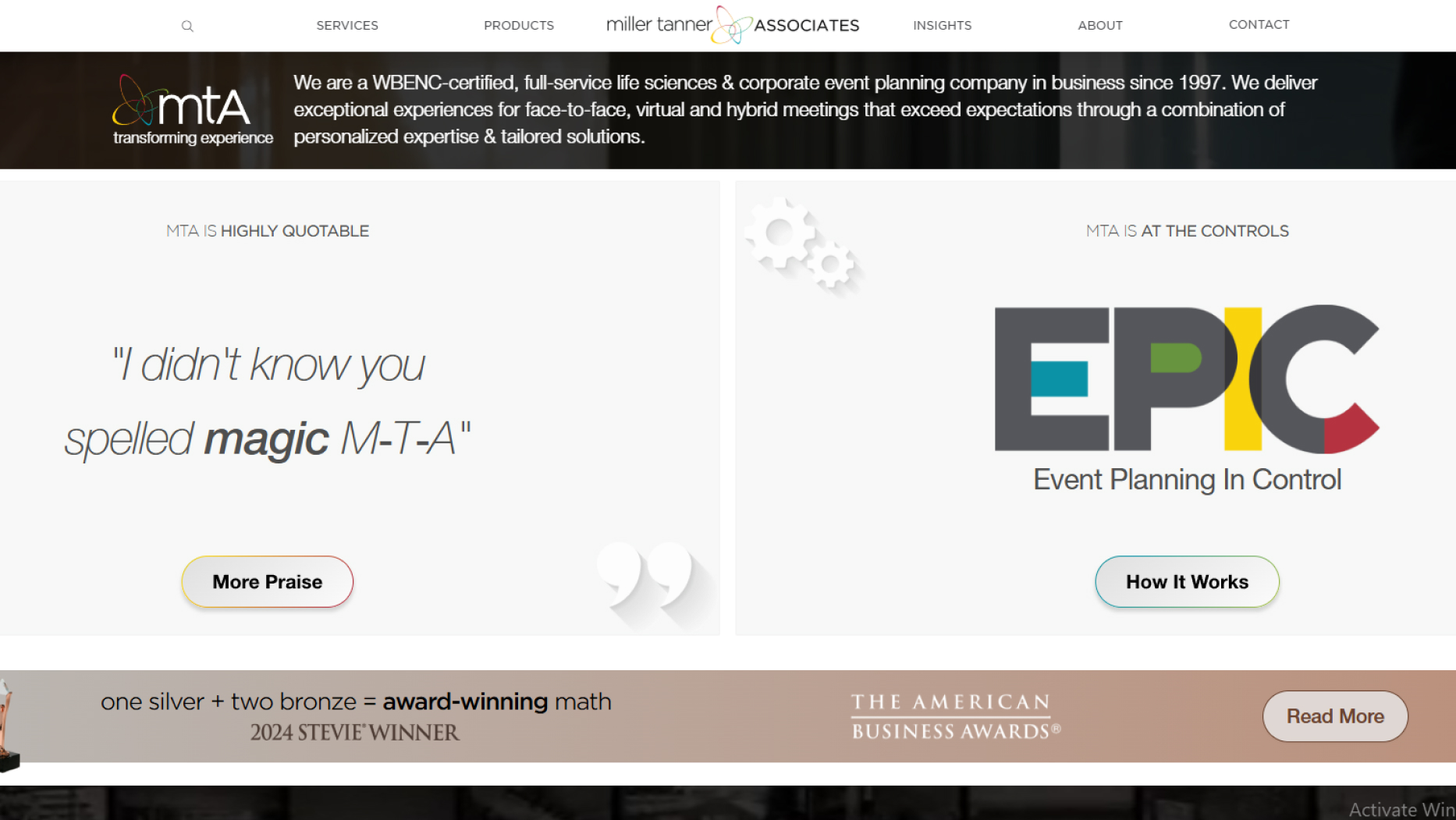
Selected moments from the shipped Miller Tanner platform the surfaces where event lifecycle, registration, scheduling, and engagement come together across CMS, web dashboards, and hybrid delivery flows.





Core Features & Functional Capabilities
Designed For End-To-End Event Execution
- Event Lifecycle Management – Life Sciences Events: End-to-end orchestration of event planning, execution, and closure through structured workflows, ensuring consistent delivery across global life sciences programs.
- Registration & Participant Management – Multi-Region Events: Automated registration and attendee management with validation and tracking, enabling accurate data capture and seamless participant journeys across regions.
- Scheduling & Session Coordination – Global Operations: Centralized scheduling and agenda management across distributed teams, ensuring synchronized execution of sessions and reduced coordination gaps.
- Engagement System – Hybrid Audiences: Unified engagement workflows enabling real-time interaction across virtual and onsite audiences, ensuring consistent participation across hybrid environments.
- Real-Time Operations Dashboard – Live Events: Live monitoring of event performance, attendee activity, and system health, enabling proactive control and faster decision-making during execution.
- Data Synchronization Layer – Event Systems: Real-time synchronization across CMS, registration, and engagement systems, ensuring data consistency and operational alignment across the platform.
Technologies and Tech Stack We Used
Tools Chosen For Scale, Speed & Real-Time Sync
WordPress (Decoupled CMS)
Headless content management layer driving CMS-to-execution data flow.
Custom Theme (mta2020)
Tailored theme structure aligned with MTA's brand and event surfaces.
Tailwind CSS
Utility-first styling for consistent, responsive, performant UI.
PHP (WordPress Template System)
Server-side rendering and template orchestration for content delivery.
Vanilla JavaScript
Lightweight interaction layer optimized for high-traffic event pages.
HTML5 · SVG
Semantic markup with scalable vector assets for crisp delivery.
HTML5 Video
Native video playback aligned with hybrid and virtual event needs.
REST APIs · Webhooks
API-driven synchronization across registration, scheduling, and engagement.
Testing & Quality Assurance
Validated For Reliability, Performance & Compliance
Lifecycle workflow testing for registration, scheduling, and state validation
- API testing for WordPress and external system integrations
- Form validation testing for reliable data submission
- Content and template rendering validation
- Responsive and cross-browser UI testing
- JavaScript functionality and state handling tests
- Media rendering checks (images, video, SVG)
- Tracking validation for Pixel and LinkedIn events
- Security testing for HTTPS and safe resource handling
Our Approach & Development Timeline
Phased Delivery Across 4 Years
Implementation followed a phased delivery approach, building a stable foundation first and then layering architecture, features, integrations, and optimization without disrupting active event workflows.
Foundation & System Setup
Environment, CMS baseline, and core infrastructure.
Architecture & Layout Design
Hybrid modular structure and CMS-to-execution data flow.
Frontend System Implementation
Theme, components, and responsive event surfaces.
Core Features & Integration
Registration, scheduling, engagement, and API wiring.
Performance & Interaction Optimization
Caching, query tuning, and high-load readiness.
Testing & Production Readiness
QA, tracking validation, and global rollout.
Measurable Outcomes
Stable, Scalable & Globally Consistent Operations
Digisoft Solution enabled Miller Tanner Associates to achieve stable, scalable, and consistent event operations across global environments. By aligning technology with operational workflows, they ensured reliable performance, seamless integration, and long-term system efficiency.
Cross-system data consistency maintained under peak load conditions
Reduction in manual coordination through workflow automation
Real-time engagement tracking during live events
Improved data synchronization accuracy across modules
Increased traffic handling via auto-scaling infrastructure
Accelerated event execution from planning to deployment
Overall, the platform replaced fragmented tools and manual coordination with a unified, API-driven execution layer that scales reliably across virtual, hybrid, and onsite events.