Software Development Cost Calculator
Get a market-rate cost estimate in minutes. Our software development cost calculator answers your questions about your platform, features, and compliance needs: walk into vendor conversations knowing what a fair quote looks like.
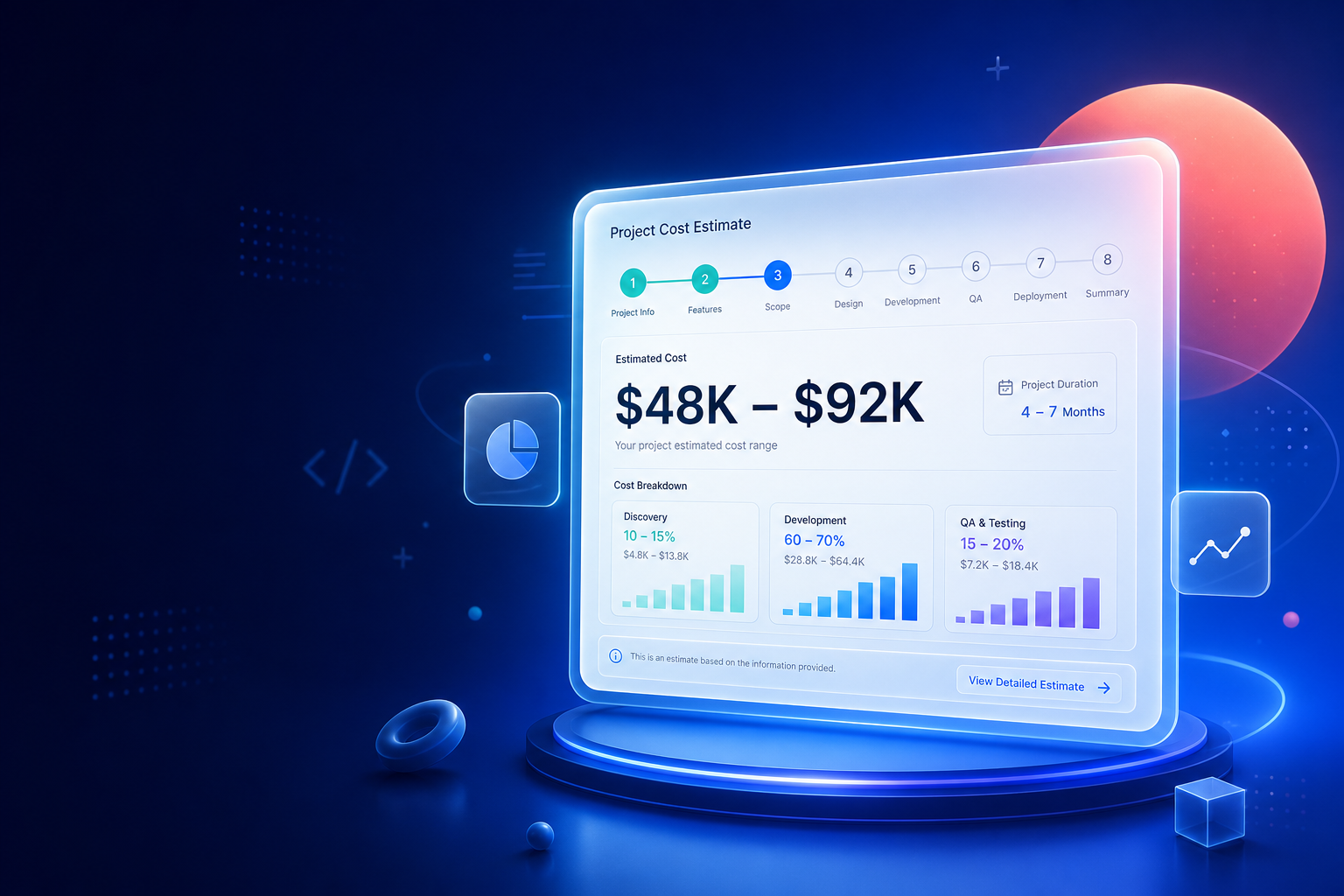








Get Your Software Development Cost Estimate
The eight steps below cover the same factors we account for when scoping a real project at Digisoft Solution: industry, platform, feature depth, integrations, user scale, compliance, and delivery model. Work through them in order. If you're not sure about an answer yet, several steps include a "not sure" option so you can keep moving and refine the estimate later.
Explore More Tools
Affects
What Goes Into a Software Development Estimate
Software development cost is one of the first questions any founder, product owner, or IT lead asks before a project starts, and it's also one of the hardest to pin down with a single number. The cost of software development depends on far more than how many screens or features you're picturing. It depends on which platforms you're building for, how deep the feature set goes, what you need to integrate with, how much compliance overhead your industry carries, and who's actually building it. Two teams quoting the same one-line project brief can land tens of thousands of dollars apart, simply because they're scoping different things under the same name.
That's the gap this calculator is built to close. Instead of asking "what does software cost" and getting a shrug, or a number so generic it's useless, you'll answer a short set of questions about your platform, feature scope, integrations, and compliance needs, and get back a market-rate software development cost estimation built from typical benchmarks for a project shaped like yours. It won't replace a formal proposal, and it's not meant to. What it will do is give you a number to walk into vendor conversations with, so you can tell early whether a quote is in the right neighborhood or wildly off.
COST RANGE
How Much Do Software Development Costs Really Range?
Software development costs typically fall into three broad tiers, and knowing which tier your project sits in is more useful than chasing a single average figure. A small, single-platform tool with a narrow feature set, such as an internal dashboard or a simple booking form, sits at the lower end. A mid-complexity product, like a customer-facing web or mobile app with a handful of integrations and moderate user scale, sits in the middle. A large-scale platform with multiple integrations, compliance requirements, and a build meant to support tens of thousands of users or more sits at the top. The calculator above places your project into the right tier based on your actual answers, rather than asking you to guess which bucket you fall into.
The cost of software development also shifts depending on who is building it and where that team is based. A US-based agency, a nearshore team, and an offshore development partner can quote very different numbers for the identical scope, and that is a separate variable from project complexity. If location, rather than feature scope, is the main question you're trying to answer, that comparison deserves its own dedicated calculator rather than being folded into this one.
WHAT AFFECTS PRICING
What Determines the Cost to Develop Software?
Platform
Web, mobile, tablet, and desktop each carry a different baseline cost to develop software, and targeting more than one at once usually costs less per platform than building each in isolation, since backend logic and business rules can often be shared.
Build depth
An MVP costs meaningfully less than a fully-featured product, because it ships with only the core workflow needed to validate the idea, deferring secondary features to a later phase.
Integrations
Connecting to existing tools, payment processors, or internal systems adds development and testing time on top of the core build, and the effort scales with how many systems you need to talk to.
Compliance
Standards like HIPAA, PCI-DSS, or GDPR add setup, documentation, and process overhead that scales with how regulated your industry is.
Scale
A system built for a handful of internal users costs less to engineer than one built to handle hundreds of thousands of concurrent users, since the latter requires more attention to infrastructure and load handling from day one.
Delivery model
Whether you're comparing onshore, nearshore, or offshore teams, and whether you're pricing Fixed Price or Time and Material, changes the final number even when the technical scope is identical.
BUILD APPROACH
Custom Software Development Cost vs. Off-the-Shelf Software
Off-the-shelf software has a lower upfront cost, since you're paying a subscription for something that's already built and already has users on it. Custom software development cost is higher upfront, because you're paying for a solution shaped around your exact workflow rather than the average customer's workflow. In exchange, you avoid paying for features you'll never use, and you avoid being boxed in by someone else's product roadmap when your business needs change.
Which one is cheaper over time depends entirely on how close an off-the-shelf tool gets to what your business actually needs. We've built custom platforms for clients across healthcare, events, and other regulated or highly specific workflows over more than 13 years and 500+ client engagements, and the pattern holds up consistently: the further your process drifts from what a generic tool assumes, the faster custom development pays for itself.
ENGAGEMENT MODEL
Fixed Cost Software Development vs. Time and Material
Fixed cost software development locks in a price before work starts, which is appealing for budgeting, but most vendors build a premium into that number to cover the risk of scope they haven't fully seen yet. Time and Material bills for actual hours worked, which usually costs less overall when requirements are reasonably stable, and gives you more room to adjust course as the project develops without renegotiating a contract every time priorities shift.
Neither model is universally cheaper. Fixed cost software development tends to make sense when requirements are locked and well documented up front. Time and Material tends to make sense when you expect the product to evolve as you learn from early users. Your software development cost estimation should account for which model you're comparing, since the same technical scope can carry two different price tags depending on how it's billed.
ESTIMATION APPROACH
Software Development Cost Estimation: Why a Range Beats a Single Number
Any software development cost estimation you get before a discovery phase is, by definition, a range rather than a fixed figure. Requirements shift once real users, edge cases, and integration quirks show up, and a vendor who hands you a single flat number without asking about platform, scale, or compliance is usually guessing, not estimating. A wide but honest range, narrowed as you answer more specific questions, is more useful for budgeting than a confident-sounding number with nothing behind it. That's the approach this calculator takes, and it's the same approach we use internally before scoping a formal proposal.
FAQs
Frequently Asked Questions
Custom software development cost depends on platform choice, feature scope, integrations, compliance needs, and team location. There is no single market-wide number, since every vendor prices differently. Use the calculator above to get a market-rate range based on your specific project details.
Software development costs vary widely based on whether you're building an MVP or a fully-featured product, how many platforms you need, and how many users the system must support. Rather than quoting a flat average, our calculator adjusts the estimate to your actual scope.
A software development cost estimation from an online calculator gives you a market-rate planning range, not a fixed quote. It's accurate enough for early budgeting, but a project-specific proposal from a development team will always be more precise once requirements are documented in detail.
Fixed cost software development is possible when requirements are locked in advance, but most vendors price it at a premium over Time and Material engagements to cover their own risk. If your requirements are likely to evolve, Time and Material usually gives you more flexibility for the same budget.
The cost to develop software is driven by platform (web, mobile, desktop), whether you need an MVP or a fully-featured build, third-party integrations, compliance requirements like HIPAA or PCI-DSS, expected user scale, and your preferred engagement model. Our calculator walks through each of these factors.
A software development cost calculator works best when you answer each question as specifically as you can, rather than skipping ahead. Details like platform, integrations, and compliance change the estimate meaningfully, so a rough guess on any one of them will shift your range.
Ready for a project-specific proposal?
Share your requirements with our team and get a tailored estimate aligned to your scope, timeline, and engagement model.