Mobile App Development Cost Calculator
Get an instant, market-rate mobile app development cost estimate. Answer a few questions about your app category, screens, and design needs — and get a number to check vendor quotes against before you commit to anything.
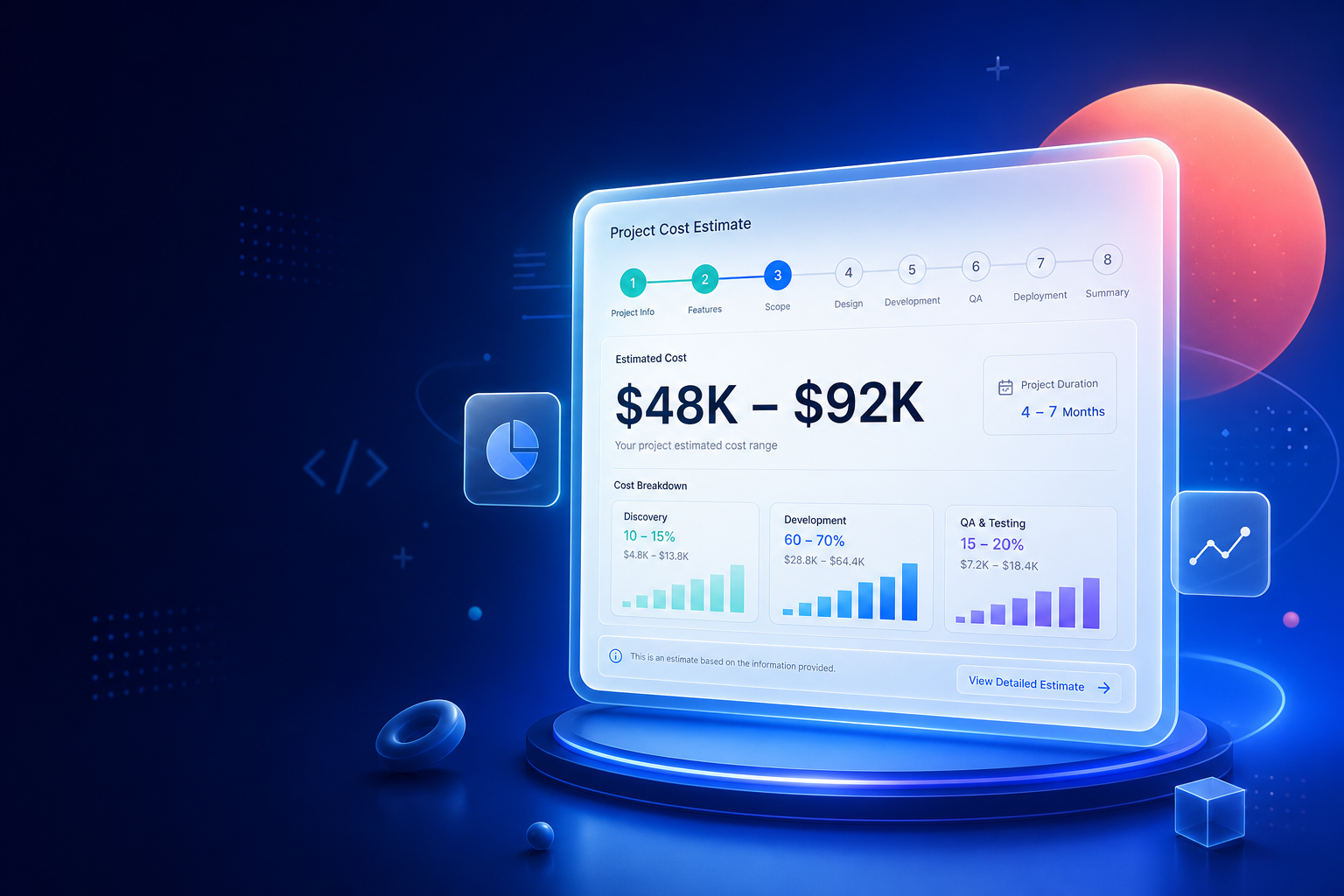








Get Your Mobile App Development Cost Estimate
Answer the questions below about category, platform, complexity, design, and features. If you're unsure about backend or admin needs this early, most steps include a "not sure" option so you can keep moving and refine the estimate later.
Explore More Tools
Affects
What Affects Your Mobile App Development Cost
Mobile app development cost is driven less by a one-line feature list than by things people forget to mention up front: what category of app it is, how many screens it has, whether the design still needs to be created, what kind of login it uses, and whether there's an admin dashboard behind it. A social media app, a fintech app, and a simple booking app can have the same screen count and still cost very differently, because the category itself carries its own baseline complexity.
This calculator asks about the factors that actually move a mobile budget, and returns a market-rate app development cost estimate for a project shaped like yours, whether that's a native iOS app, an Android app, or a cross-platform build covering both. It won't replace a full proposal, but it gives you a number to sanity-check against before you start comparing vendor quotes.
WHAT AFFECTS PRICING
What Drives Mobile App Development Cost?
App category
A fintech or on-demand marketplace app carries more inherent complexity, security, and multi-sided logic (customer, provider, and admin roles) than a booking or content app, even before you add specific features. Social, dating, and media apps carry their own baseline complexity from real-time data, media handling, and moderation.
Screen count
Every screen needs its own layout, states, and testing pass, which makes screen count one of the most reliable early sizing signals, often more useful than a feature list alone.
Design scope
A project that still needs full custom UI/UX design carries meaningfully more cost than one where designs are already finished, or where an existing design system can be reused.
Authentication
Simple email and password login is inexpensive. Each additional method, Google, Apple, Facebook, enterprise SSO, or multi-factor authentication, adds its own integration and testing work, and most real apps combine more than one.
Real-time features
In-app chat and voice or video calls are considerably more expensive than push notifications or basic camera access, since they involve persistent connections and more edge cases to test.
Backend and admin panel
An app that only calls existing APIs costs less than one that needs a custom backend built from scratch, and a full admin dashboard with analytics is its own substantial build, frequently underestimated in early conversations.
BUILD APPROACH
Native App Development Cost vs. Cross-Platform Development Cost
Native app development cost is usually the right call when an app depends heavily on platform-specific performance, the newest device APIs, or a very polished, platform-native feel. It comes at a price: iOS and Android versions are effectively two separate codebases, so features, bug fixes, and testing happen twice.
Cross-platform development cost is usually lower when you need both platforms and don't need bleeding-edge native features, since frameworks like Flutter or React Native let one codebase run on both. The trade-off is a small amount of native polish and slightly slower access to brand-new platform capabilities when they first launch.
FAQs
Frequently Asked Questions
The cost to build a mobile app depends on its category, how many screens it has, whether it needs custom design, what kind of login it uses, which device features it needs, and whether it needs a custom backend or admin dashboard. Use the calculator above to get a market-rate range based on your specific app.
Yes. A fintech or on-demand marketplace app carries more inherent complexity, security, and multi-sided logic than a booking or content app, even with the same number of screens and features. Categories like social media, dating, and media streaming also carry their own baseline complexity from real-time data, media handling, or moderation needs.
Building for a single platform is cheaper upfront than building for both. If you need both iOS and Android, a cross-platform framework typically costs less than two separate native builds, since much of the code is shared between platforms.
Every screen needs its own layout, states, and testing, so screen count is one of the most reliable ways to size a mobile app before detailed requirements exist. Two apps with the same feature list can cost very differently if one has 12 screens and the other has 60.
Most apps that involve managing users, content, or orders need a companion admin dashboard, usually a web interface, separate from the mobile app itself. It's frequently underestimated in early conversations even though it can account for a large share of total development time.
In-app chat, voice or video calls, offline sync, custom backend development, and a full admin dashboard tend to add the most time. Simpler additions like push notifications or basic camera access add comparatively little.
Ready for a project-specific mobile app proposal?
Share your requirements with our team and get a tailored estimate aligned to your scope, timeline, and platform strategy.