Table of Content
- What Is Denial Management Automation in Healthcare
- Why Claim Denials Keep Rising in 2026
- How Denial Management Automation Actually Works
- 1. Data Ingestion Layer
- 2. Denial Classification and Root Cause Engine
- 3. Predictive Denial Scoring (Pre-Submission)
- 4. Workflow Orchestration and Task Routing
- 5. Appeal Generation
- 6. Analytics and Reporting
- Core Technical Components You Need to Build or Buy
- Build vs. Buy: Off-the-Shelf Denial Management Software vs. Custom Automation
- What Actually Drives the Cost of Denial Management Automation
- Is Denial Management Automation Actually Worth the Investment?
- Common Mistakes Healthcare Organizations Make When Automating Denial Management
- How Digisoft Solution Helps in Healthcare Software Development
- Topics This Guide Also Sets You Up to Explore
- Frequently Asked Questions
- What is denial management automation in healthcare?
- How much does denial management automation cost to build?
- Is denial management software the same as revenue cycle management (RCM) software?
- Can AI actually predict which claims will be denied before submission?
- How long does it take to build a custom denial management automation system?
- Do denial management systems need to be HIPAA compliant?
- What's the average denial rate healthcare organizations should be targeting?
- Can small practices benefit from denial management automation, or is it only for large health systems?
Digital Transform with Us
Please feel free to share your thoughts and we can discuss it over a cup of coffee.
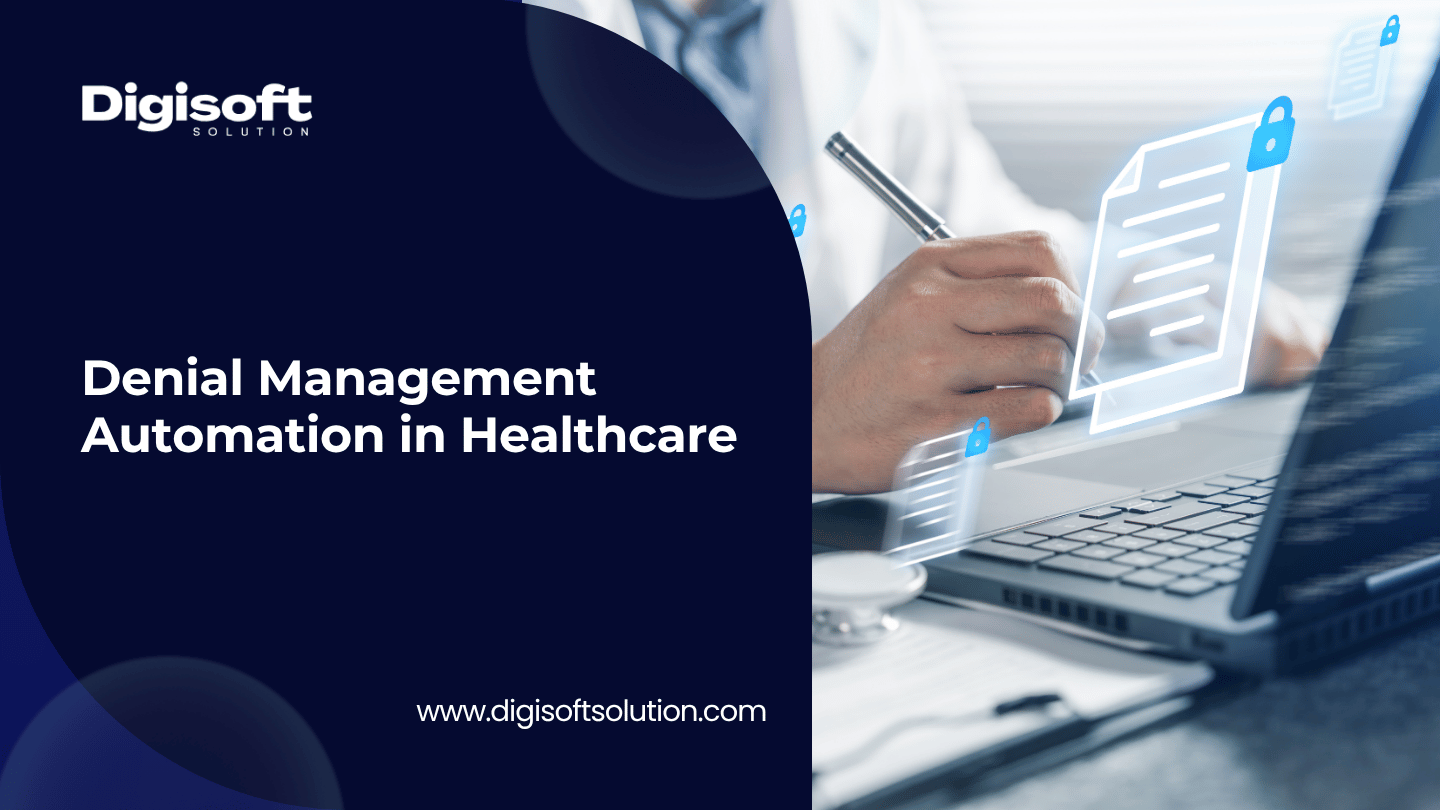
Claim denials are quietly eating into the revenue of almost every healthcare provider in the US, and most teams are still fighting them the old way, one claim at a time, in a spreadsheet nobody trusts. Industry data shows providers lose close to $20 billion a year to denied claims that never get reworked, out of more than $260 billion in claims that get denied on first submission. If you're running a hospital, a multi-specialty group, or a billing company and you're reading this, you already know the pain. This article breaks down what denial management automation actually is, how it works under the hood, and what it realistically costs to build, so you're not going into a vendor call or a build decision blind.
What Is Denial Management Automation in Healthcare
Denial management automation is the use of software, rules engines, and AI/ML models to detect, prioritize, correct, and appeal denied insurance claims with minimal manual touch. Instead of a biller manually checking a payer portal for each claim's status, the system pulls remittance data automatically, flags the denial reason, tells staff (or another system) what to do next, and in mature setups, drafts and submits the appeal itself.
It sits inside the broader revenue cycle management (RCM) process, but it's narrower and more technical. Where RCM covers the whole patient-to-payment journey, denial management automation focuses specifically on the part where a claim gets rejected, underpaid, or pended, and what happens after that.
Two things get automated here, and it's worth separating them because vendors blur this a lot:
- Denial prevention: catching errors before the claim ever leaves your system (eligibility mismatches, missing prior auth, wrong modifiers)
- Denial recovery: managing what happens after a claim actually comes back denied (root cause tagging, appeal generation, resubmission tracking)
A good system does both. A lot of the software being sold right now only really does one of these well, so it's worth knowing which one you actually need before you buy or build.
Why Claim Denials Keep Rising in 2026
This isn't a new problem, but it's getting worse, not better, and it helps to know why before you automate anything.
- Average initial denial rates across health systems are sitting near 12%, and some organizations are seeing higher. Best-practice organizations are targeting under 5%.
- Payers are increasingly using their own AI-driven adjudication engines, which reject claims faster and catch smaller discrepancies than a human reviewer would have.
- Prior authorization and medical necessity disputes remain one of the biggest denial categories, and the rules change by payer, by plan, and sometimes by year.
- Eligibility and registration errors at intake are still one of the most common (and most preventable) root causes.
- According to industry surveys, roughly 65% of denied claims are never corrected and resubmitted at all. That's not a technology gap, that's a capacity gap, and it's exactly where automation earns its keep.
The cost of handling a single denial manually averages around $30 to $57 depending on complexity, and that's before you count the revenue that's simply written off because nobody had time to appeal it.
How Denial Management Automation Actually Works
Here's where most articles online stay vague. Let's actually break down the technical flow, because if you're evaluating a build or a vendor, this is what you need to be asking about.
1. Data Ingestion Layer
The system needs to pull data from multiple sources in near real time: the 835 remittance advice files from payers, 837 claim submission files, EHR/PMS data, and eligibility responses (270/271 transactions). Most denial automation platforms use HL7 or FHIR-based connectors for clinical data and standard X12 EDI parsers for the financial transaction files. If your EHR is Epic, Cerner, or Athenahealth, this integration work is a meaningful chunk of the build, legacy or homegrown PMS systems take even longer because there's no standard API to lean on.
2. Denial Classification and Root Cause Engine
Once a denial comes in, the system parses the CARC and RARC codes (the standardized reason and remark codes payers attach to denials) and maps them to a root cause category: eligibility, authorization, coding, timely filing, medical necessity, duplicate claim, and so on. This is usually rules-based at the core, with a machine learning layer on top that learns payer-specific patterns your rules engine wouldn't catch on its own, like a specific payer consistently denying a modifier combination that's technically valid.
3. Predictive Denial Scoring (Pre-Submission)
This is the part that actually prevents denials instead of just processing them after the fact. A trained model scores outgoing claims before submission based on historical denial patterns for that payer, that CPT/ICD combination, and that provider. High-risk claims get flagged for review before they go out the door instead of coming back three weeks later as a denial. This is where a lot of the real ROI lives, and it's also the hardest part to build well, since it needs a decent volume of historical claims data to train against.
4. Workflow Orchestration and Task Routing
Denials get automatically prioritized, usually by dollar value and appeal deadline, and routed to the right queue or the right person. A $40 denial and a $4,000 denial shouldn't be sitting in the same queue with the same urgency. Some platforms use RPA (robotic process automation) to log into payer portals and pull claim status automatically instead of having a human do it, which sounds small but saves an enormous number of billing hours.
5. Appeal Generation
More mature platforms use NLP and generative AI to draft appeal letters automatically, pulling in payer-specific policy language, medical necessity documentation, and prior successful appeal templates. Human review still matters here. Fully autonomous appeal submission without a human checking it is not something most compliance teams are comfortable with yet, and honestly, they shouldn't be.
6. Analytics and Reporting
The dashboard layer surfaces denial trends by payer, provider, service line, and denial category. This is where leadership actually gets value, it's not just about recovering revenue on individual claims, it's about spotting that Payer X keeps denying a specific code so you can fix the upstream process instead of appealing the same denial every month forever.
If you want to see how this kind of layered AI and automation architecture gets built in a real clinical setting, our AI development services team has worked through similar workflow automation and predictive layers for healthcare clients, and our Medizen AI healthcare platform case study shows the kind of NLP and semantic search architecture that underlies a lot of this.
Core Technical Components You Need to Build or Buy
If you're scoping this as a build (custom software) rather than buying an off-the-shelf tool, here's the actual component list your dev team or vendor should be talking about:
- EHR/PMS integration layer (HL7 FHIR R4, HL7 v2/v3, custom middleware for legacy systems)
- EDI transaction processing for 837 (claims), 835 (remittance), 276/277 (claim status)
- A payer rules engine that's configurable per payer, since denial logic isn't standardized across insurers
- Machine learning models for denial prediction and root cause classification, retrained periodically as payer behavior shifts
- RPA bots for payer portal automation where APIs aren't available (which is still most payers)
- A secure document management layer for medical records, EOBs, and appeal attachments
- Role-based access control and audit logging, this is non-negotiable under HIPAA
- Analytics and BI dashboards, usually built on a standard data warehouse layer
- API layer for connecting to clearinghouses and, where possible, payer systems directly
Every one of these touches Protected Health Information at some point, which means the architecture needs to be HIPAA-compliant from the ground up, not bolted on afterward. This is also where a lot of vendors and in-house teams underestimate the work. Our team has documented this in detail on our healthcare software development page, including the compliance frameworks (HIPAA, HL7 FHIR, SOC 2) that actually apply here.
Build vs. Buy: Off-the-Shelf Denial Management Software vs. Custom Automation
This decision matters more than most articles give it credit for.
Off-the-shelf platforms (the kind you'll find in most "top 10 denial management software" roundups) are faster to deploy and come with pre-built payer rule libraries. But they're built for the average provider, not your provider. If your organization has a specific payer mix, a specialty with unusual billing rules (behavioral health, home health, and DME all have unusual denial patterns compared to general practice), or an EHR that isn't one of the big three, you'll spend a surprising amount of time and money customizing a platform that was supposed to save you that exact effort.
Custom-built denial management automation makes more sense when:
- Your denial patterns are specific to your specialty or payer mix and a generic rules engine won't catch them
- You need deep, bidirectional integration with a legacy or proprietary EHR
- You want the AI models trained specifically on your historical claims data, not a vendor's aggregate dataset
- You're a billing company or RCM vendor building this as your own product, not just using it internally
If you're not sure which side of that line you're on, that's a scoping conversation worth having before committing budget either way.
What Actually Drives the Cost of Denial Management Automation
This is the part most articles get wrong, either by quoting a suspiciously low "starting from" number with no context, or by not mentioning cost at all. Let's actually walk through this properly instead of just repeating a number we found somewhere.
Across multiple industry sources, the compliance layer alone (HIPAA architecture, audit trails, security testing, documentation) typically adds $25,000 to $60,000 to a healthcare software build, and 15 to 25% to overall project cost. Each non-standard EHR or legacy system integration adds another $20,000 to $50,000. Building and validating the machine learning models for denial prediction and root cause analysis typically runs $30,000 to $70,000 on its own, and that's before ongoing retraining costs.
Some vendor sites advertise custom medical billing or denial software "starting from $30,000." Technically, that number isn't wrong, you probably can get a very basic denial tracking dashboard for that. But it's misleading for anyone actually comparing quotes, because a $30,000 build almost never includes real EHR integration, payer-specific rule configuration, or a trained prediction model. It's a tracker, not automation. If a quote that low includes AI-powered denial prediction and multi-payer appeal automation, that's the number worth questioning, not celebrating.
Realistically, based on triangulating multiple project-level cost breakdowns and comparable healthcare system builds, a genuinely functional denial management automation system, meaning EHR-integrated, HIPAA-compliant, with at least basic predictive scoring, lands somewhere between $60,000 and $180,000 depending on scope. Enterprise-grade systems with multi-payer support, full appeal automation, and hospital-wide deployment can run past $250,000, which lines up closely with what comprehensive RCM platforms with denial modules are priced at industry-wide.
Here's a breakdown by scope, based on realistic project ranges rather than a single marketing number:
|
Build Scope |
What's Actually Included |
Typical Investment Range |
|
Denial Tracking Dashboard (Basic) |
Manual denial logging, basic reporting, no EHR integration |
$10,000 to $25,000 |
|
Denial Management with Root Cause Analysis |
CARC/RARC parsing, basic rules engine, one EHR/PMS integration |
$30,000 to $70,000 |
|
Predictive Denial Management (Mid-Tier) |
Pre-submission scoring, root cause ML, workflow routing, HIPAA compliance layer |
$70,000 to $140,000 |
|
Full Denial Automation Suite |
Predictive scoring, AI appeal generation, multi-payer rules engine, RPA portal automation, analytics dashboard |
$140,000 to $250,000+ |
|
Enterprise / Hospital-Wide Deployment |
Multi-facility, multi-EHR, full RCM integration, dedicated AI infrastructure |
$250,000+ |
A few honest notes on this table. These ranges assume a US-based or hybrid delivery model with proper compliance testing baked in, not skipped to hit a lower number. They also assume you're not paying twice, once to build it and once to fix the security gaps a rushed build leaves behind, which happens more often than vendors like to admit. And timeline matters as much as cost here: a mid-tier predictive build typically takes 4 to 7 months, not the 6 to 8 weeks some MVP-focused vendors advertise for "denial management" as a feature bolt-on.
If you want an estimate scoped to your actual claims volume and payer mix instead of a generic range, our software development cost calculator gives a starting point, though for anything touching PHI we'd still recommend a proper scoping call over a self-serve number.
Is Denial Management Automation Actually Worth the Investment?
Short answer, for most mid-size-and-up providers, yes, and the math isn't hard to check yourself.
Take a practice billing $1 million a year with a 12% denial rate, that's about $120,000 in denied claims annually. Even a conservative automation setup that recovers an additional 20 to 30% of that (on top of whatever you're already recovering manually) pays for a mid-tier build inside 12 to 18 months, and keeps paying after that. McKinsey's research on agentic AI in the revenue cycle points to a 30 to 60% reduction in cost-to-collect when AI is applied to the back end of RCM specifically, which lines up with what smaller studies on denial prediction have shown too, up to 25% improvement in reimbursement accuracy and 15 to 30% fewer days in accounts receivable.
For a smaller single-specialty practice with low claim volume, the math is less obvious, and a lighter off-the-shelf tool or an outsourced billing partner might genuinely make more sense than a custom build. Worth being honest about that instead of pretending every provider needs a six-figure system.
Common Mistakes Healthcare Organizations Make When Automating Denial Management
- Buying a generic RCM platform's denial "module" and expecting it to behave like a purpose-built denial system, it usually doesn't have the depth
- Skipping the HIPAA architecture review until after development starts, which almost always means expensive rework later
- Training prediction models on too little historical data and trusting the output anyway
- Automating appeal generation without a human review step, which creates compliance risk nobody signed off on
- Treating this as a one-time build instead of a system that needs ongoing retraining as payer rules and behavior shift
- Not testing integrations against real payer response formats before go-live, EDI files are messier in practice than in documentation
Our security testing services and QA process exist specifically to catch the kind of gaps that show up in healthcare integrations once real payer data starts flowing through, not just in the demo environment.
How Digisoft Solution Helps in Healthcare Software Development
We build HIPAA-compliant healthcare software, and denial management automation sits squarely inside that, not as a side offering bolted on to sound current.
Here's what that actually looks like when you work with us:
- We start with a full discovery and clinical/billing workflow mapping phase before any code gets written, so the automation logic actually reflects how your billing team works today, not a generic template.
- Our healthcare software development team builds HIPAA-compliant architecture from day one, PHI isolation, role-based access, audit logging, and encryption are structural, not added at the end. We execute a Business Associate Agreement (BAA) before any project involving PHI begins.
- We've built certified HL7 FHIR R4 and HL7 v2/v3 integrations for systems including Epic, Cerner, Athenahealth, and eClinicalWorks, along with custom middleware for legacy and proprietary EHR systems that don't have modern APIs.
- Our AI development services and machine learning development teams have real delivery experience building predictive models and NLP-driven automation inside live healthcare products, our Medizen AI healthcare platform case study shows this kind of clinical AI copilot work in production, including semantic search and automated documentation.
- We've delivered HIPAA-compliant platforms for real healthcare clients already in active use, including a multi-clinic ABA therapy management platform and a healthcare credentialing SaaS platform, not theoretical case studies.
- Every healthcare build goes through structured QA and compliance testing, HIPAA and GDPR validation, security penetration testing, and performance testing under real claim volumes, before it reaches production.
- We're transparent about scope and cost upfront, no retroactive scope creep and no quote that mysteriously doubles once integration work actually starts.
If you're weighing a custom denial management build against an off-the-shelf tool, or you already have a system that's underperforming, our team can walk through a scoping session and give you a realistic project estimate based on your actual claims data and EHR setup, not a generic price list. You can get in touch with our healthcare software team here.
Topics This Guide Also Sets You Up to Explore
Denial management automation connects to a few other decisions healthcare teams usually end up researching next. Worth a look if any of these apply to you:
- How AI-powered prior authorization automation reduces one of the fastest-growing denial categories
- What HL7 FHIR R4 integration actually involves when connecting a new system to Epic or Cerner
- The difference between RPA and true AI automation in revenue cycle management, and where each one actually fits
- How to build a HIPAA-compliant Business Associate Agreement checklist before starting any PHI-related project
- What a realistic healthcare software development timeline looks like from discovery to production
- How predictive analytics in RCM differs from traditional rules-based claim scrubbing
Frequently Asked Questions
What is denial management automation in healthcare?
It's the use of software and AI to automatically detect, classify, prioritize, and in some cases appeal denied insurance claims, reducing the manual work billing teams would otherwise do claim by claim.
How much does denial management automation cost to build?
Realistic ranges run from $10,000 to $25,000 for a basic tracking dashboard up to $250,000 or more for a full AI-driven, multi-payer automation suite with predictive scoring and appeal generation. The final number depends heavily on EHR integration complexity, compliance scope, and how much AI/ML work is involved.
Is denial management software the same as revenue cycle management (RCM) software?
No. RCM software covers the entire patient-to-payment process. Denial management is a focused piece of that, specifically what happens when a claim is denied, underpaid, or pended. Some RCM platforms bundle a denial module, but it's often less capable than a purpose-built denial management system.
Can AI actually predict which claims will be denied before submission?
Yes, this is one of the more mature applications of AI in RCM right now. Models trained on historical claims data can score outgoing claims by denial risk before they're submitted, based on payer, procedure code, and provider history, letting staff fix issues proactively instead of reactively.
How long does it take to build a custom denial management automation system?
A mid-tier system with predictive scoring and one or two EHR integrations typically takes 4 to 7 months. A basic dashboard can go live faster, closer to 8 to 12 weeks. Enterprise, multi-facility builds usually run 9 months or more.
Do denial management systems need to be HIPAA compliant?
Yes, without exception. These systems handle claims data tied directly to PHI (diagnosis codes, treatment details, patient identifiers), so HIPAA compliance, PHI isolation, audit logging, and a signed BAA aren't optional add-ons, they're a baseline requirement.
What's the average denial rate healthcare organizations should be targeting?
Industry benchmarks put average initial denial rates around 12% currently. Best-practice organizations aim to keep this under 5%. Anything consistently above 10% usually signals a real process or system gap worth investigating.
Can small practices benefit from denial management automation, or is it only for large health systems?
Larger systems typically see faster ROI simply due to claim volume, but small and mid-size practices can still benefit, usually through a lighter-weight, off-the-shelf tool rather than a full custom build. The right choice depends on claim volume, payer mix complexity, and whether existing manual processes are actually keeping up.
Digital Transform with Us
Please feel free to share your thoughts and we can discuss it over a cup of coffee.